
Heart Sutra Meaning: A Line-by-Line Reading Guide
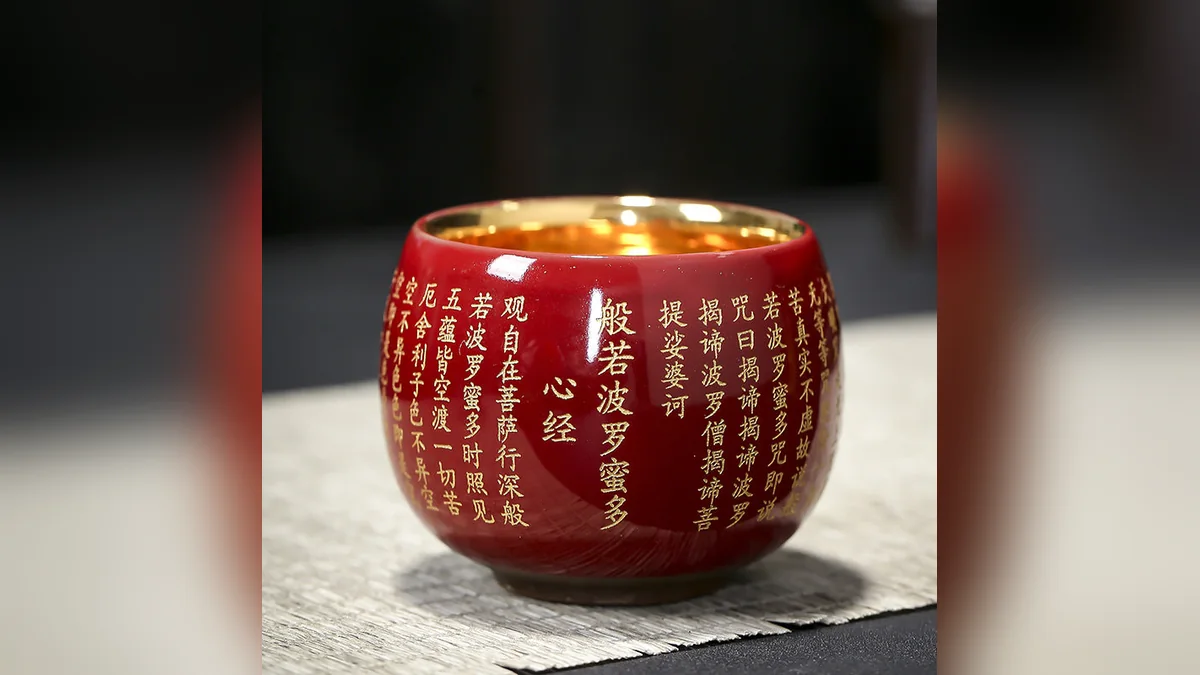
The Heart Sutra contains about 260 Chinese characters in its most common Chinese version, short enough to copy out on a single page. The Heart Sutra meaning centers on emptiness: this short Mahayana Buddhist text, also called Prajnaparamita Hridaya, presents the bodhisattva Avalokiteshvara explaining emptiness, or shunyata, to Shariputra. It ends with a mantra.
Its brevity can make it deceptively difficult to read. Familiar words such as form, emptiness, and attainment carry meanings that ordinary English does not fully convey.
Heart Sutra meaning: What the sutra says, in plain terms
Wording and line breaks vary between translations. The following sections follow the main sequence of the short text, paraphrasing its passages rather than reproducing a complete translation.
1. Avalokiteshvara observes the five aggregates
The opening presents Avalokiteshvara practicing the perfection of wisdom and seeing the five aggregates as empty. These aggregates are commonly described as form, feeling, perception, mental formations, and consciousness. They are a Buddhist way of examining what we ordinarily call a person.
Here, empty does not mean absent, worthless, or meaningless. It means lacking a fixed, independent existence. The aggregates arise through conditions; none stands alone as an unchanging self. This distinction matters throughout the sutra, especially when its wording becomes more compressed.
2. Form is emptiness; emptiness is form
Avalokiteshvara addresses Shariputra and brings the explanation to form: the material aspect of experience. Form depends on conditions and relationships. Emptiness names that absence of independent existence; it is not a separate substance hidden behind things.
A ceramic cup offers an ordinary example. Its existence depends on clay, shaping, firing, and other conditions. It can still hold tea. Calling it empty in this Buddhist sense does not deny its everyday use. The example is only a starting point, but it helps keep emptiness distinct from the idea that nothing exists.
The passage extends the same understanding to the other aggregates. Feeling and perception, for example, are not exceptions to dependence and change.
3. The text questions fixed categories
The next passage describes phenomena through paired expressions about arising and ceasing, purity and impurity, increase and decrease. These lines are easy to misread as claims that ordinary distinctions never matter.
One introductory way to read them is that no phenomenon possesses a permanent essence that can be captured by these labels. The text asks readers to examine the status of the categories themselves. It does not provide a reason to disregard conduct, responsibility, or the circumstances of daily life.
4. The repeated “no” reaches Buddhist teachings
The sutra then moves through a series of negations, including the senses and their objects, dependent arising, and the Four Noble Truths. The scope is striking: even familiar Buddhist teaching categories appear within this examination.
Read in context, these negations continue the discussion of emptiness. They challenge treating a teaching or category as something with independent, fixed existence. They need not be read as instructions to abandon Buddhist practice. A fuller commentary can explain the technical lists that the short text leaves almost entirely unexpanded.
5. There is no attainment to grasp
The language of nonattainment carries the argument into the idea of spiritual achievement. If nothing has an independent essence, attainment cannot become a permanent possession of a separate, unchanging self.
The text connects bodhisattvas and buddhas with the perfection of wisdom before introducing its final mantra. This is a useful place to pause when reading: the passage belongs to a Buddhist account of wisdom and awakening, and its compact language deserves more than a quick slogan.
The closing mantra
The closing words are often written in Roman letters as gate gate paragate parasamgate bodhi svaha. A rough rendering is “gone, gone, gone beyond, gone completely beyond, awakening.”
This is a reading aid, not a complete word-for-word equivalent. Mantras do not always fit ordinary sentence structure, and English renderings differ. The final svaha is a ritual exclamation often retained rather than given a single English substitute.
When following a particular community’s chanting, use its pronunciation and rhythm as your reference. Our guide to Om Mani Padme Hum introduces another Buddhist mantra; it is a different text from the Heart Sutra’s closing formula.
Where you see it
The Heart Sutra is chanted in Chinese, Japanese, Korean, Tibetan, and Vietnamese Buddhist communities. Language, pronunciation, and liturgical setting vary. The same short text may therefore sound quite different from one community to another.
It is also copied by hand as a practice called sutra copying. Following the characters or words in order gives the text a physical form on paper. Engraving offers another setting for its words, including jewelry and teaware.
Our Tibetan Heart Sutra White Copper charm bracelet is adjustable, made of white copper, and listed as unisex. Its name identifies the text it references; understanding that text begins with reading it.
The Heart Sutra and Great Compassion Mantra ceramic teacup comes in blue or red, with Heart Sutra or Great Compassion Mantra versions. Listed sizes are 7.4 × 5.8 cm, 130 ml, or 8.5 × 6.7 cm, 170 ml. Choose the Heart Sutra version if that is the text you want. For the brewing vessel used alongside teacups, see our guide to using a gaiwan.
Wearing or using a text
Many people treat sutra-inscribed objects with particular respect, keeping them clean and avoiding placing them on the floor. These are customs, and expectations differ among communities and households. If you participate in a Buddhist community, its guidance can help you understand local practice.
Our Tibetan Seal Heart Sutra titanium steel ring is unisex, about 10 mm wide, and about 10 g. It comes in golden or silvery options and US6 to US13 sizes. Our ring size guide explains how to check sizing before choosing.
The Peace and Joy Tang Dynasty Flower lotus Heart Sutra carved copper ring is copper, listed at about 18 mm and adjustable, with Peace or Joy options.
An inscription can invite a return to a particular passage. Start with the opening, read through the repeated negations, and let the mantra mark the close. The words on an object have a context: a short Buddhist text whose account of emptiness asks for careful, continuing attention.
Shop the story
 Buddha Stones Tibetan Heart Sutra White Copper Charm BraceletSpecial Price $27.59 Regular Price $38.86
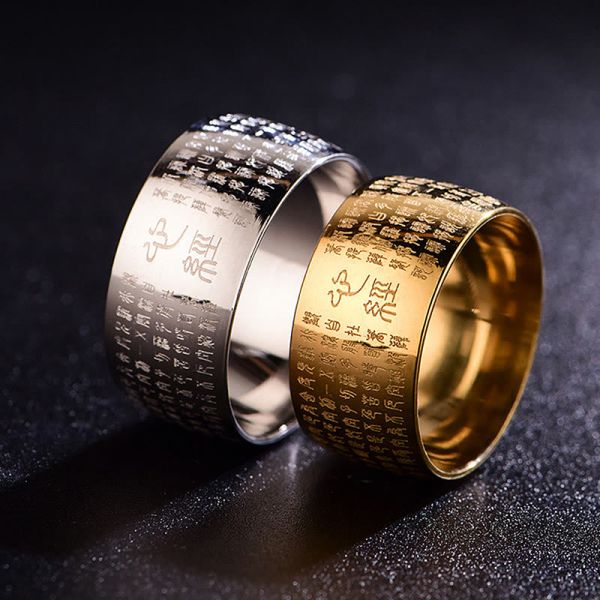 Buddha Stones Tibetan Seal Heart Sutra Titanium Steel Balance RingAs low as $25.59 Regular Price $36.04
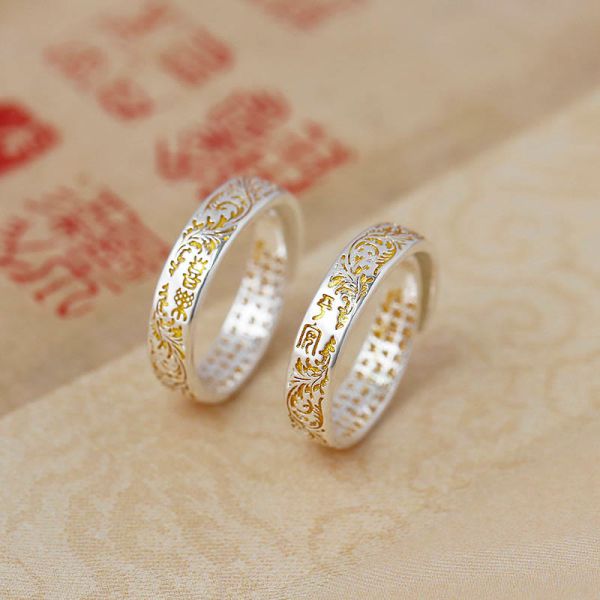 Buddha Stones Peace and Joy Tang Dynasty Flower Design Lotus Heart Sutra Carved Copper Luck Adjustable RingAs low as $25.59 Regular Price $36.04
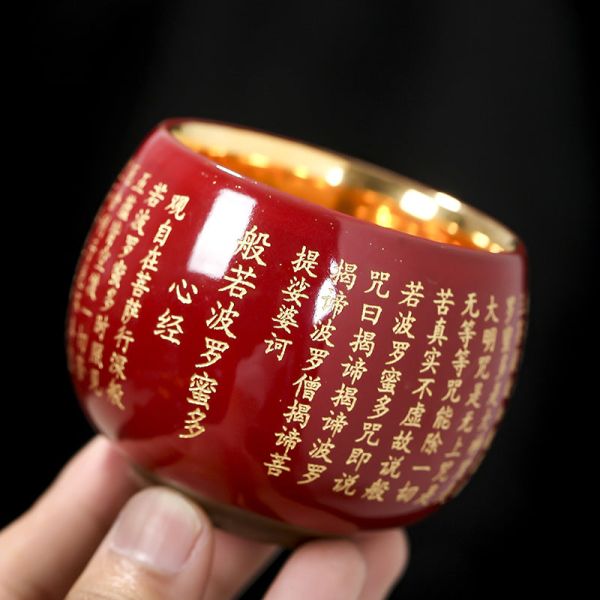 Buddha Stones Heart Sutra Great Compassion Mantra Engraved Ceramic Teacup Kung Fu Tea CupAs low as $47.59 Regular Price $65.19