
How to Measure Ring Size: A Practical Home Guide
Sizing is a frequent reason a ring goes back in its box. A band that looks right still needs to fit the finger you plan to wear it on. The answer to how to measure ring size is straightforward: measure your finger’s circumference, or the inner diameter of a ring that already fits, in millimeters, then match that measurement to a size chart. At Buddha Stones, our ring pages use several sizing formats, so keep the measurement itself alongside any US size you record.
Method 1: a strip of paper or string
You need a narrow strip of paper or a piece of string, a pen, and a ruler marked in millimeters. Paper is usually easier to mark clearly; string can work, but avoid anything stretchy. Stretching the material while wrapping it changes the result.
- Wrap at the base of the finger. Place the strip where the ring will sit. Keep it level around your finger, with enough contact to stay in place without pulling it tight. Leave the finger relaxed rather than curled into a fist.
- Mark the meeting point. Mark where the end meets the rest of the strip or string. Make a fine line so you can identify the same point once the material is flat. A broad mark makes a small measurement harder to read.
- Measure flat with a ruler. Unwrap the material and lay it straight beside the ruler. Measure from the starting end to your mark in millimeters. This length is your finger’s circumference, the distance around it.
- Measure twice. Repeat the whole process with a fresh wrap. If the readings disagree, check for stretching, a twisted strip, or a mark that shifted. Take another measurement rather than choosing whichever number seems preferable.
- Check the knuckle. The ring must pass over it as well as fit at the base. If your knuckle is noticeably wider, measure around it too. A paper loop can help you compare the two points, but it cannot reproduce the feel of a rigid band.
Write down the finger, hand, and circumference together. A note such as “right ring finger, 57 mm” is more useful than an unlabeled number, especially when comparing several rings.
Method 2: a ring you already own
Choose a ring that fits the intended finger on the intended hand. A ring from your left ring finger is not automatically a reliable guide for your right ring finger, and a ring that fits your middle finger answers a different sizing question.
Lay the ring flat and measure its inner diameter: edge to edge across the inside, through the center. Do not include the metal on either side. Measuring across the outside adds the band itself to the reading and points you toward a larger size.
Align the inside edge with the ruler’s zero mark and read the opposite inside edge. Check the alignment again before recording the number in millimeters. If the ring is bent or visibly oval, this method becomes less dependable. A jeweler’s sizing tools can help when a home reading is unclear.
Use the diameter column below for this method. Do not compare a diameter reading directly with a circumference range; both use millimeters, but they describe different distances.
When to measure
Fingers can be slightly larger at the end of the day and in warm weather, and smaller when cold. Measure when your hands are at a comfortable, ordinary temperature. A reading taken just after coming in from cold weather may not represent your usual fit.
Take measurements a few times, including on another day, before settling on a size. Look for a consistent result rather than treating one reading as final. The dominant hand is often a touch larger, which is another reason to measure the exact finger you intend to use.
Wide bands tend to fit tighter than thin bands. Consider going up a little for a wide ring, especially if your measurement sits between sizes. There is no single increase that suits every band and finger. Trying a band of similar width or using a jeweler’s ring sizer gives a better check than automatically adding a full size.
How to measure ring size: reference chart
Match your recorded measurement to the appropriate column. These US sizes provide a reference for comparing the two home methods. For example, a circumference close to 57.0 mm corresponds to US 8 here, while an inner diameter close to 19.0 mm corresponds to US 9.
| US size | Inner diameter (mm) | Circumference (mm) |
|---|---|---|
| 5 | 15.7 | 49.3 |
| 6 | 16.5 | 51.9 |
| 7 | 17.3 | 54.4 |
| 8 | 18.2 | 57.0 |
| 9 | 19.0 | 59.5 |
| 10 | 19.8 | 62.1 |
| 11 | 20.6 | 64.6 |
Size charts differ slightly between sources. Use this table as a reference and check the measurements and sizing format on the individual product page.
Fixed, ranged and adjustable rings
Our ring listings show why keeping your millimeter measurement matters. A fixed US size, a circumference range, and an adjustable band each need a slightly different comparison.
Fixed US sizes
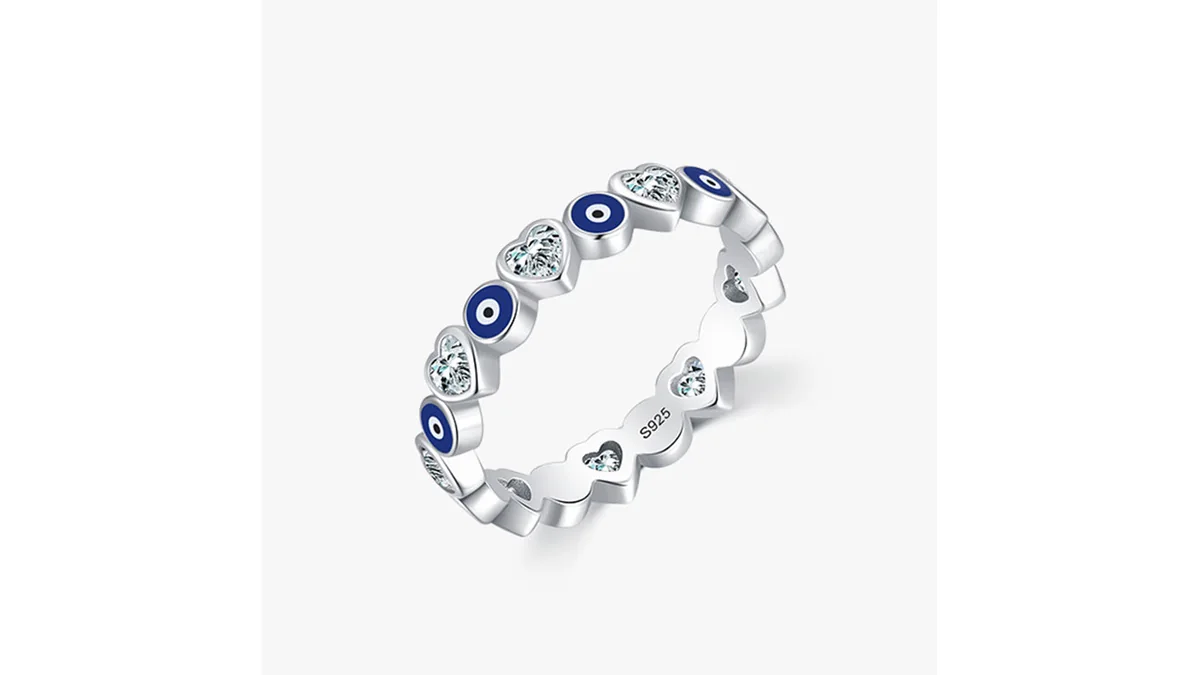
The 925 Sterling Silver Evil Eye Love Heart Zircon ring comes in US5 through US9. It combines sterling silver and zircon, with a width of 3.65 mm and a listed weight of 2.56 g. Match your measurement to a US size, then check that the size is among those listed.
Circumference ranges
The 990 Sterling Silver Natural Chalcedony Plum ring lists circumference ranges of 52.1-54.3 mm, 55.6-57.5 mm, 58.7-60.9 mm, and 61.9-64.1 mm. Compare your finger’s circumference directly with those ranges. Its listed thickness is 3.5 mm, the chalcedony measures 1.1 × 1.5 cm, and its weight is 5.5 g. If your measurement falls between the stated ranges, the chart alone cannot confirm which option will fit.
Adjustable bands
The 999 Sterling Silver Lotus Symbol Heart Sutra ring is adjustable, with a listed inner diameter of 19 mm. It is 10 mm wide, 1.5 mm thick, and weighs 6.8 g. This is a wide band, so the advice about allowing a little more room applies. Its listed diameter does not establish the full range of adjustment.
The 999 Sterling Silver Lotus Elephant Six True Words ring is also adjustable. Its listed width is 0.6 cm, with weights of 4.5 g or 5.5 g and lotus, elephant, or Six True Words symbol options. Adjustable sizing still calls for checking the intended finger and the band’s width.
Open or close adjustable rings gently and avoid repeated bending. Pure silver and sterling silver are soft, and repeated bending can weaken the band. Adjustable does not mean a ring can accommodate every finger size.
Keep your measurement, the hand and finger, and the band width together. Those few details make a size label easier to interpret and help you judge fit with more care.
Shop the story
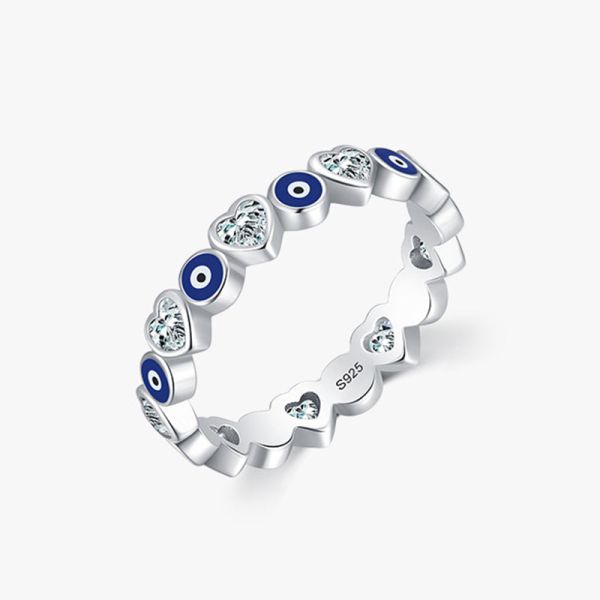 Buddha Stones 925 Sterling Silver Evil Eye Love Heart Zircon Blessing RingAs low as $87.59 Regular Price $119.99
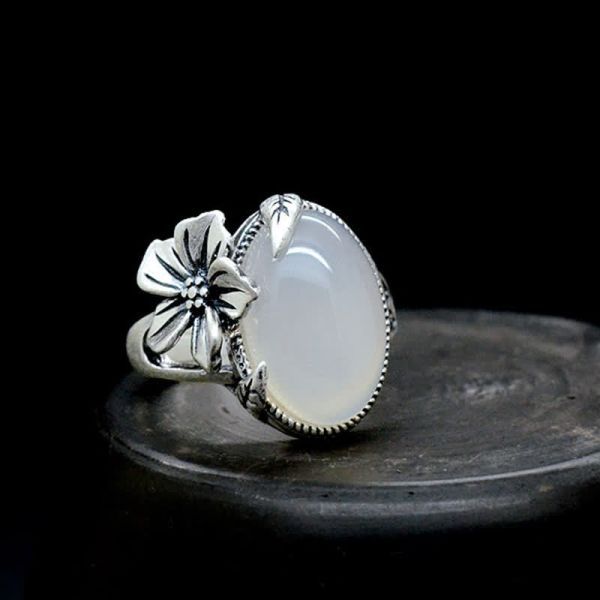 Buddha Stones 990 Sterling Silver Natural Chalcedony Plum Positive Harmony RingAs low as $173.59 Regular Price $231.45
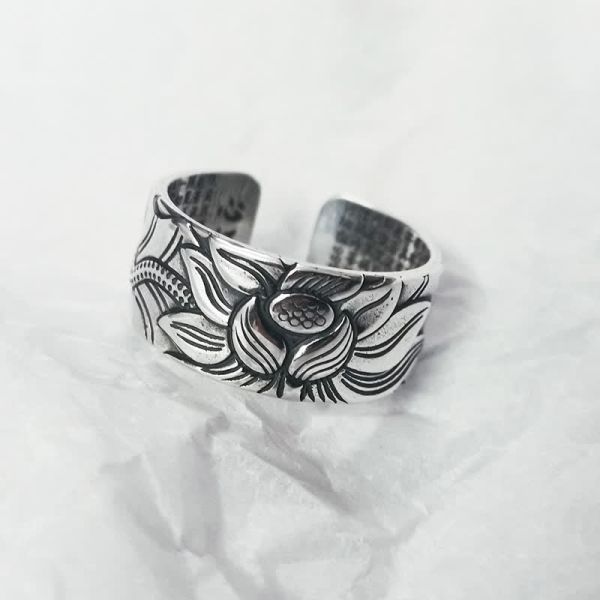 Buddha Stones 999 Sterling Silver Lotus Symbol Heart Sutra Protection RingSpecial Price $183.59 Regular Price $258.58
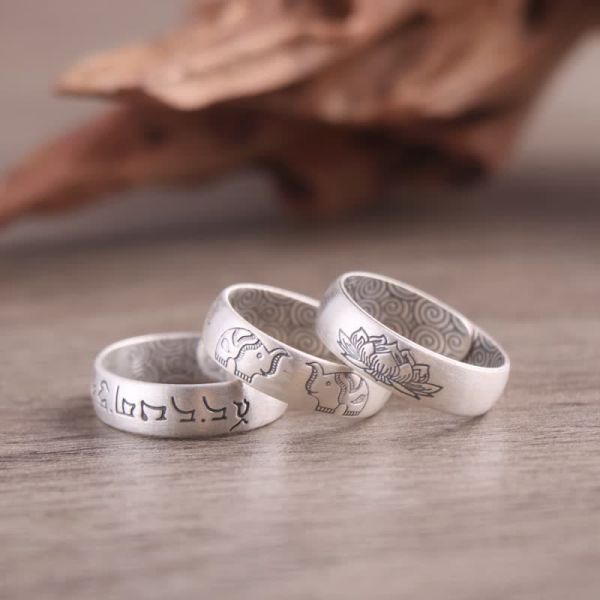 Buddha Stones 999 Sterling Silver Lotus Elephant Six True Words Blessing RingAs low as $59.59 Regular Price $80.53