
Om Mani Padme Hum Meaning: The Six Syllables Explained
Along pilgrim paths in Tibet, six syllables turn up everywhere a traveler looks. They are carved into mani stones stacked along the trail, painted across strings of prayer flags that snap in mountain wind, and cast into the metal cylinders of prayer wheels that pilgrims spin by hand as they walk. The syllables are om mani padme hum, and anyone who spends time around Tibetan Buddhist practice eventually asks about the om mani padme hum meaning behind them. The short answer is that it is a mantra of compassion, repeated so often across the Himalayan plateau that it has become a kind of visual and spoken shorthand for the whole tradition.
Om Mani Padme Hum Meaning in Tibetan Buddhism
In Tibetan Buddhism, this mantra is linked to Avalokiteshvara, known in Tibetan as Chenrezig, the bodhisattva who embodies compassion. Reciting the six syllables is understood as a way of calling on that quality of compassion, both in the world and within oneself. Because of this close association, the mantra is sometimes called the Six True Words, or simply the six-syllable mantra, and it is likely the most recited mantra in Tibetan practice.
Teachers who have explained the mantra over the centuries have not always agreed on every detail, and that is worth saying plainly: interpretations vary from lineage to lineage and teacher to teacher. What most agree on is the literal reading of the middle four syllables. Mani is usually translated as jewel, and padme as lotus. Om and hum are harder to translate as single words; they are often treated as seed sounds that frame the jewel-and-lotus image at the center.
| Syllable | One common explanation |
|---|---|
| Om | Often read as the vibration of the universe, and as a reminder of the practitioner’s own body, speech, and mind. |
| Ma Ni | The jewel. Many teachers connect it to method, compassion, and love, and to the wish to become enlightened for the benefit of others. |
| Pad Me | The lotus. Commonly tied to wisdom, since a lotus grows up through mud without being stained by it. |
| Hum | Often described as inseparability, the point where method and wisdom join, sometimes read as a symbol of purity. |
Our own product pages describe Om as the vibration of the universe tied to body, speech, and mind; Ma Ni as the jewel standing for compassion and the wish to help others; Pad Me as the lotus standing for wisdom; and Hum as the point where those two qualities, method and wisdom, come together. That lines up with how most teachers introduce the mantra to newcomers, even if the fuller explanations go further than any one paragraph can cover.
How it is actually said
Written out, the mantra looks like six distinct syllables. Spoken aloud by Tibetan speakers, it usually blends into something closer to “Om Mani Peme Hung,” with the d in padme softening toward an m sound. There is no single official pronunciation, and regional accents shift it further, but that four-beat rhythm is the one most visitors hear at monasteries and on pilgrimage routes.
The Logic Behind a Spinning Mantra
Part of the om mani padme hum meaning, for many practitioners, extends beyond sound: prayer wheels work on the idea that a cylinder packed with printed copies of the mantra, spun on a spindle, sends the mantra out into the world with each rotation, repeating the recitation without requiring anyone to recite it aloud every time. Pilgrims turn hand-held wheels as they walk, and larger wheels line monastery walls so visitors can set them turning as they pass. The scale changes, but the principle stays the same: motion stands in for repetition.
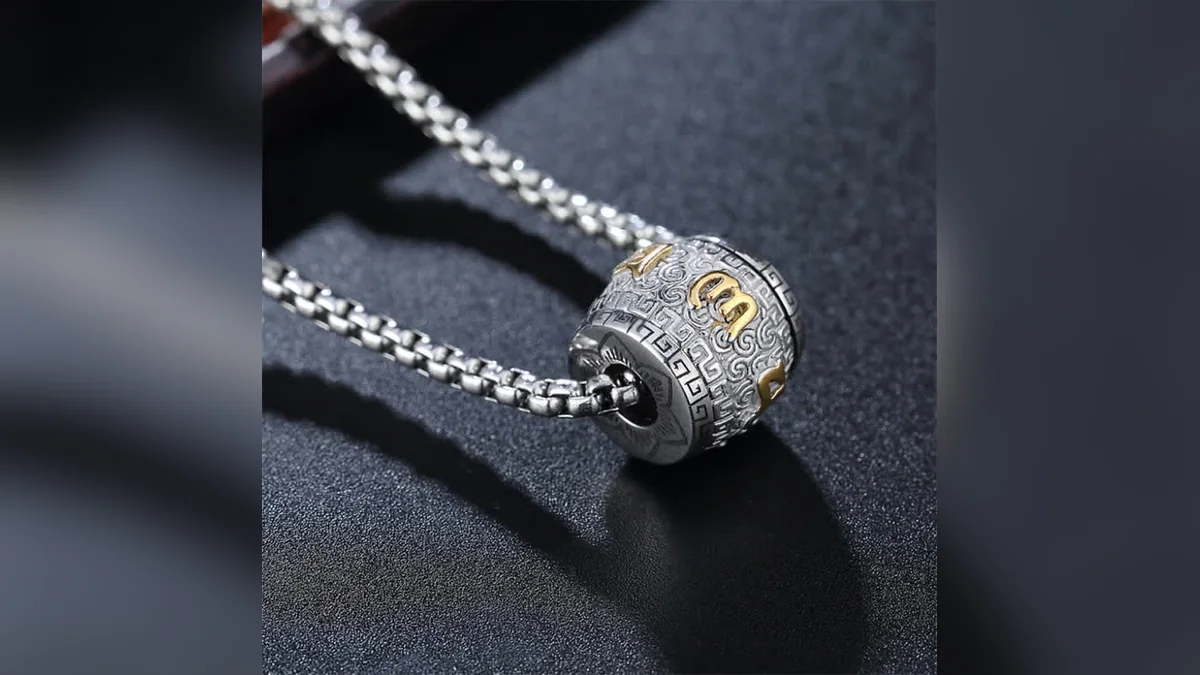
That is the tradition our engraved rotating cylinder necklace draws on. The pendant is a small titanium steel cylinder engraved with the mantra, built to turn on its setting the way a prayer wheel turns on its spindle. It will not have the scale or the painted scroll inside a temple wheel, but the gesture, spinning the mantra rather than only reading it, is the same one pilgrims use with wheels built for that purpose. The pendant measures roughly 25 mm and comes on a necklace about 24 inches (60 cm) long.
The Mantra Across Our Pieces
Beyond the necklace, the mantra turns up across several of our pieces, each carrying it in a different material.
The Five Elements braided bracelet is hand-woven on an adjustable cord sized to fit a wrist of about 5.9 to 6.7 inches. Its five colors are tied, on the product page, to the five elements of feng shui: white for metal, black for water, green for wood, red for fire, and yellow for earth. The mantra runs alongside that color symbolism rather than replacing it, so the piece carries two traditions at once, Tibetan and feng shui, on the same braided cord.
The copper bracelet takes a plainer approach: a copper alloy band carrying the mantra, offered in three wrist sizes, from about 6.3–6.7 inches up to 7.9–8.3 inches, so it can be sized rather than adjusted after the fact.
For a piece meant to be seen rather than worn, the wall art sets the mantra inside an eight-petal lotus mandala, cut from iron sheet in an openwork pattern with a matte black finish. It comes in a range of sizes and is made for hanging, with a hole at the top of the piece. Where the jewelry lets someone carry the mantra through the day, the wall art is built to sit in a fixed spot, a meditation corner or a quiet wall, where it can be seen each time someone walks past. Both approaches fit under our broader Om Mani Padme Hum collection, and the wall piece sits alongside other options in our wall art category.
Wearing and Displaying the Mantra
Because the mantra is treated as sacred text in Tibetan Buddhism, many people extend it the same everyday courtesy they would give any meaningful writing: they try to keep it clean, and they avoid setting it down on the floor or in places where it might get stepped on. None of this is a strict rule for jewelry bought outside a monastic setting, and practices differ from person to person and household to household, but it is common enough to be worth knowing. A simple habit, such as hanging the wall art at a height where it will not be brushed against, or wiping a pendant clean before putting it away, is usually enough to stay on the respectful side of the tradition.
Beneath the metalwork and the color symbolism sit six syllables built around compassion: a jewel held inside a lotus, offered toward every being a practitioner meets, including, teachers often point out, the one reciting it. That is why the mantra survives in so many forms, carved into stone, spun in a wheel, engraved on a cuff, cut into iron on a wall, each one a different way of keeping the same idea in view.
Shop the story
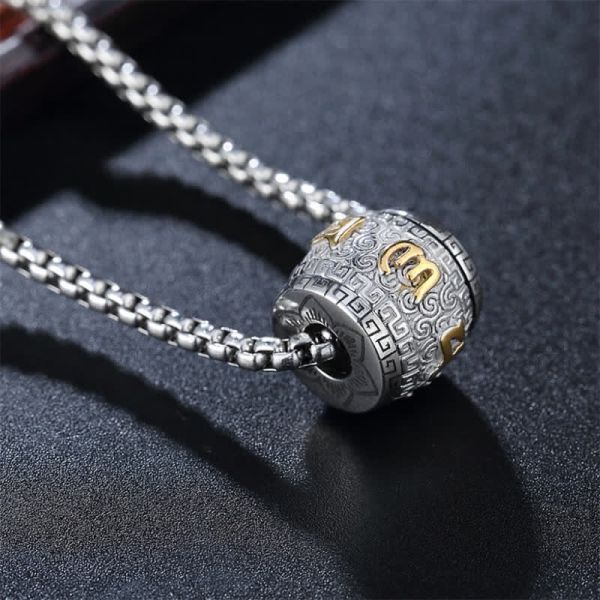 Buddha Stones Titanium Steel Om Mani Padme Hum Engraved Rotating Cylinder Necklace for ProtectionSpecial Price $25.59 Regular Price $36.04
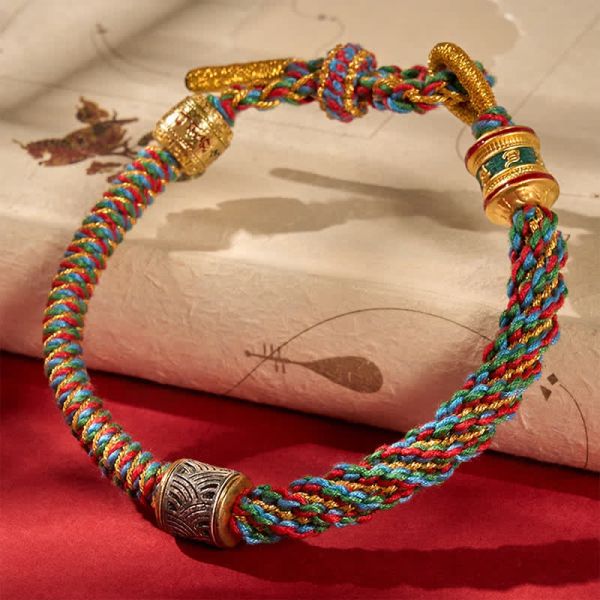 Buddha Stones Hand-Woven Om Mani Padme Hum Five Elements Wuxing Wisdom Tibetan Braided BraceletAs low as $25.59 Regular Price $35.54
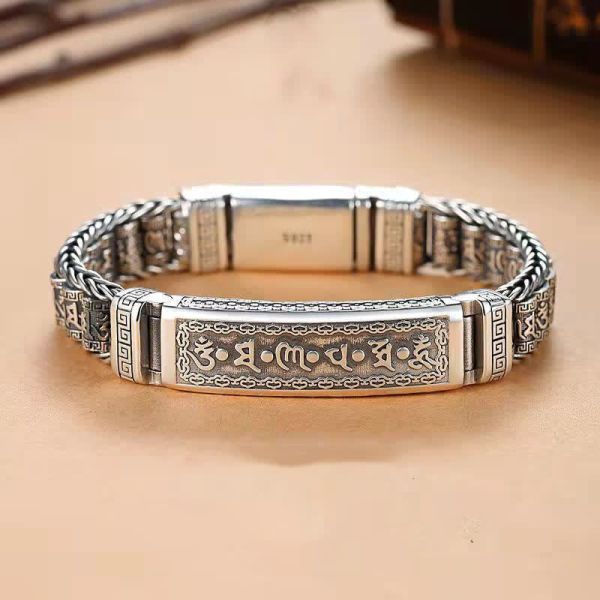 Buddha Stones Copper Om Mani Padme Hum Protection BraceletAs low as $29.59 Regular Price $40.53
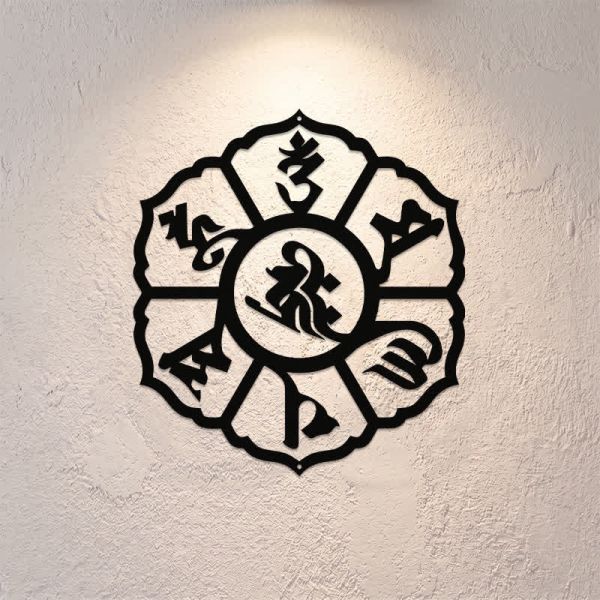 Buddha Stones Om Mani Padme Hum Wisdom Iron Metal Meaningful Symbols Wall ArtAs low as $28.59 Regular Price $38.12