
Auspicious Clouds Meaning: A Visual Guide to Xiangyun
The motif curls into rounded scrolls, with a broad cloud head and a tapering tail. Auspicious clouds, xiangyun (祥云), are a stylized cloud motif that in Chinese tradition signals good fortune, heaven, and the realm of immortals. That is the core of auspicious clouds meaning: a traditional visual expression of favorable wishes and a celestial world. Recognizing the outline helps you follow the design across a bronze vessel, a robe, a teacup, or a piece of jewelry.
How to recognize the motif
Begin with the outline, then look at how the forms repeat and what surrounds them. A cloud may stand alone as a single curl or join a larger pattern. These five cues offer a useful starting point:
- A rounded, lobed head. The leading edge often has several soft bumps gathered around a central curve. This cloud head frequently resembles the head of a ruyi scepter. The resemblance is a useful visual clue, although a cloud motif and a scepter remain distinct subjects.
- An inward curl. Follow the line toward its center. It may coil back on itself like a scroll, creating a rounded hook rather than the loose outline of a cloud observed in the sky.
- A trailing tail. A narrow extension may stretch behind the cloud head. Some designs keep this tail short; others draw it into a long, flowing line that joins neighboring curls.
- Repeated forms. Several cloud heads may face the same direction, alternate, or spread across a surface. Repetition can turn an individual cloud into a border or a continuous decorative field.
- Celestial companions. Dragons and immortals are often shown riding on clouds. Their presence helps establish the setting, especially when the cloud itself has been simplified into only a few curved lines.
Color alone is a weak identifier. Compare the cloud head, curl, and tail before deciding what you are seeing. A rounded floral scroll may share a similar rhythm, so check for recognizable leaves or petals as well.
Where auspicious clouds meaning comes from
The motif belongs to a long Chinese decorative tradition. Cloud-scroll patterns were common on Han dynasty lacquer and bronzes. Their curved lines could fill a surface, follow the shape of a vessel, or connect separate figures. Recognizing this history does not mean that every curled mark on an old object should be labeled xiangyun; the surrounding design still matters.
Clouds also help artists depict heaven and the realm of immortals. An immortal riding a cloud occupies a setting beyond ordinary earthly life. A dragon moving among cloud scrolls belongs to the same broad celestial imagery. Our article on Chinese dragon symbolism looks more closely at the creature; here, the clouds are the part to follow through the composition.
Popular explanations also connect yun (云, cloud) with yun (运, fortune) through sound. The words use different characters and tones, so this association is a wordplay explanation, not a literal translation of “cloud.” It adds another way to understand why the pattern can express a favorable wish.
The design remains recognizable in modern settings. The 2008 Beijing Olympic torch carried an auspicious cloud design, bringing the curling motif onto a widely seen contemporary object. Its appearance there offers a useful comparison with older decorative surfaces: the material and purpose change, while the scroll-like cloud remains legible.
Where to spot auspicious clouds
Scale changes the way the motif is arranged. On a broad surface, clouds can spread around figures; on a narrow band, the same idea may become a short sequence of curls. Use this field guide to compare the setting with the outline.
| Where you see it | How the clouds usually appear |
|---|---|
| Bronzes and lacquer | Cloud scrolls form flowing surface patterns or bands. On Han dynasty examples, look for curling lines that repeat and connect across the object. |
| Imperial robes | Cloud clusters surround dragons and occupy the space between larger motifs. Follow individual cloud heads through the broader arrangement rather than reading the whole field as one cloud. |
| Architecture | Cloud forms appear in decorative details on beams, panels, and other building elements. Distance may make the rounded head more noticeable than the smaller interior curl. |
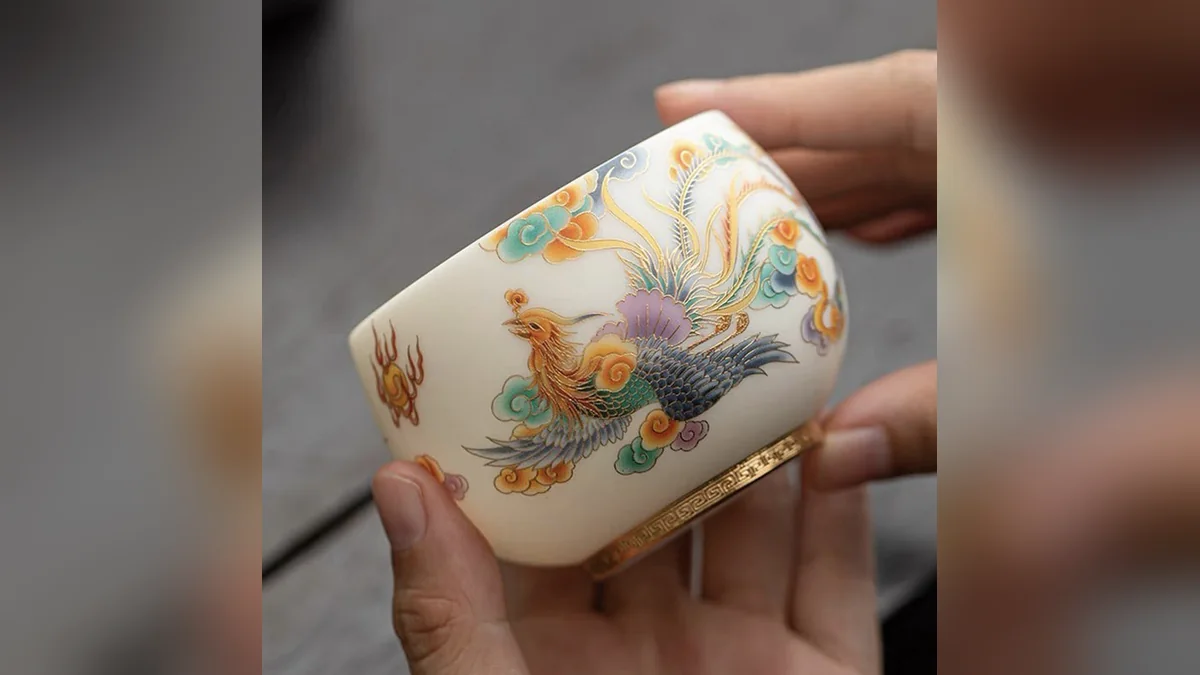
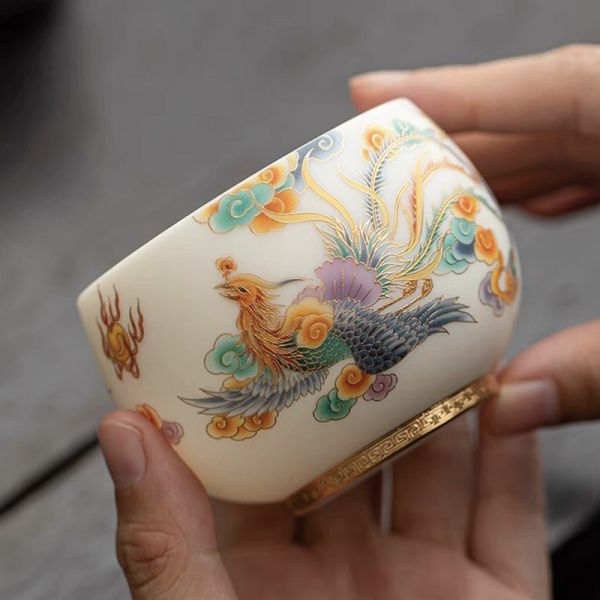
| Teaware | Clouds may circle a cup or share its surface with dragons and phoenixes. A curved vessel reveals only part of a repeating pattern from any single viewpoint. |
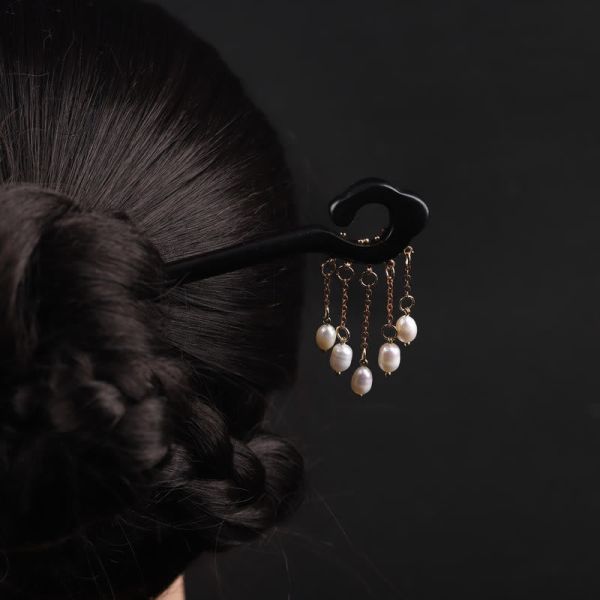
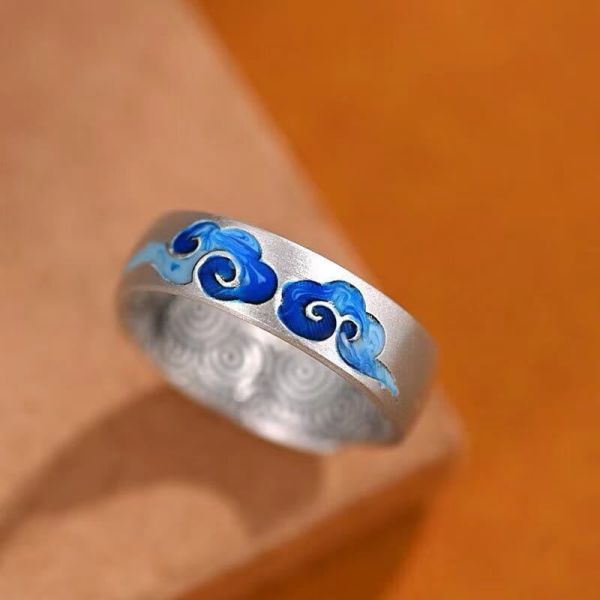
| Jewelry and hair ornaments | A cloud may become one prominent outline or a compact repeating band. Look for the relationship between the lobed head and its trailing curve. |
Placement gives you another clue, but it does not establish an object's age or origin. A familiar historical motif can appear on a newly made object. Read the design and the product description as separate kinds of information.
Auspicious cloud designs to compare
Our product names bring the motif into accessories and teaware. Words such as “Protection” and “Wealth” in these names express traditional wishes. They provide no guarantee of safety, financial gain, or good fortune.
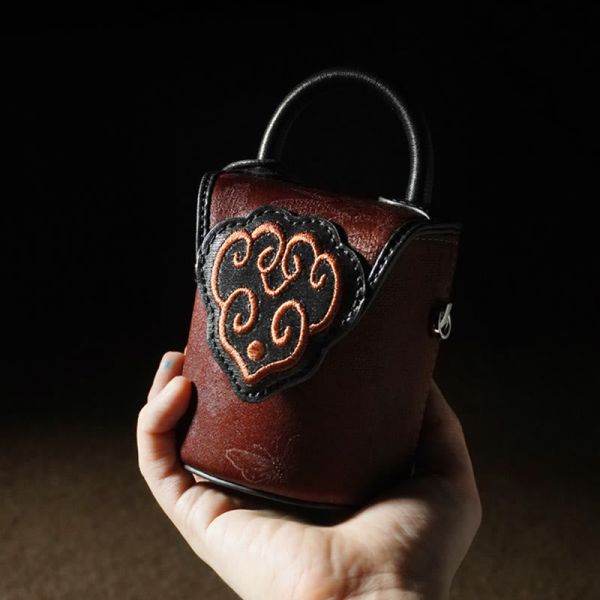
Xiangyunsha silk crossbody bag
Our Auspicious Clouds Butterfly Flowers Xiangyunsha Silk Crossbody Bag comes in pink or saddle brown. It combines mulberry silk and xiangyunsha silk with cow split leather and a metal chain. The bag measures 7.5 × 7.5 × 9.5 cm, has a flap closure, and uses a non-adjustable 120 cm metal chain. The page gives a 7-day pre-sale period.
The fabric name deserves a separate look. Xiangyunsha is written 香云纱, often translated as “fragrant cloud gauze.” Its first character differs from the 祥 in 祥云. Our page describes xiangyunsha as a traditional handmade silk fabric dyed with plant dyes, associated with Shunde in Foshan and listed as national intangible cultural heritage.
Dragon and phoenix ceramic teacup
The Dragon Phoenix Auspicious Clouds Ceramic Teacup combines the cloud motif with the two named creatures. The small option measures 8.5 cm × 6.5 cm and holds 150 ml. The big option measures 8.6 cm × 6 cm and holds 170 ml. Compare both dimensions and capacity when choosing between the ceramic cup options.
Ebony and pearl hairpin
The Ebony Auspicious Cloud Pearl Tassel Hairpin uses ebony and pearl and measures about 17 cm long. Its cloud reference brings the motif into a hair ornament. If you are new to this kind of pin, our hair stick walkthrough covers placement step by step.
Blue cloud-pattern copper ring
Our Blue Auspicious Clouds Pattern Copper Adjustable Ring is copper, measures 6 mm wide, and weighs about 4 g. Its size is adjustable. For a starting measurement, follow our instructions on how to measure ring size; the adjustable description does not specify a numerical size range.
A rounded head, an inward curl, and a trailing line give you a practical way to recognize xiangyun. The surrounding figures and setting then help explain its traditional associations. Those details let you appreciate a cloud pattern as both a decorative form and an expression of a favorable wish.
Shop the story
 Buddha Stones Auspicious Clouds Butterfly Flowers Xiangyunsha Silk Crossbody Bag HangbagsAs low as $129.59 Regular Price $177.52
 Buddha Stones Dragon Phoenix Auspicious Clouds Ceramic Teacup Kung Fu Tea CupAs low as $57.59 Regular Price $76.79
 Buddha Stones Ebony Auspicious Cloud Pearl Tassel Protection HairpinSpecial Price $25.59 Regular Price $35.54
 Buddha Stones Blue Auspicious Clouds Pattern Wealth Copper Adjustable RingSpecial Price $25.59 Regular Price $34.58