
Chinese Dragon Symbolism: An Anatomy of the Creature
Carved along temple eaves, stitched into wedding robes, and coiled around the rim of an incense burner, the Chinese dragon rarely shows up as a single, simple shape. Chinese dragon symbolism works less like one creature and more like an inventory: a head borrowed from one animal, a body from another, each part carrying its own layer of meaning. Painters and carvers across many generations worked from the same traditional checklist, so that a dragon on a roof tile and a dragon on a bronze mirror could still be read the same way. This guide moves across the creature the same way, feature by feature, rather than taking in the whole shape at once.
The body: an anatomy of Chinese dragon symbolism
Start with the trunk. The Chinese dragon is long, limbless except for four legs set far apart, and moves in a sinuous curve rather than a straight line. Traditional descriptions compare the body to a snake’s, scaled and flexible enough to loop through clouds or dip under a river without a visible break. One well-known version of the old composite description lists the dragon as built from nine different creatures: a camel’s head, a deer’s horns, a snake’s body, a carp’s scales, and an eagle’s claws, among others. Few artists followed the list to the letter, but the idea behind it stuck. A dragon is not one animal pretending to be another; it is several animals read as one.
The horns and head
Following that same traditional list, the head is often drawn close to a camel’s, broad and slightly flattened, with horns taken from a deer, branching rather than curving back like a goat’s or a bull’s. Painters varied the details by region and by period, adding a mane, long whiskers, or ears set low on the skull, but the horns stayed close to the deer pattern in most depictions. On temple roofs and old scroll paintings, the head is usually turned to one side, looking back over the shoulder rather than straight ahead, as if the dragon had just noticed something behind it. That backward glance became almost as recognizable as the horns themselves, a small gesture repeated on roof ridges and carved panels for generations.
The scales
Moving down the neck, the body is covered in scales, which the same traditional description borrows from the carp. Folklore ties the carp to the dragon directly: a fish strong enough to swim upstream against a current was sometimes said to turn into a dragon, which is part of why carp scales and dragon scales look so similar in paintings. The scales themselves are traditionally said to number eighty-one, nine times nine, since nine was treated as the highest and most favorable single digit in old number symbolism. That detail shows up more often in writing about the dragon than in paintings, where scale counts are usually implied rather than drawn one by one. Our Jade Dragon Scale ring takes that single detail and turns it into a band worn on one finger: cut from jade, with inner diameters from 15 to 21 millimeters, or US sizes 4-5 through 11. The product page suggests measuring the widest part of the knuckle and sizing up if your finger falls between two sizes.
The claws
The claws, by the same list, come from an eagle: narrow, curved, and gripping rather than flat like a bear’s paw. In later dynasties, the number of claws became a matter of rank as much as anatomy. Five-clawed dragons were reserved for the emperor and imperial buildings, by the custom of the time; four claws were said to appear on robes and objects belonging to princes and high officials; three claws were common on everyday goods and on decoration meant for wider, less restricted use. The line was not kept with the same strictness everywhere, and plenty of surviving pieces bend it, but the general pattern of fewer claws for broader use held for a long stretch of history. A dragon’s foot, in other words, could once say almost as much about who owned the object as its face did.
The pearl
Many dragon images, especially a pair of dragons facing each other, chase or circle a round, flaming pearl. What the pearl stands for has never been settled the same way everywhere; it is read variously as wisdom, enlightenment, or something precious and hard to reach, often placed just ahead of the snout or held near the throat. The chase matters as much as the object itself. Two dragons curling toward a single pearl, each reaching but neither quite closing the gap, became one of the more common compositions on temple ceilings, lacquerware, and the fronts of robes — a kind of visual shorthand for something worth pursuing rather than something already held.
The clouds and water
Unlike the dragon of European legend, which breathes fire and often guards a hoard, the Chinese dragon’s traditional domain is water. It is pictured moving through clouds, coiling along riverbanks, or surfacing from the sea, and older accounts credit it with bringing rain, governing rivers, and stirring up storms rather than breathing flame. Clouds, waves, and spiraling water patterns fill the space around a painted dragon almost as often as the dragon itself, to the point that the background can be as recognizable as the creature. Where the Western dragon tends to be a solitary hoarder, the Chinese dragon’s lore ties it to weather and farmland, to the rivers that fields once depended on — and that contrast is part of what sets Chinese dragon symbolism apart from its European counterpart.
Wearing the dragon
The dragon is also the fifth animal in the twelve-animal zodiac cycle, following the rabbit and preceding the snake, and years born under it are still named for it on calendars and red envelopes. In wedding imagery, the dragon is traditionally paired with the phoenix, a combination read as the joining of two different forces rather than one symbol repeated twice. That pairing is part of why dragon-and-phoenix motifs still turn up in wedding jewelry and gifts today.
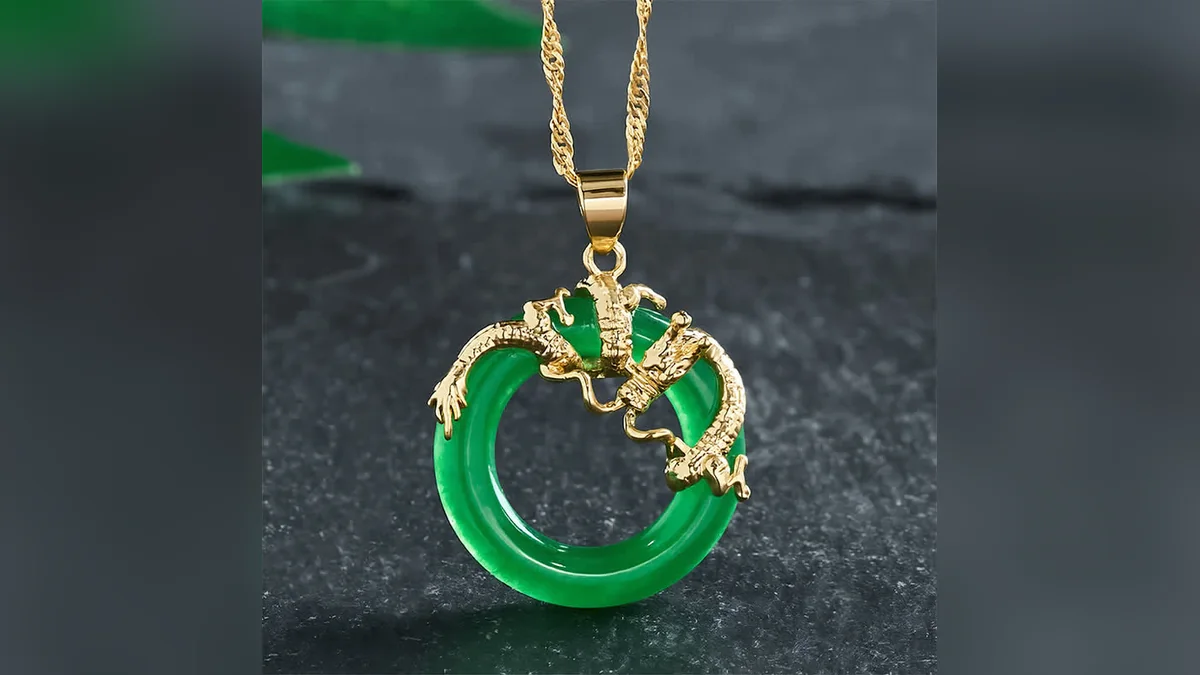
Jewelry keeps the same part-by-part habit as the older paintings and carvings. Our Jade Dragon pendant necklace sets a round jade pendant, about 3.5 by 2.5 centimeters, on an 18-inch (45 cm) necklace, small enough that the dragon reads as a single curled shape rather than a full scene. The Dragon Strength crescent pendant, made of alloy on a 21.6-inch (55 cm) necklace with a pendant close to 4.4 by 3.3 centimeters, gives the body more room to coil across a curved shape. Even a brass dragon keychain, made of copper brass and sized for a set of keys, carries the same figure at a smaller scale. For more pieces built around the same shape, our dragon collection works through it in different materials and sizes.
None of this keeps the dragon confined to temples and ceremony. The same coiled body, horned head, and chasing pearl show up on teapot handles, embroidered children’s clothing, lucky money envelopes, and the trim of ordinary furniture, often without anyone stopping to name each part. It has become common enough to pass almost unnoticed, which is its own kind of staying power.
Shop the story
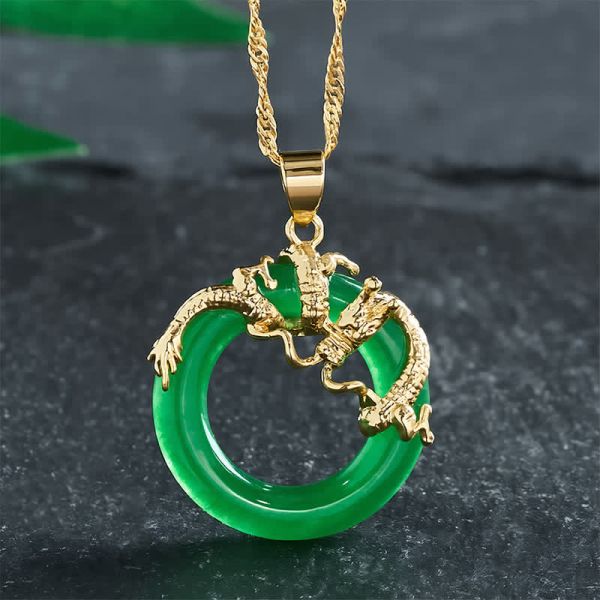 Buddha Stones Jade Dragon Round Pendant Protection NecklaceAs low as $25.59 Regular Price $35.54
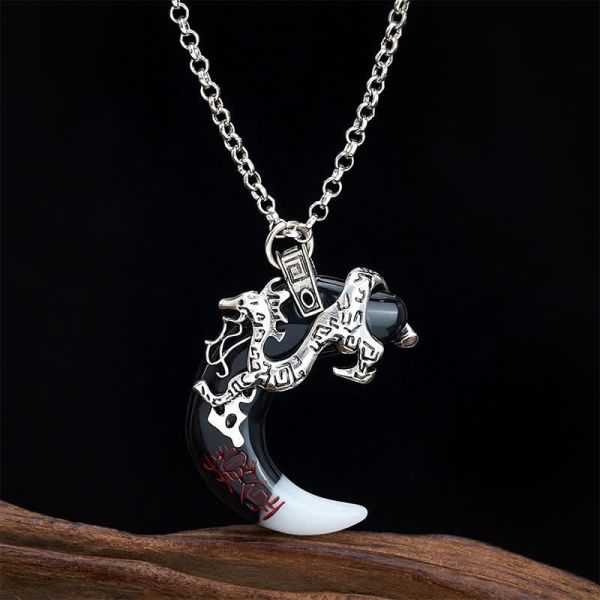 Buddha Stones Dragon Strength Crescent Pendant NecklaceAs low as $25.59 Regular Price $34.12
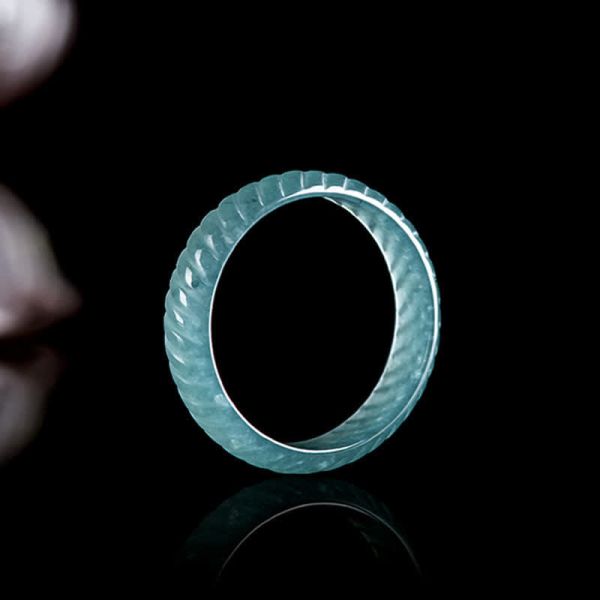 Buddha Stones Translucent Jade Dragon Scale Power RingAs low as $34.59 Regular Price $48.72
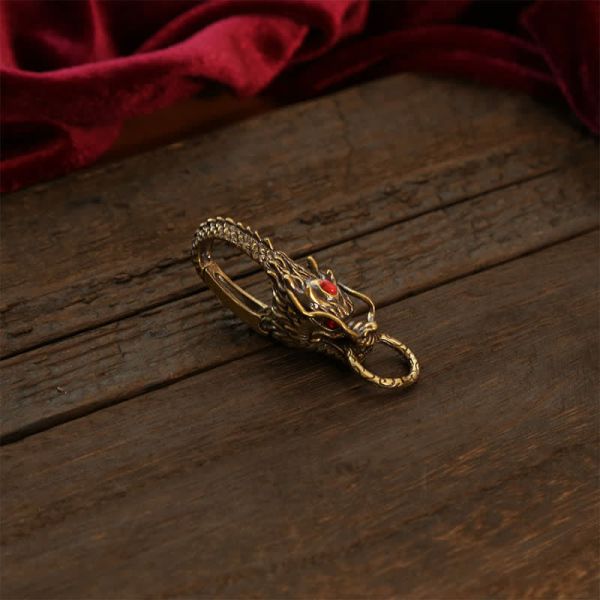 Buddha Stones Brass Dragon Strength Lock KeychainsAs low as $25.59 Regular Price $34.12