Pearl Meaning: Cultural Symbols, Care, and Jewelry
Pearls form when a mollusk builds layers of nacre around an irritant over time. They are organic gems, produced by living organisms. Across cultures, pearl meaning gathers around purity, wisdom, the moon, and treasured things. These associations belong to tradition: they describe how people have understood pearls in art, stories, ceremonies, and jewelry.
That background gives a pearl more than one possible reading. Purity may be the familiar association at a wedding, while wisdom may be more relevant beside a dragon in Chinese art. Choosing a pearl accessory can begin with that symbolism or with the simpler question of where and how you want to wear it.
Pearl meaning across three traditions
The pearl appears in settings that do not share a single explanation. Its rounded form and luster have invited comparisons with the moon, while its place among treasured objects has made it a useful image for something precious. Context matters: the same visual form can carry a different emphasis in religious imagery, folklore, or a family custom.
| Tradition | What the pearl stands for |
|---|---|
| Chinese tradition | The flaming pearl chased by dragons in art can symbolize wisdom or something precious. Pearls are also tied to the moon in folklore. |
| Buddhist imagery | The wish-fulfilling jewel, or cintamani, is often pictured as a pearl or jewel. |
| Western custom | Pearl is a June birthstone in the modern list and has a long association with weddings and purity. |
In Chinese art, the surrounding dragon and flames help establish the pearl as a symbolic object. The image need not be read as a literal piece of jewelry. Its value within the composition can stand for wisdom or a precious thing being sought. The moon association belongs to another strand of folklore, so it is useful to leave room for more than one interpretation.
In Buddhist imagery, the cintamani belongs to a religious vocabulary of jewels and valued ideals. The name “wish-fulfilling jewel” expresses a traditional belief. Reading the image involves more than recognizing a rounded shape: the surrounding figures and setting help give the jewel its place in the composition. This is why a symbolic pearl in religious art and pearl as a jewelry material need separate descriptions.
Western wedding associations are more familiar in everyday dress. Pearls can refer to purity within that custom, but wearing them does not require a wedding or a particular interpretation. The June birthstone connection offers another reason to choose them, especially for a birthday gift. A recipient may value the calendar association, the appearance, or both.
How to care for pearls
Pearls are soft, about 2.5 to 4.5 on the Mohs scale. That scale describes resistance to scratching, so storage and everyday handling deserve attention. Keep pearl surfaces from rubbing against harder stones and metal, including other jewelry loose in the same box.
Put pearls on after perfume, hairspray, and lotion. Finish those steps first and let the products dry before adding your jewelry. For a pearl hair accessory, complete any hairspray application before placing the accessory. For a brooch, think about where perfume will be applied before fastening it to clothing.
After wear, wipe pearls gently with a soft cloth. Use a light touch around settings and decorative parts, and avoid abrasive cloths or vigorous scrubbing. A simple wipe is a sensible routine; a strong jewelry cleaner chosen for another stone may be unsuitable for pearls. Avoid ultrasonic and steam cleaners.
Give pearl pieces their own compartment, away from harder stones and metal. A separate compartment or a soft pouch helps prevent pieces from knocking or rubbing together. Give a brooch enough space that other objects do not press against its decoration, and arrange a tassel so it does not become tangled with neighboring jewelry.
Mixed-material accessories deserve care as complete objects. Copper, alloy, acrylic, and pearl are different materials, so avoid assuming that a cleaning method suited to one component suits the entire accessory. Our magnolia and lotus brooch listings also advise avoiding crushing, pressing, and contact with sharp objects, and storing them in a dry, dust-free, cool place.
Choosing a pearl bracelet, brooch, or hairpin
Start with where you want to wear the detail: at the wrist, on clothing, or in the hair. Then compare the listed dimensions and materials. Our pearl accessories below use different formats, so the practical choice depends on the placement you want and the measurements relevant to it.
A clover detail at the wrist
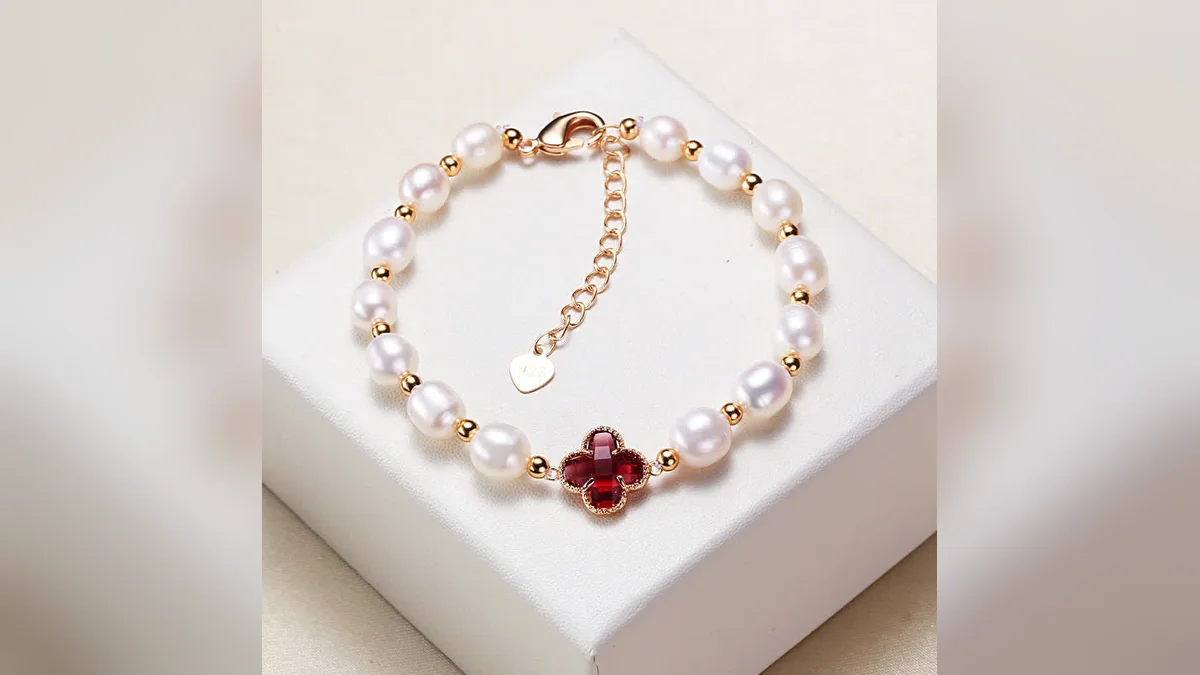
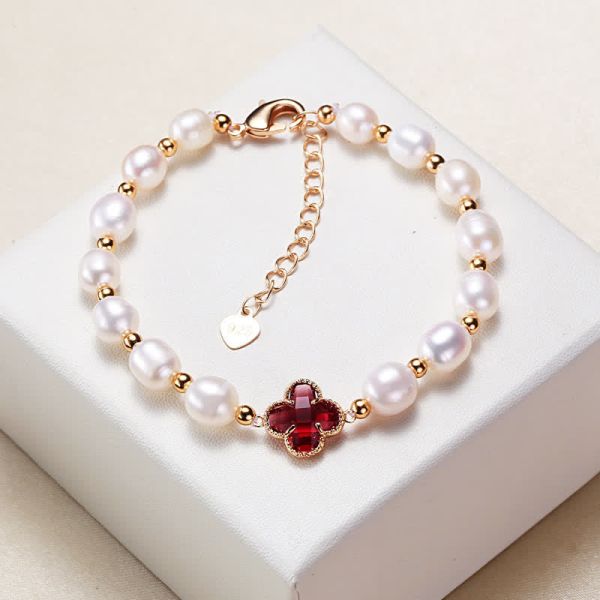
Our Pearl Four Leaf Clover chain bracelet has a chain band and lists pearl as its material. The stated wrist circumference is 15-19 cm, with a listed perimeter of 16+4 cm. Its pearl size is 7 mm, and its weight is 9 g.
The clover color options are black, blue, dark green, green, pink, red, and white. Choose the clover color in relation to the clothing or jewelry you plan to pair with it. Compare the stated wrist range with your wrist measurement, giving fit as much attention as the motif when choosing a bracelet as a gift.
A magnolia for a floral accent
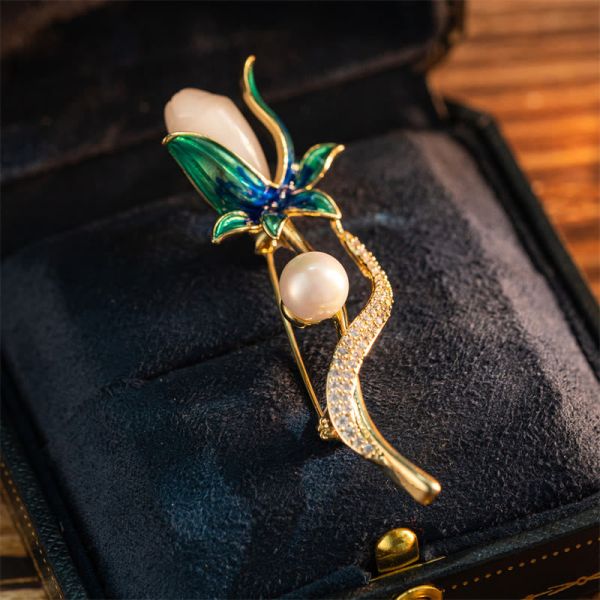
The Magnolia Flower Pearl copper brooch lists copper and pearl as its materials and measures about 1.97 in (5 cm). The magnolia motif gives you a flower-based alternative to the clover bracelet, with the pearl detail moved from the wrist to clothing.
Consider the listed size against the area where you intend to place it. Fabric weight and space around the motif matter when planning a brooch placement. Our guide to how to wear a brooch offers more guidance on choosing a position.
A lotus with two color options
Our Lotus Flower Pearl copper brooch is made of copper and pearl. Its listed size is about 2.05 × 1.89 in (5.2 × 4.8 cm), with green or rose red options. Those measurements provide both dimensions for considering its placement on clothing.
The lotus brings a separate symbolic tradition to the floral design. For that background, our article on lotus flower meaning in Buddhism discusses the flower itself. You can appreciate that context while choosing a color for purely visual reasons.
A flower and leaf tassel hairpin
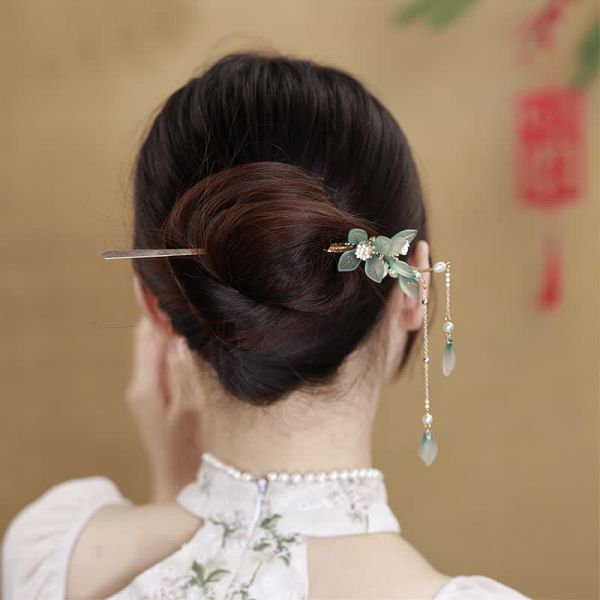
The Flower Leaf Pearl tassel hairpin lists alloy, acrylic, and pearl as its materials. The hairpin length is 21 cm, the tassel length is 9.5 cm, and the weight is 35.2 g. Keep the hairpin and tassel measurements distinct when considering the space the accessory will occupy.
A pearl accessory can carry a cultural reference, a birth-month connection, or simply a place in how you dress. Let that meaning remain personal, and let the practical details guide the choice: the listed materials, the relevant dimensions, and care that respects the pearl surface.
Shop the story
 Buddha Stones Pearl Four Leaf Clover Wealth Chain BraceletAs low as $25.59 Regular Price $36.04
 Buddha Stones Magnolia Flower Pearl Optimism Copper BroochSpecial Price $36.59 Regular Price $48.79
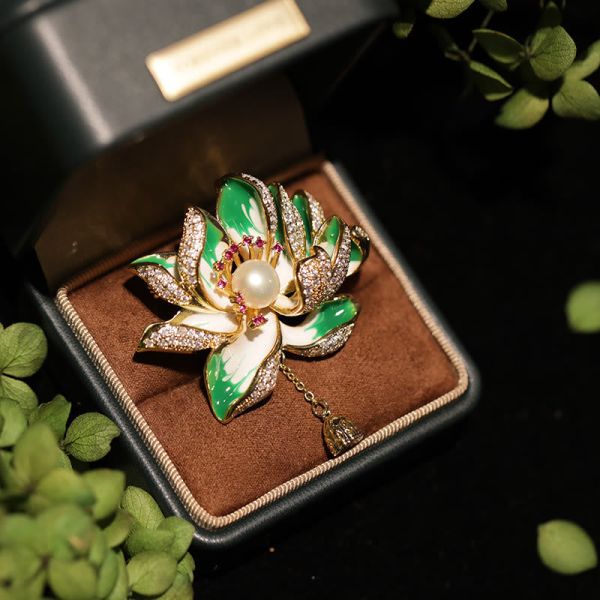 Buddha Stones Lotus Flower Pearl New Beginning Copper BroochAs low as $68.59 Regular Price $96.61