Elephant Feng Shui: Trunk Meanings and Placement Guide
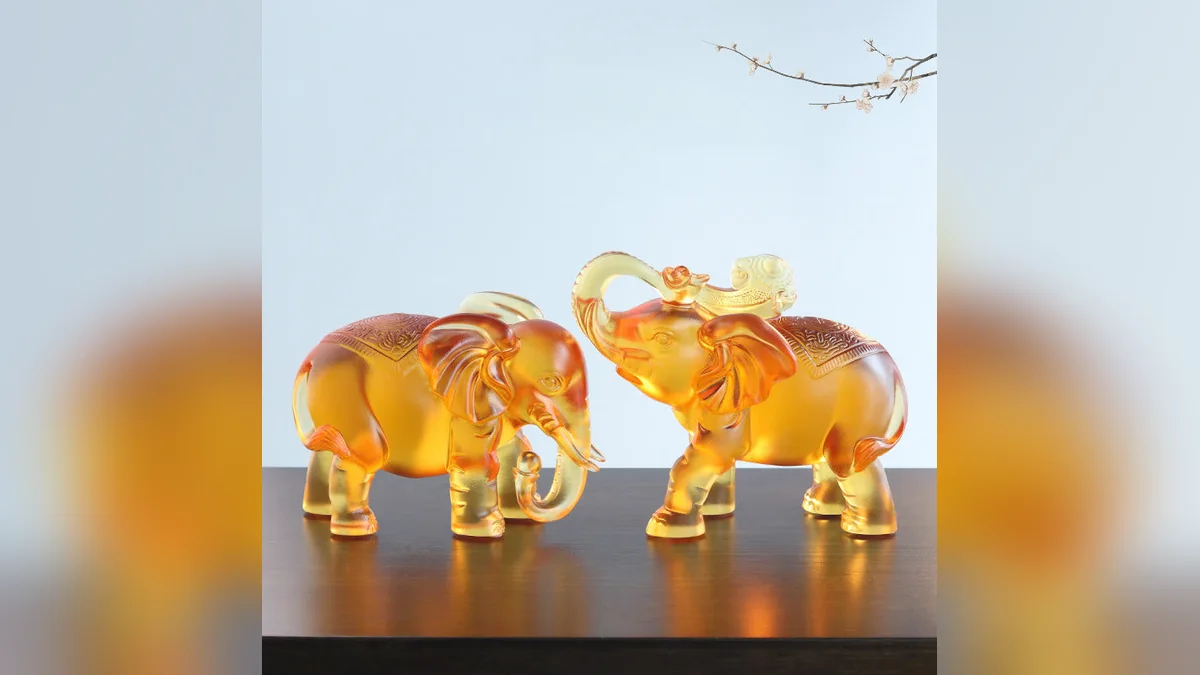
The trunk is usually the first detail people ask about when choosing an elephant figure. In elephant feng shui, the animal symbolizes strength, wisdom, stability, and good fortune. A raised trunk is customarily read as welcoming good luck, while a lowered trunk represents steady, grounded strength or, in some readings, fertility. These readings are customs, and none of them promises a result. Neither trunk position makes a figure unsuitable for your home. Start with the meaning you prefer, then find a secure place where the figure fits.
What the elephant represents across traditions
Elephants appear in several cultural and religious settings, and those settings deserve distinction. In Buddhist art, the white elephant recalls the story of Queen Maya’s dream before the Buddha’s birth. This association belongs to a religious narrative; a white elephant ornament does not automatically serve as a Buddhist devotional object.
Ganesha is a separate Hindu deity, recognizable by his elephant head. A decorative elephant figure and a Ganesha statue are not interchangeable. Our Ganesha placement guide addresses that subject separately.
In Chinese symbolism, a frequently cited pun connects the word for elephant, xiang, with the similar-sounding word for auspicious, also written xiang in unmarked romanization. The traditional phrase tai ping you xiang is often understood as a blessing for peaceful times. Such associations help explain the elephant’s place in decorative traditions without making its presence a promise of future events.
Elephant feng shui placement by room
Placement customs vary between households and interpretations. Treat the arrangements below as starting points. A figure needs a stable surface, room around its edges, and a position that allows doors and drawers to open freely.
| Spot | Common custom | Practical note |
|---|---|---|
| Entrance | A pair facing inward is a common custom, symbolically welcoming good fortune into the home. | Use a console or shelf clear of the door swing, keys, bags, and passing elbows. |
| Living room | An elephant is displayed as a symbol of strength and stability in a shared space. | Choose a firm cabinet or shelf where the figure does not crowd everyday objects. |
| Study or desk | The elephant’s wisdom association makes it a customary study ornament. | Keep your writing area, keyboard, cables, and access to drawers clear. |
| Bedroom | Pairs are customary for couples in some readings; lowered trunks may carry fertility symbolism. | These are symbolic associations, not promises. Place figures on a stable dresser clear of bedding. |
| High shelf versus floor | An elevated display is commonly preferred as a respectful arrangement. | Keep the figure off the floor and dust regularly. Avoid a shelf too high to reach safely. |
For an inward-facing entrance arrangement, turn the elephants toward the interior of the home. There is no need to force a symmetrical display onto a narrow ledge. A single figure on a secure surface is a reasonable decorative choice when a pair would leave too little space.
Pairs, direction, and trunk position
A pair can express companionship in some interpretations, but two figures do not guarantee a relationship outcome. If you prefer a pair, allow enough room to see both outlines clearly. Their trunks should not project into a walkway or over the edge of furniture.
Trunk position is also separate from the direction the whole figure faces. An elephant with a raised trunk can face into a room, just as one with a lowered trunk can. Choose the symbolic reading first, then turn the figure to suit the intended arrangement and available space.
Choose a figure that fits the surface
Before choosing a material or size, measure the usable display area. Include clearance around the figure rather than matching its listed dimensions exactly to a shelf. We list several forms below because a desk, a substantial cabinet, and a bare wall call for different practical choices.
A resin figure with green trim for a shelf or console
Our Lucky Feng Shui Green Elephant statue is made of resin. Its photos show a gold-toned elephant with a green, decorated saddle cloth, so the green in the name refers to that trim. Its listed sizes are small, 3.54 × 3.54 in / 9 × 9 cm; medium, 4.13 × 4.13 in / 10.5 × 10.5 cm; and large, 5.5 × 5.5 in / 14 × 14 cm.
Use those measurements to compare the available surface with the option you select. Leave space to lift the figure without brushing nearby objects, particularly on an entrance console where bags or mail may also be placed.
White ceramic options for a desk
The Small Elephant Statue in white porcelain ceramic is ceramic. The head-down option measures 5.5 × 5.5 × 8.5 cm, and the lifts-its-foot option measures 9 × 5.5 × 7 cm. A 2Pcs Elephant option is also listed.
Choose the set if you want two figures in your arrangement, or a single option if desk space is limited. The product’s head-down option describes its pose; avoid assuming that a lowered head and a lowered trunk mean the same thing.
Liuli glass with trunk-up and trunk-down designs
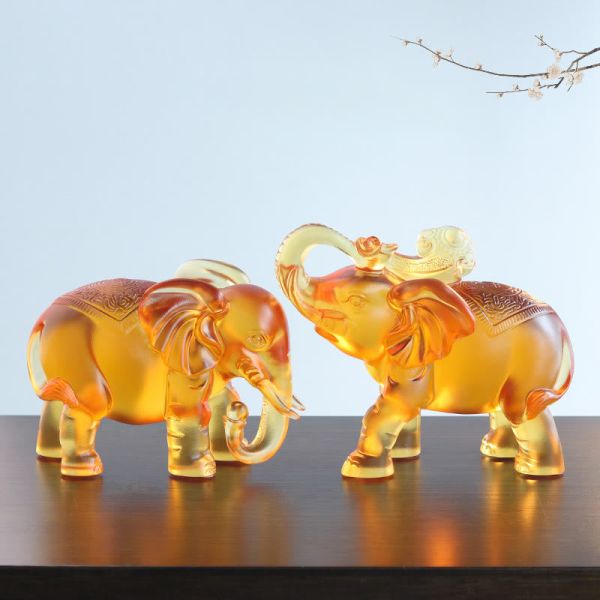
Our Yellow Liuli Crystal elephant is made of what the page calls liuli glassware/crystal glass, with trunk-up or trunk-down designs available singly or in pairs. For background on that material, read what liuli glass is.
- Small: trunk up, 14.5 × 7.5 × 11.5 cm; trunk down, 13 × 8 × 9 cm. A single small elephant weighs about 1000 g.
- Large: trunk up, 16.8 × 8.9 × 13.8 cm; trunk down, 15.5 × 7.8 × 11.5 cm. A single large elephant weighs about 1500 g.
- Extra large: trunk up, 30 × 17 × 24.5 cm; trunk down, 30 × 17 × 21 cm. A single extra large elephant weighs about 11000 g.
Check furniture weight limits before choosing a display spot, accounting for both figures if selecting a pair. The extra large options need particular attention to support and safe handling.
An iron elephant for the wall
The Sacred Elephant iron wall decor is made of iron and comes in six sizes, from approximately 25 × 21.74 cm to 60 × 52.17 cm. Its flat wall format offers a place for elephant symbolism when shelf space is short.
Measure the wall area before choosing a size, then use mounting hardware appropriate for the wall and the piece. Keep the outline clear of a door that could swing against it.
Keep the arrangement simple and cared for
A respectful display does not require numerous objects. Keep the elephant off the floor, dust it regularly with a soft cloth, and clear nearby clutter so you can reach it safely. Follow any material-specific care instructions rather than applying the same cleaning product to resin, ceramic, glass, and iron.
Let elephant feng shui remain a matter of symbolism and considered placement. A raised or lowered trunk can carry the customary meaning you choose; the practical foundation is a suitable surface, enough clearance, and regular care.
Shop the story
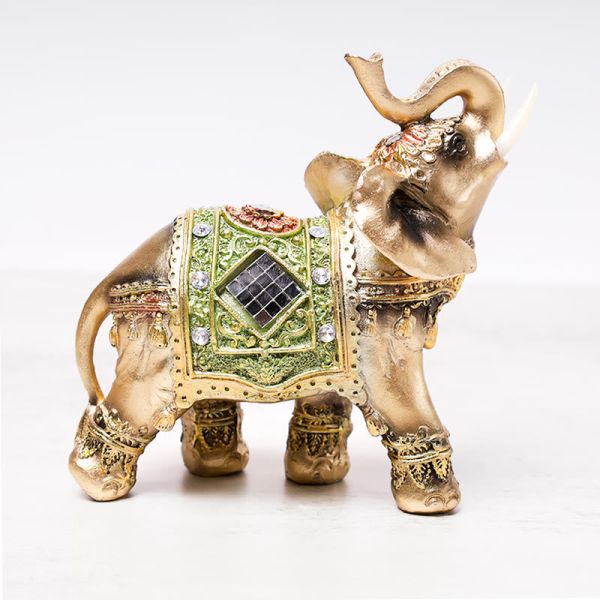 Buddha Stones Lucky Feng Shui Green Elephant Statue Sculpture Wealth Figurine Gift Home DecorationAs low as $23.59 Regular Price $31.45
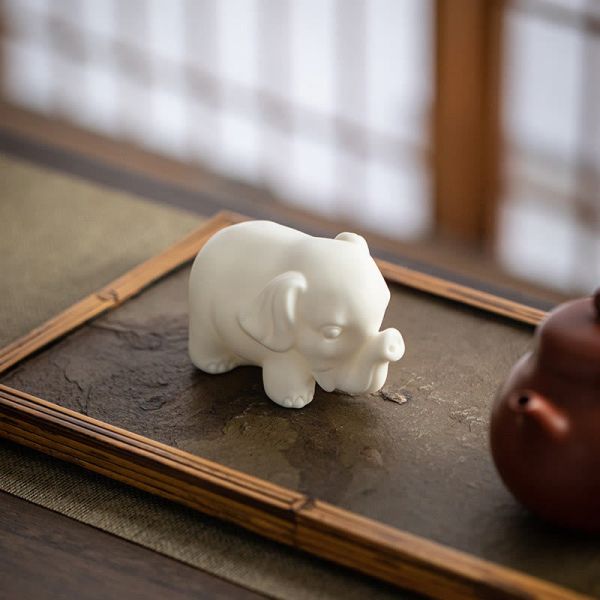 Buddha Stones Small Elephant Statue White Porcelain Ceramic Strength Home Desk DecorationAs low as $41.59 Regular Price $58.58
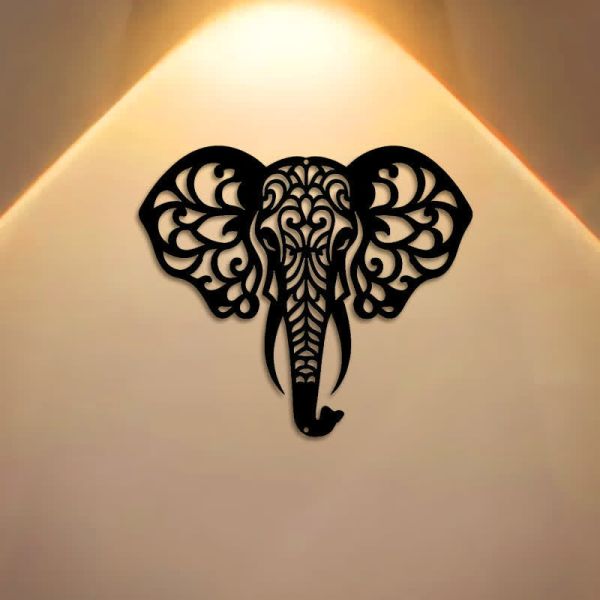 Buddha Stones Sacred Elephant Iron Metal Wall Decor Of WisdomAs low as $28.59