
Liuli Glass: From Mold to a Place on Your Shelf
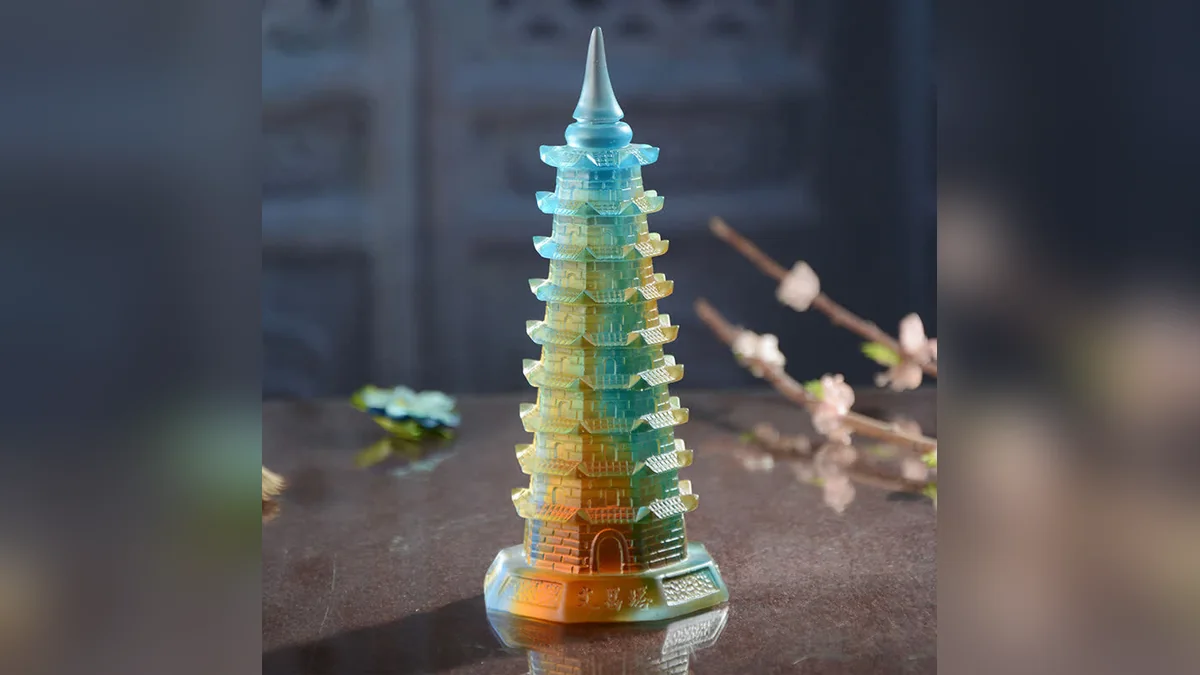
Light passing through a thick piece of colored glass on a windowsill reveals pale edges, deeper pools of color, and small bubbles within. Liuli is a Chinese word for colored glass and glazes; today, it most often refers to cast art glass, frequently called liuli glass or liuli crystal in English. Its appearance invites a closer look at how an object takes shape: first as a model, then as a hollow mold, and finally as a solid piece that can be finished and displayed.
At Buddha Stones, we use the material descriptions on our product pages alongside the traditional meanings of their forms. Understanding both makes it easier to read a piece without confusing a name, a making technique, and a symbolic story.
An old word, a modern studio craft
Glass and glazes have been made in China since ancient times. The word liuli belongs to that long material history, but its use today also reflects a more recent studio practice. In recent decades, contemporary art glass studios in Taiwan and mainland China have revived and popularized approaches involving pâte de verre and lost-wax casting.
These terms describe related aspects of working with glass in a mold. Pâte de verre involves arranging glass particles in a mold, often with a binder. Lost-wax casting describes how a wax form is enclosed and removed to leave the space that will receive the glass. Studio methods vary, so a shared material name does not establish one exact recipe for every object.
Likewise, the English label “liuli crystal” should be read in context. Here, the subject is decorative glass. Our product listings provide the specific material wording for each piece; the name alone does not identify its composition or the details of its firing.
From model to finished piece
The following are general steps of lost-wax glass casting. They explain the technique, rather than document how any particular product below was made. Individual studios may divide the work into more stages or use different tools.
- Sculpt a model. The maker establishes the form, proportions, and surface details in an original model. A projecting petal or a narrow opening needs consideration at this stage, because the shape must later be reproduced and released through several mold-making steps.
- Make a mold. A mold is taken from the model to preserve its shape. Depending on the form, this may need several sections so that the original can be removed without losing fine details.
- Cast a wax copy. Wax goes into this first mold to create a copy of the model. Once removed, the wax can be checked and refined. Marks left where mold sections meet can be addressed before the next mold is made.
- Invest the wax and melt it out. The wax copy is enclosed in a heat-resistant mold material, a process called investing. Heating removes the wax, leaving a cavity that records its shape. This is the “lost wax” part of the method.
- Fill with glass and fire. Glass pieces or particles are placed in the prepared mold or a connected reservoir. In the kiln, the glass softens and flows into the cavity. The arrangement of colors helps shape the appearance of the finished casting.
- Cool slowly. The casting follows a controlled cooling schedule, including annealing, to relieve internal strain. The schedule depends on the glass and the thickness of the object. Cooling is part of making the piece, even though its form is already established.
- Remove the mold and finish. The heat-resistant mold is broken away to release the glass. Remaining mold material is cleaned off, and areas that need finishing are ground and polished. These last steps bring the base, edges, and selected surfaces to their intended finish.
Tiny bubbles and color variation are normal features of casting. Color may gather differently through thicker and thinner areas, while small bubbles can remain within the glass. These details are part of its appearance; they do not, by themselves, establish where a piece was made or prove a particular production method.
Four shapes and what they stand for
Once finished, a cast object also carries the associations of its shape. We describe the meanings below as folk belief and tradition. They explain why a form may be chosen, without promising an outcome for the person displaying it.
Wenchang Tower
In Chinese folk belief, the Wenchang Tower is associated with study and scholarly success. Our Wenchang Tower liuli pagoda is listed as crystal glass. The small option measures 10.5 × 5 cm, and the large measures 16.5 × 7 cm. The listing identifies these measurements as length × height, so keep that order when planning its place on a shelf.
Treasure Bowl
The ju bao pen of folk stories is a treasure bowl that never empties, an image of abundance within the tale. Our Treasure Bowl liuli art piece is listed as crystal glass and comes with six ingots. Its three sizes are 10.5 × 9 × 5.5 cm, 11.5 × 10 × 7.4 cm, and 14.3 × 12.5 × 10 cm, given as length × width × height.
Kirin
Known as qilin as well as kirin, this hooved mythical creature is said in traditional stories to appear when a sage or wise ruler is near. Our Kirin liuli art piece is listed as crystal glass. It measures 9 × 5 × 7 cm, in length × width × height, and is offered in gold or purple, individually or as a pair. Each weighs about 500 g.
Lotus Flowerpot
In Buddhist tradition, the lotus is associated with purity and awakening; it also represents new beginnings. Our Lotus Liuli Flowerpot is made of liuli and measures about 6.5 × 6.5 × 12 cm, in length × width × height. It weighs about 200 g. The six colors are blue, dark blue, deep pink, light pink, purple, and white. The page notes that color, shape, and size vary slightly because each piece is handmade.
Displaying and caring for liuli glass
Choose a stable place where light can pass through or behind the piece. A little space around it lets its outline remain visible, while a plain background makes changes in color easier to see. Check the available shelf depth as well as its width before arranging the display.
Avoid sudden temperature changes and direct hot sun on a windowsill. A position near a window with indirect light can show the glass without leaving it in strong sun. Keep it away from shelf edges and places where it could be knocked while curtains or nearby objects are moved.
Dust gently with a soft cloth. If washing is needed, use lukewarm water and mild soap, rinse carefully, and dry right away with a soft cloth. Support the body of the piece while handling it, rather than lifting by a narrow projection. Do not put it in the dishwasher.
From the first model to the polished surface, casting gives colored glass its form. On the shelf, light reveals that form again, alongside the familiar stories carried by a tower, bowl, mythical creature, or flower.
Shop the story
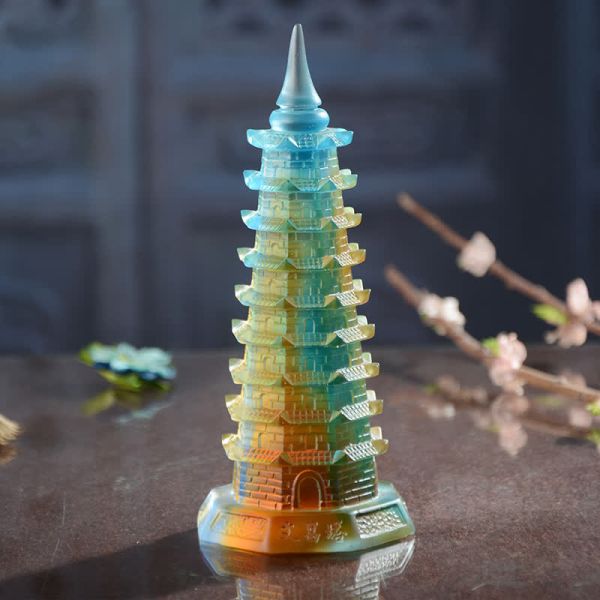 Buddha Stones Feng Shui Wenchang Tower Handmade Liuli Crystal Pagoda Art Piece Luck Home Office DecorationAs low as $159.59 Regular Price $212.79
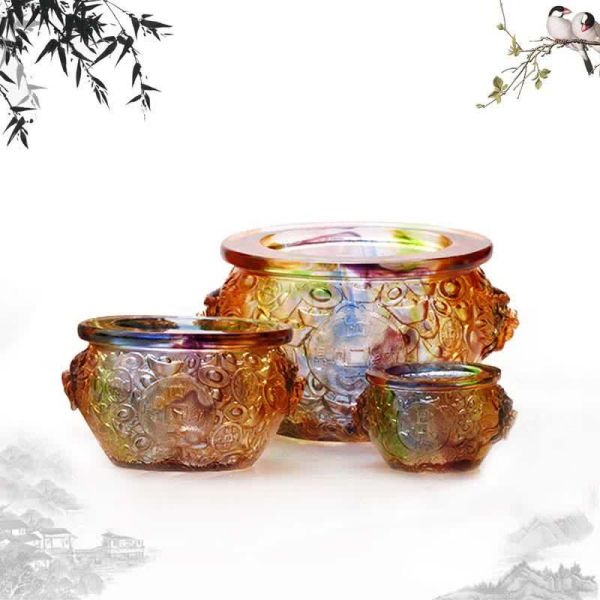 Buddha Stones Handmade Liuli Crystal Treasure Bowl Art Piece Home DecorationAs low as $189.59 Regular Price $252.79
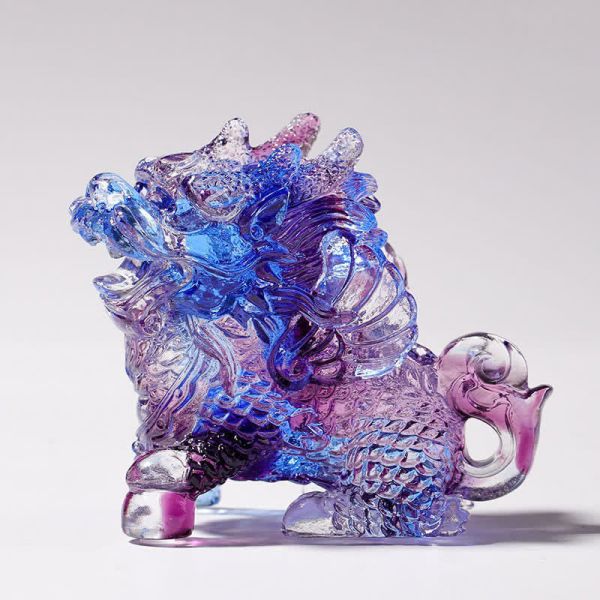 Buddha Stones Feng Shui Kirin Handmade Liuli Crystal Art Piece Home Office DecorationAs low as $119.59 Regular Price $159.45
 Buddha Stones Lotus Liuli Flowerpot Handmade Mindful Living DecorAs low as $45.59 Regular Price $60.79