Bamboo Symbolism: Four Lenses on a Chinese Motif
Bamboo is a grass, and its stems are hollow and divided by nodes. In Chinese art and literature, bamboo symbolism centers on integrity, resilience, and humility: the plant bends in wind without breaking, stays green in winter, and has a hollow interior read as an open, modest mind. Bamboo is also one of the Four Gentlemen of Chinese painting. These are cultural interpretations of the plant, connecting its visible form with qualities people have long admired.
The plant itself: bamboo symbolism
The stem gives this symbolism its structure. Its upright form suggests integrity, while its flexibility offers an image of resilience. In this reading, standing by your principles does not require refusing to bend. The plant supplies a way to picture firmness and adaptability together.
The hollow stem carries a different association. Chinese writers and artists have read that empty interior as humility: leaving room to learn instead of assuming you already know enough. This is a metaphor about character. A botanical feature becomes a way of describing a modest, receptive person.
Green leaves in winter add the idea of persistence through difficult conditions. Taken together, the stem, hollow interior, and winter foliage explain why bamboo can carry several meanings without requiring an elaborate scene. A few leaves beside a jointed stalk can suggest the whole plant and its familiar associations.
The scholar’s bamboo
Bamboo has a close place in Chinese scholarly painting and poetry. For a scholar, it could serve as a companion in the garden and an image of personal conduct on paper. An upright stalk offered a visible comparison with integrity; a bending branch allowed strength to be expressed through flexibility.
Su Shi, the Song dynasty poet, wrote a line usually translated as:
“I would rather eat without meat than live without bamboo.”
The Chinese is 宁可食无肉,不可居无竹. The contrast places bamboo among the things that make a dwelling worth inhabiting, beyond the practical question of food. It also helps explain why a plant could become such an enduring subject of cultivated taste.
Ink bamboo painting is a classic subject for practicing brushwork. Stems, nodes, branches, and leaves call for different strokes, and their arrangement matters as much as their individual shapes. The painter can suggest a grove with relatively few marks, leaving open paper between them.
When you look at an ink bamboo painting, notice how the leaves gather and where the stalk changes direction. Dense clusters and open spaces give the composition its rhythm. The subject offers both a recognizable plant and a setting for the painter’s command of the brush.
Bamboo in words and wordplay
Bamboo’s nodes also appear in the phrase jie jie gao sheng (节节高升), often rendered as “rising node by node.” It is a wish for steady progress. The repeated joints make a useful image: growth has successive stages, with one section following another.
That phrase can give a bamboo motif a particular meaning in a gift. For someone beginning a course of study or marking a new stage at work, it can express a hope for continued progress. The object communicates the giver’s wish; it cannot guarantee achievement or advancement.
Another word preserves a more physical connection. Baozhu, a Chinese word for firecracker, literally refers to burning bamboo. Bamboo crackled when burned in early New Year customs, and the word carries that earlier practice into later language.
These examples show two routes from plant to meaning. One turns the repeated nodes into a verbal wish. The other keeps the memory of an actual sound and custom. Neither depends on the leaf pattern alone, which is why knowing a little of the language adds something to a familiar design.
Bamboo in the home
Bamboo can appear at home as a living plant, a painted subject, or a motif on an everyday object. Those forms need different descriptions. A paper surface bearing bamboo leaves depicts the plant; a bamboo frame uses the plant as a material. A design may do both, but the image alone does not establish what an object is made from.
For a bamboo-themed arrangement, start with the object’s use and scale. A fan needs room for its open shape, while a teacup belongs within a usable tea setting. There is no need to assign a symbolic meaning to every placement. The motif can simply be a pattern you appreciate, with its cultural associations available when you want to explain it.
Bamboo symbolism runs through these connections to art, literature, and traditional wishes. Three distinctions are useful when reading a product name or recognizing a painted grouping:
- Three Friends of Winter: pine, bamboo, and plum, grouped through their associations with endurance in winter.
- Four Gentlemen: plum, orchid, bamboo, and chrysanthemum, a familiar grouping in Chinese painting.
- Lucky bamboo: the houseplant sold under this name is Dracaena sanderiana, not a true bamboo.
Bamboo motifs in our products
A printed crossbody bag
Our Green Bamboo Print Vintage Crossbody Bag uses cheongsam printed fabric, polyester, steel wire, and a metal buckle. Its listed size is 14 × 11.5 × 19.5 cm (L × W × H). Inside are one main pocket and one zipper interior pocket. The handle is non-adjustable; the adjustable crossbody strap is 120 cm. A buckle provides the closure.
A bamboo grove folding fan
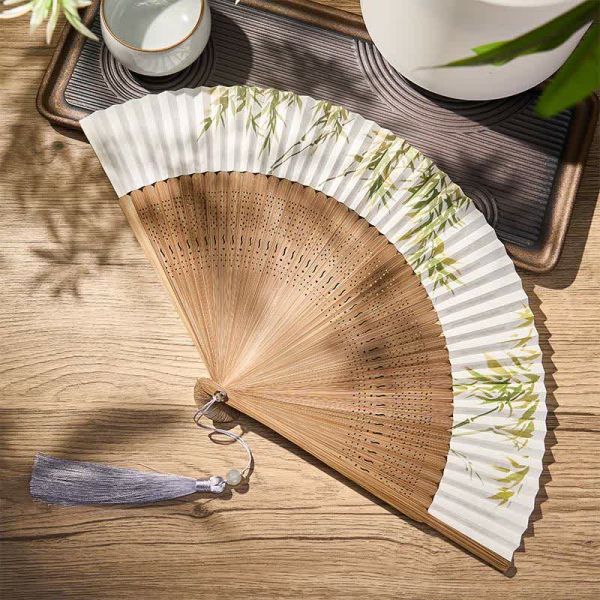
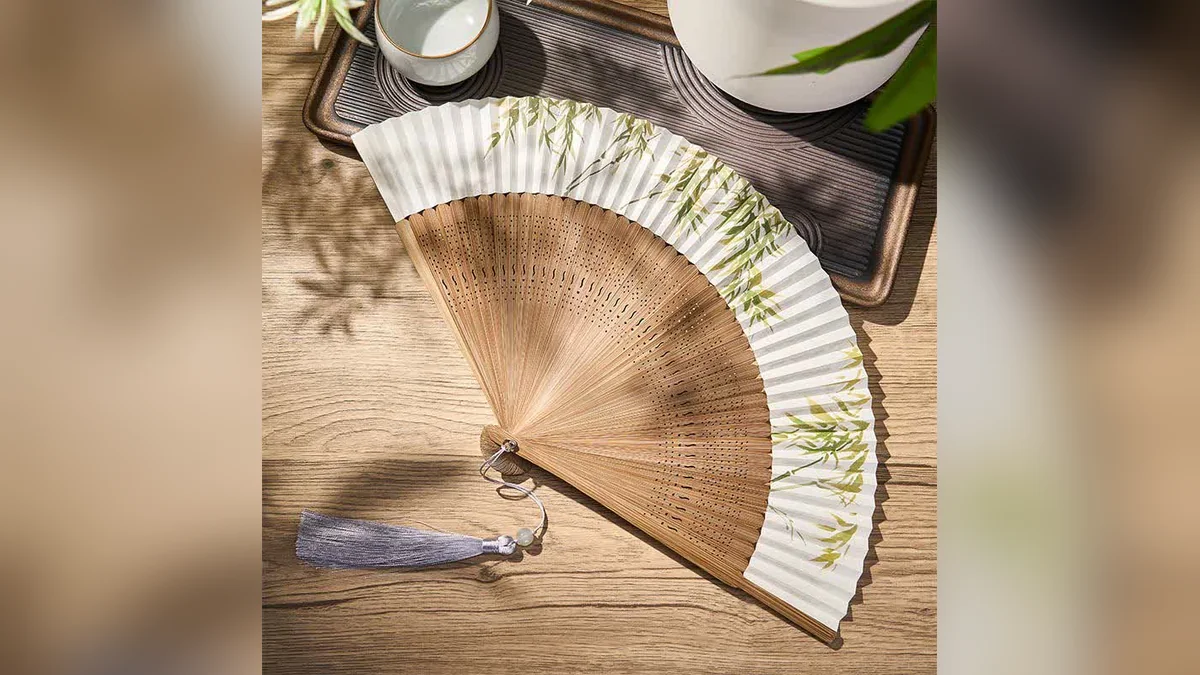
The Bamboo Grove Pattern Paper Folding Fan pairs a bamboo frame with a paper surface. It measures approximately 22.5 cm closed and 40.5 cm open. Here bamboo appears as both a material and a pictured subject. Our Chinese folding fan guide covers folding fans in more depth.
A bamboo leaf teacup
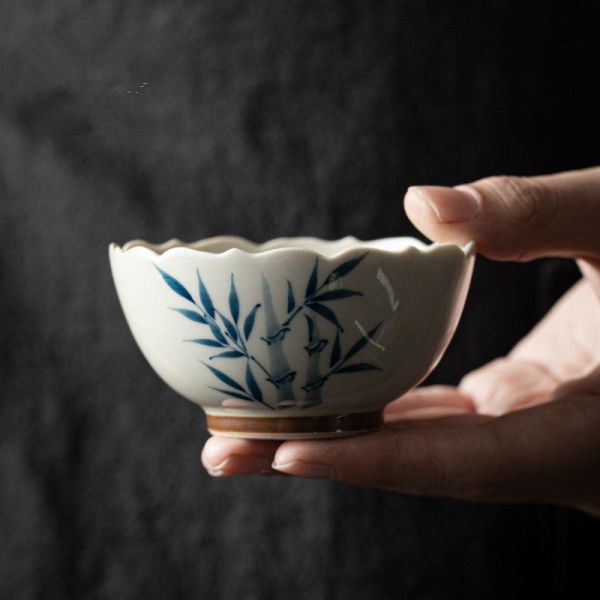
The Small Blue Bamboo Leaves Ceramic Teacup measures 7.7 × 4 cm and holds about 65 ml. The cup is ceramic, and its fired patterns vary slightly. The order is for one teacup; anything else in the pictures is staging.
A bamboo design in jade
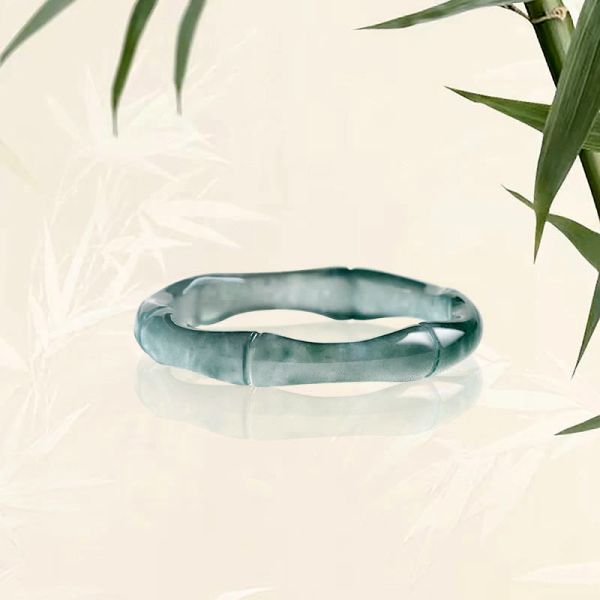
The Natural Jade Bamboo Ring has a carved bamboo design in jade. Available inner diameters are 15, 16, 17, 18, 19, and 20 mm; the width is about 3 mm and the weight about 1.5 g. Its title words “Prosperity Abundance” follow the custom of naming a hope; the ring itself promises nothing. Check the diameter against your fit using our ring measurement guide.
A printed leaf, a paper grove, or a bamboo design in jade can carry the reference in different forms. Knowing the plant and its literary associations lets you describe that reference precisely, while choosing an object for its actual material, dimensions, and use.
Shop the story
 Buddha Stones Green Bamboo Print Vintage Crossbody Bag HandbagSpecial Price $69.59 Regular Price $92.79
 Buddha Stones Small Blue Bamboo Leaves Ceramic Teacup Kung Fu Tea Cup BowlSpecial Price $28.59 Regular Price $40.27
 Buddha Stones Natural Jade Bamboo Prosperity Abundance RingAs low as $25.59 Regular Price $36.04