Chinese Folding Fan Guide: Comparing Fans by Material
A fan snaps open with a soft clatter of ribs, a rush of air crossing the wrist, then a single clean click as it folds shut again. That bit of mechanical poetry is part of why the chinese folding fan has stayed in daily use long after electric fans took over the job of cooling a room. It folds flat enough to slip into a sleeve or a handbag, opens into a full arc of painted cloth or silk, and closes back down to almost nothing.
Round fixed fans, often called tuanshan, came first in China. Made of silk stretched over a bamboo or wood frame, they turn up again and again in old paintings and poems, usually in the hands of court ladies cooling themselves in a garden or a painted hall. The folding fan is generally thought to have reached China from Japan and Korea, and it grew popular over later dynasties as scholars and artists took it up. A folding fan leaf gave a painter or calligrapher a new kind of surface, narrow and curved, meant to be held and refolded rather than hung flat on a wall. Finished fans were exchanged as gifts between friends, and they still turn up as props in Chinese opera and traditional dance, snapped open for emphasis or carried as a stand-in for a sword, a book, or a flower.
We carry four fans that cover most of what a folding or fixed fan can be made from. Below is how they compare side by side.
Comparing chinese folding fan styles by material and shape
| Fan | Leaf and frame | Size | Feel and best use | Price* |
|---|---|---|---|---|
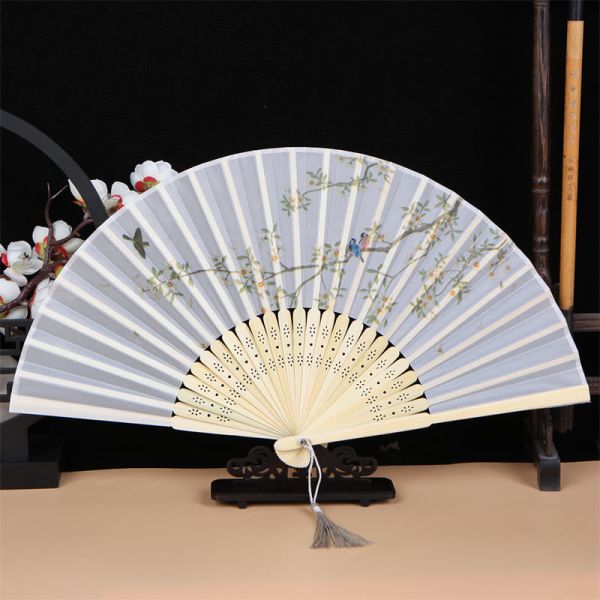
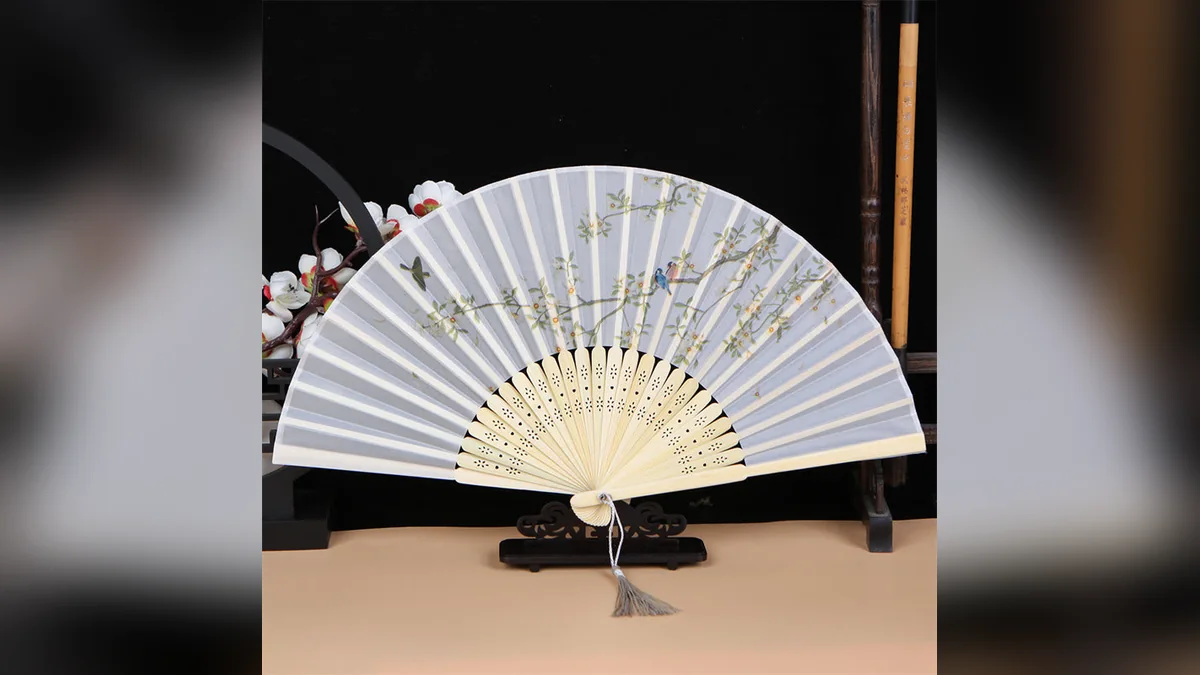
| Birds and flowers folding fan | Cloth leaf, bamboo frame | Folded 19.5–21 cm, open 36–38 cm | Light and casual, good for everyday carry; tassel color is random | $15.59 |
| Blue and white crane fan | Silk leaf, bamboo frame | Folded 22.5 cm, open 41 cm | Smoother glide and a softer sheen, suited to display or a dressier occasion | $36.59 |
| Engraved sandalwood fan | Carved green sandalwood ribs, no fabric leaf | Folded 23 cm | Meant more for holding and showing than brisk fanning; wood color varies piece to piece | $83.59 (geometric, dot, auspicious clouds) $89.59 (peacock, crane, Chang’e moon) |
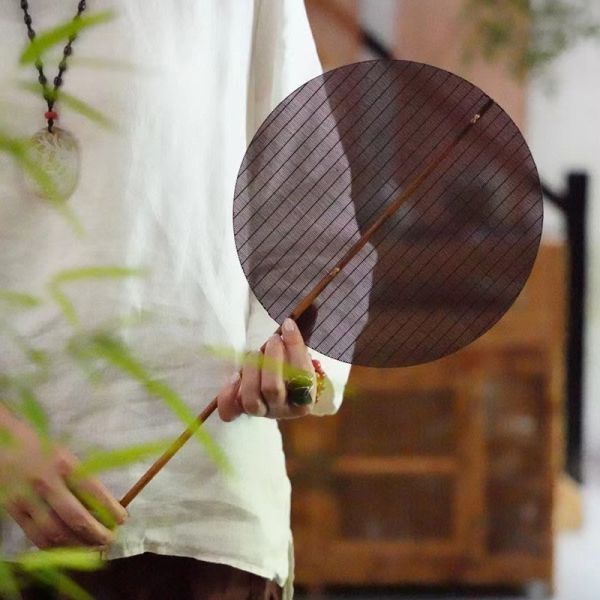
| Round bamboo long-handle fan | Bamboo, fixed round shape, does not fold | 25 x 47 cm, handle about 47 cm | Rigid and steady, stays open on its own; good for a stand, a wall, or a long, slow fanning motion | $65.59 |
*Prices listed on our site on November 1, 2026; check the product page for the current price.
Cloth leaves
Cloth is the sturdiest and most affordable leaf material we carry. It holds up to regular handling, folds and unfolds without much fuss, and shrugs off the odd damp afternoon better than silk does. The birds and flowers folding fan uses this material, and it is the one we would reach for as an everyday piece or a casual gift, rather than something kept purely for show.
Silk leaves
Silk is lighter and drapes more softly than cloth, which gives the pattern a bit of sheen and lets the fan move air with less effort. It is also the more delicate of the two fabrics, so it is worth treating with a little more care, especially around sharp fingernails or rough storage. The blue and white crane fan is the silk option here, and its pattern reads more like a small painting than a printed design.
Carved wood ribs
Some folding fans skip fabric altogether and carve the pattern straight into wood ribs instead. That is the case with our engraved sandalwood fan, where the pattern is cut into the ribs themselves; you can choose an auspicious clouds, crane, peacock, Chang’e moon, dot, or geometric engraving. There is no leaf to tear or fade, and the product page describes the fan as lightweight and easy to carry in a handbag. Since it is sandalwood, the exact color of the wood will vary from one fan to the next.
Bamboo, fixed shape
Handmade bamboo is the material behind our one fixed, non-folding piece, the round bamboo long-handle fan. Instead of ribs that spread and close, it has a flat round face set on a long handle, in black or brown. It cannot fold down small, but it also cannot snag or crease, and the long handle makes it easy to prop against a stand or hang on a wall as a piece of fan decor rather than something you carry in a bag.
Opening and closing a folding fan without stressing the ribs
Most of the damage done to a folding fan happens in the first and last second of use, right as it snaps open or shut. Hold the fan near the base, close to the rivet that pins the ribs together, rather than gripping a single rib partway along its length. Let the fan unfurl in one smooth motion instead of flicking it open as hard as possible; the ribs are meant to spread evenly, and forcing them wide in a jerk puts uneven strain on the weakest one. On a silk or sandalwood fan, it helps to guide the far edge open with your other hand the first few times, until you know how much pressure the piece actually needs.
Closing is the same idea in reverse. Gather the ribs back together slowly so the leaf folds along its original creases instead of bunching sideways. If a fan starts to feel stiff or catches partway through, stop and look at where it is binding rather than pushing it the rest of the way shut. A little resistance near the rivet is normal on a new fan and usually eases after a few uses.
Storing and displaying a folding fan
A fan that is only ever closed in a drawer loses some of the point of owning one, so it is worth giving at least one piece a place to be seen. A small stand or a wall mount will hold a fan open, which is also the gentlest state for it to rest in, since nothing is pressing on the folds. Fans you handle more often are better kept closed in a fabric sleeve or pouch, standing upright rather than lying flat under other objects, where a fold or a rib tip can get crushed.
Keep any fan, whether cloth, silk, carved wood, or bamboo, away from direct damp and strong sun. Humidity can warp a bamboo frame or loosen a cloth leaf over time, and direct sunlight will fade printed or painted color faster than ordinary daily use ever will. A cupboard shelf or a shaded wall is a better long-term home than a windowsill.
Set side by side, these four pieces show how differently a fan can be built while doing roughly the same job: a cloth leaf for daily use, silk for something softer, carved sandalwood for a piece that is more sculpture than tool, and handmade bamboo for a shape that never folds at all. Which one earns a spot on your wall or in your bag usually comes down to how often you plan to open it.
Shop the story
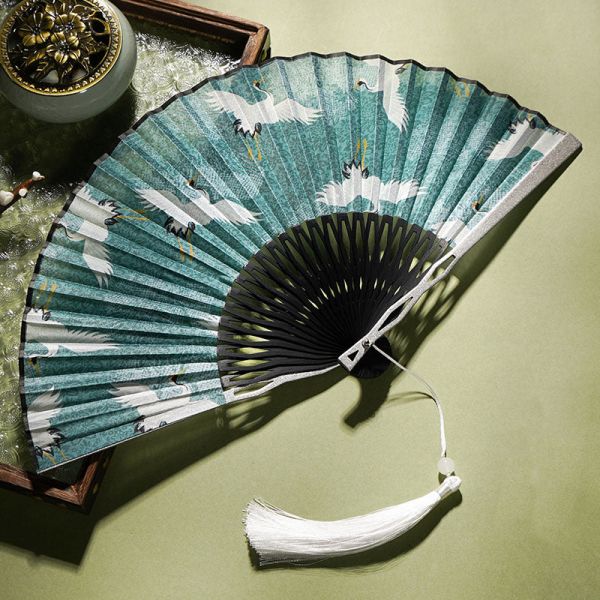 Buddha Stones Vintage Blue White Crane Pattern Handheld Silk Bamboo Folding FanSpecial Price $36.59 Regular Price $50.82
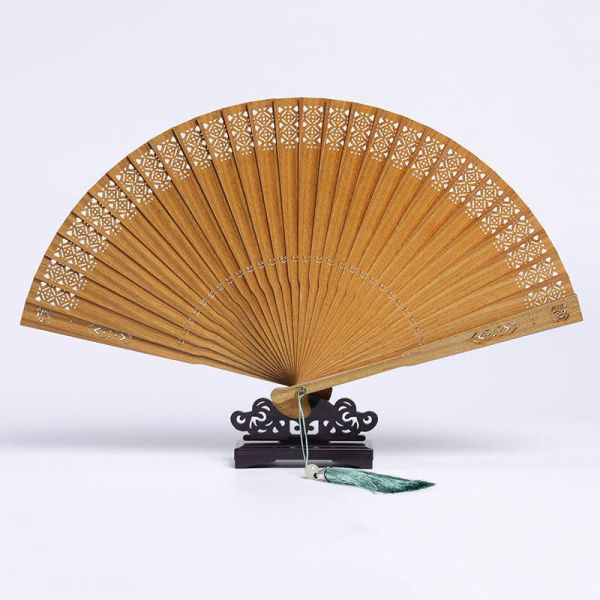 Buddha Stones Auspicious Clouds Crane Peacock Chang'e Moon Engraved Pattern Handheld Green Sandalwood Folding FanAs low as $83.59 Regular Price $111.45
 Buddha Stones Chinese Style Handmade Round Shaped Bamboo Long Handle FanAs low as $65.59 Regular Price $87.45