
What Is Amber? Its Place in Jewelry and Tradition
Amber beads range from pale yellow to deep honey brown. The answer to “what is amber” begins with fossilized tree resin, a material traditionally associated with warmth and wishes for protection and good fortune. These are cultural beliefs, and amber cannot guarantee luck, wealth, or protection. Its significance also changes with its setting: a prayer strand, a decorative object, and a bracelet paired with an auspicious motif invite different readings.
At Buddha Stones, we describe these associations as traditions. Looking at the surrounding design helps you understand a piece without assuming that every amber object carries the same message.
What Is Amber in Cultural Context?
Amber begins as tree resin that changes over a long period. Its origin connects it to trees, while its yellow and brown colors invite comparisons with honey and sunlight. Calling amber a symbol of warmth is a reading of its appearance, not a claim about what it does to someone wearing it.
Amber has been traded and used for ornament since ancient times. That long use does not establish one universal meaning. A bead might have been valued for its color, its role in dress, or its place in a religious object. The setting matters more than a single modern label.
We find it useful to separate three questions: what the material is, what shape it takes, and what a tradition associates with that shape. Amber answers the first question. A butterfly, knot, or prayer strand contributes another part of the interpretation. Treating these as separate details keeps material descriptions clear and symbolic explanations specific.
How the Setting Changes the Reading
Jewelry and personal ornament
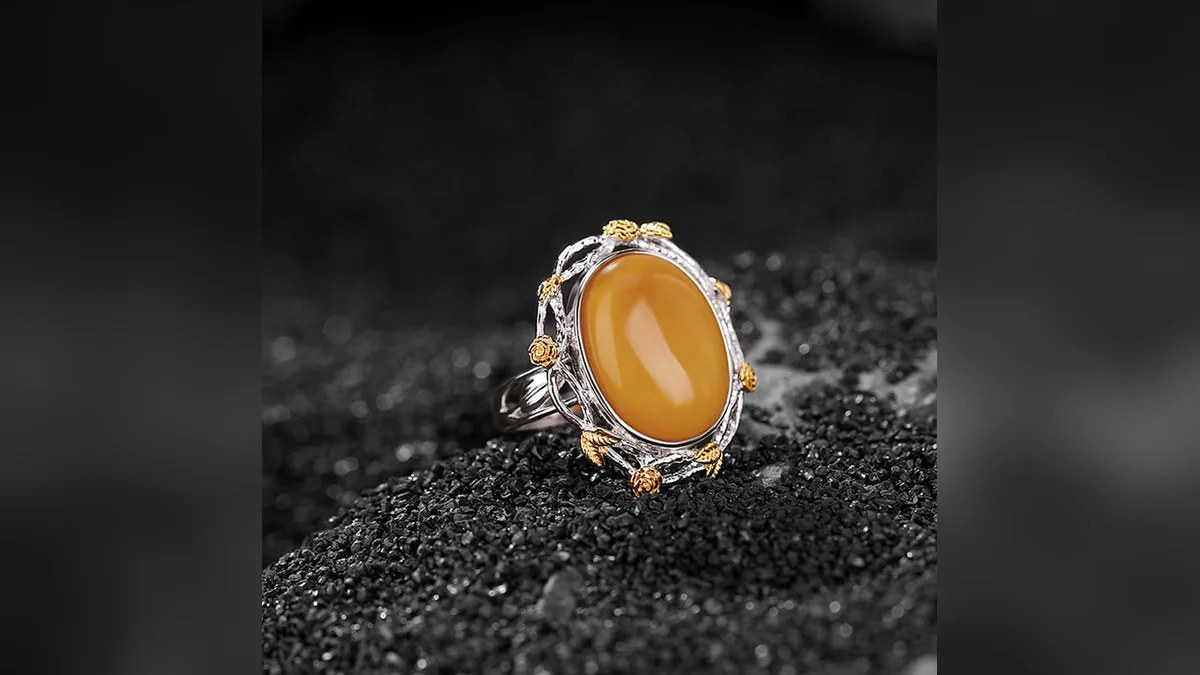
A ring presents amber as a focal detail; a necklace or bracelet can repeat its color across several beads. Neither arrangement establishes a religious meaning by itself. The surrounding motifs, the occasion, and the wearer's own intention help explain the choice.
Amber jewelry can also be given simply because someone likes its appearance. A traditional association does not need to become the recipient's belief. When describing a gift, naming its color and design before explaining an optional symbolic reading leaves room for both ways of appreciating it.
Prayer beads and Buddhist settings
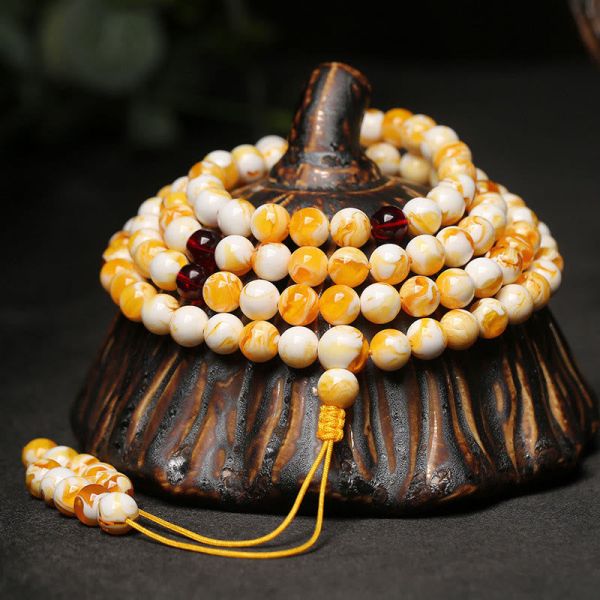
Malas are counting strands used in Buddhist practice, including the repetition of mantras. A strand's religious context comes from that practice and its form. Amber does not make every necklace a mala, and an amber-colored mala does not necessarily contain amber.
The familiar 108-bead format belongs to the structure of many Buddhist malas. It is useful to distinguish that broader convention from the count specified for a particular product. Material descriptions deserve the same attention: amber and faux amber should remain clearly identified even when their colors appear similar.
Art, textiles, and festive decoration
Amber can appear as material in decorative objects, while amber-colored tones appear in paintings and textiles. These are different uses. A golden-brown section of cloth is a color choice; it is not evidence that the textile contains amber or depicts a recognized amber emblem.
During festivals, the surrounding imagery often carries the clearer message. Red knots, flowers, or butterflies can bring their own customary associations to an arrangement. Amber alongside them becomes part of that composition. Its presence alone does not identify a festival or establish a required ceremonial use.
This distinction is especially helpful when reading photographs. A close view may show beads and cord, but it cannot establish the occasion or the beliefs of the person who owns them. Describe what is visible first, then explain any traditional interpretation as a possibility.
Pairings That Add Another Layer of Meaning
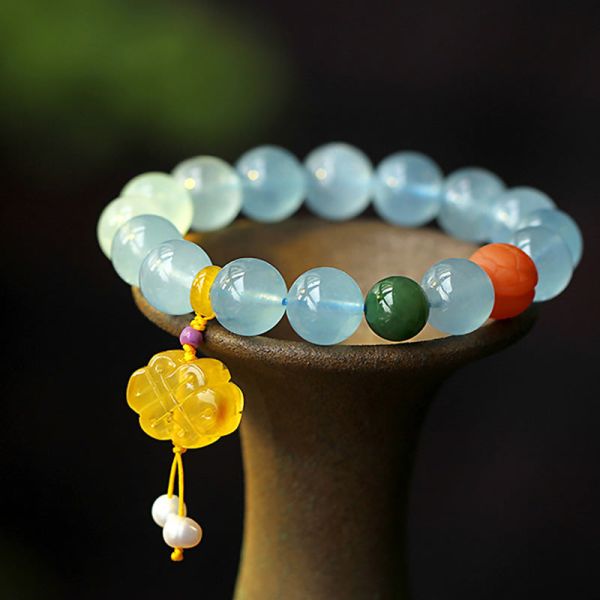
Amber and Chinese knots: Chinese decorative knotting is associated with auspicious wishes and is used in ornaments and festive displays. Beside amber, a knot contributes its own symbolic vocabulary. Wishes for good fortune belong to the tradition; the arrangement does not promise a result.
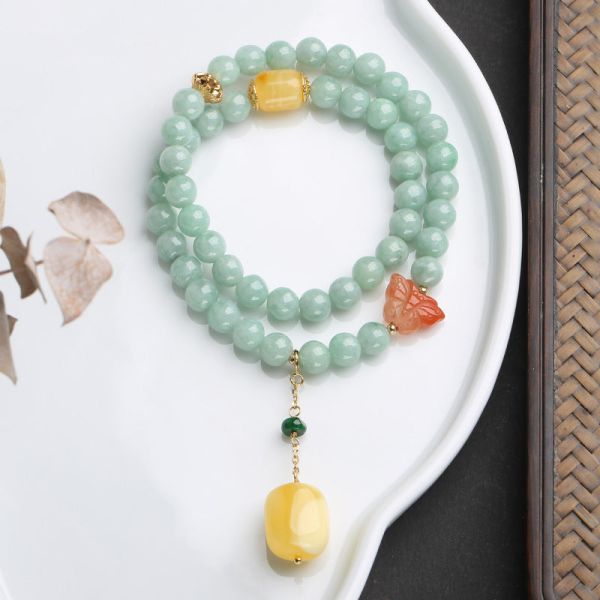
Amber and butterflies: Butterflies commonly suggest transformation, and in Chinese decorative traditions they can also carry associations with love. A design combining amber and a butterfly brings a material together with a recognizable image. The butterfly supplies the motif; amber supplies a separate material and color element.
Amber and other beads: Jade, red agate, pearl, and other materials can create contrasting colors within one piece. Their presence does not establish a fixed symbolic formula. Read any material identification separately from the meaning attached to a charm or the wish expressed in a product name.
A lotus offers another useful comparison. Its Buddhist associations come from the flower's place in religious imagery, as discussed in our article on lotus flower meaning in Buddhism. Amber's presence beside a lotus would not make the two symbols interchangeable.
Amber Pieces and Their Stated Details
Our product names and specifications provide different kinds of information. Names may include symbolic language, while specifications identify materials and dimensions. Words such as Luck, Wealth, Blessing, and Protection express traditional wishes only; they do not describe guaranteed outcomes.
An adjustable amber ring
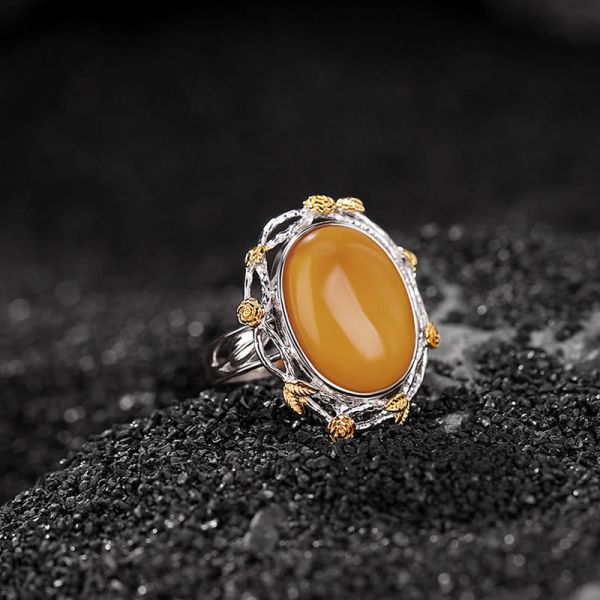
The Buddha Stones Amber Focus Adjustable Ring has an inner perimeter of 54-60mm(Adjustable), with the amber size given as 12*16mm. Its materials are 990 Sterling Silver, 990 Sterling Silver Plated Gold, and Amber. The product identifier is BS96853B212E.
A mala identified as faux amber
The Buddha Stones Tibetan White Yellow 108 Beads Amber Mala specifies Faux Amber as its material and About 108 beads. Options are 10mm, 6mm, and 8mm. The bead dimensions are Faux Amber About 0.24 in(6 mm), 0.31 in (8 mm), and 0.39 in(10 mm). It is unisex, with product identifier BSP-BS172868BF61D.
A bracelet with a Chinese knotting charm
The Buddha Stones Aquamarine Amber Chinese Knotting Charm Peace Bracelet combines Aquamarine, Amber, Red Agate, Green Jasper, and Pearl. It uses premium elastic string. Wrist circumference is 15-19cm, and bead size is 10mm. Its product identifier is BS229132C5D1.
A jade and amber butterfly bracelet
The Buddha Stones Jade Amber Butterfly Luck Abundance Bracelet uses Jade, Amber, Red Agate, and 925 Sterling Silver Plated Gold. Specifications give premium elastic string, wrist circumference of 14-16.5cm, bead size of 7mm, and weight of 34g. The care note asks you to remove it before sleeping or washing. Measurements may vary slightly because they are taken manually. Its product identifier is BS2548154147.
A Material Whose Context Matters
Amber's color offers an immediate visual connection; its setting supplies a more particular meaning. A knot, butterfly, or mala format deserves its own explanation. Keeping those details distinct allows you to appreciate traditional symbolism while recognizing the material, design, and personal preference behind a choice.
Shop the story
 Buddha Stones 990 Sterling Silver Plated Gold Amber Focus Adjustable RingSpecial Price $103.59 Regular Price $138.12
 Buddha Stones Tibetan White Yellow 108 Beads Amber MalaAs low as $25.59 Regular Price $36.04
 Buddha Stones Natural Aquamarine Amber Chinese Knotting Charm Peace BraceletSpecial Price $123.59 Regular Price $174.07
 Buddha Stones 925 Sterling Silver Natural Jade Amber Butterfly Luck Abundance BraceletSpecial Price $241.59 Regular Price $322.12