
Vajra Meaning: A Guide to Its Shape and Symbolism
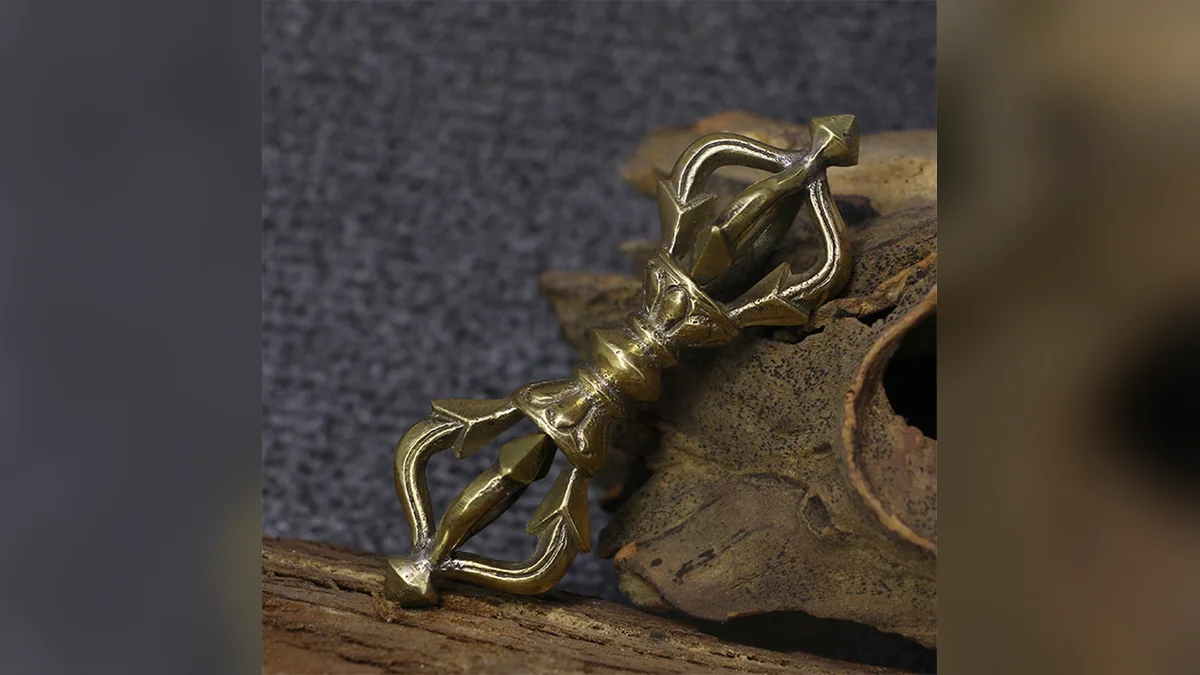
Shaped like a short metal scepter, the vajra is pinched at the waist, with curved prongs closing at each end. Understanding vajra meaning begins with its Sanskrit name, which means both thunderbolt and diamond. Dorje is the Tibetan name. In Vajrayana Buddhism, including Tibetan Buddhism, it symbolizes the indestructible, clear nature of awakened mind and skillful means. In this Buddhist context, it is a ritual implement, not a weapon.
Its repeated forms invite a closer reading: a rounded center, petals, small creature heads, and prongs that return toward a central point.
Vajra meaning: from thunderbolt to Buddhist symbol
In earlier Indian imagery, the vajra appears as the thunderbolt of Indra, a deity associated with thunder and rain. Buddhist iconography later adopted the form and gave it a place within its own teachings and rituals. That earlier association explains the thunderbolt in the name, but it does not make the Buddhist ritual object a weapon for ordinary use.
The diamond provides another metaphor: indestructibility. In Buddhist interpretation, this describes the nature of awakened mind. It is a symbolic teaching, not a statement about the durability of a particular metal object. Skillful means refers to compassionate methods of Buddhist practice, understood together with wisdom. These ideas become especially clear when the vajra appears beside a bell.
Reading a vajra from the center outward
Start at the narrow middle and follow the design toward either end. Details differ between traditions and individual designs, so this sequence is a guide to common features rather than a fixed template.
- The central sphere. The rounded center forms the meeting point of the two symmetrical halves. In traditional explanations, it is associated with emptiness: the Buddhist teaching that things do not possess a separate, fixed existence of their own. Visually, it gives the object a midpoint from which the surrounding forms extend.
- Lotus petals on each side. Moving outward, petal forms surround the central area and create a transition toward the ends. The lotus carries associations with purity and awakening in Buddhist art. Here, notice how the petals repeat on both sides, giving the vajra its balanced arrangement. Their detail and prominence vary by design.
- The makara heads. Prongs often emerge from the mouths of makaras, mythic creatures found in traditional Indian and Himalayan iconography. These small heads can be easy to miss among the curves. Look for a mouth-like form near the base of a prong, while remembering that simplified designs may show this feature less clearly.
- The prongs. A five-pronged vajra commonly has one central prong and four surrounding prongs at each end. The outer prongs curve inward toward the central one. Five-pronged forms are commonly associated with the five Buddha families and five wisdoms. Three-pronged versions are also common; the prong count identifies a variation in form, rather than a ranking of objects.
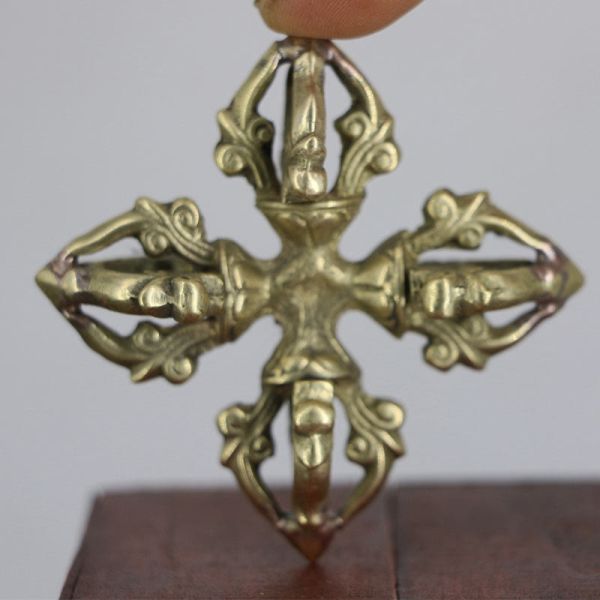
- The crossed form. The double or crossed vajra, called vishvavajra, extends the arrangement into four directions around a shared center. In Buddhist symbolism, it is an emblem of stability. Read its crossing arms as a four-direction arrangement, distinct from the two-ended silhouette of a single vajra.
Once these parts are recognizable, the overall shape becomes easier to follow. The center, petals, creature heads, and closing prongs belong to one connected design. A product title may identify a prong count, but the smaller features still deserve attention.
Why the vajra is paired with a bell
The ritual bell is called a ghanta. In a common Vajrayana arrangement, the practitioner holds the vajra in the right hand and the bell in the left. The vajra represents method or compassion; the bell represents wisdom. Their pairing expresses the importance of these qualities together in Buddhist practice.
Trained practitioners use them together within established rituals. The hand positions belong to that ceremonial context, where gestures, recitations, and instructions have specific roles. Knowing the symbolism is useful, but a short explanation does not provide ritual training.
If formal practice is your intention, seek instruction within the tradition you follow. For home display, you can acknowledge the relationship between vajra and bell without performing gestures or recitations. Display and ceremonial practice are different ways of relating to these objects.
Displaying a vajra respectfully at home
Choose a clean, raised place, such as an altar shelf, and rest the vajra on a cloth. Keep it off the floor. The surface should be stable, with enough room that the object does not sit close to an edge or become crowded by unrelated household items.
Arrange it so its form remains visible and it can be handled without knocking against nearby objects. If your display includes a bell, you may place the two near one another to acknowledge their traditional pairing. Follow your own community’s guidance if you maintain a formal Buddhist altar.
Our guide to setting up a Buddhist altar at home provides broader context for choosing and arranging that space. A modest shelf can be sufficient; respectful placement does not depend on filling it with many objects.
Vajra forms in our collection
Our listings include a double dorje, single vajra forms, and a hanging decoration. The details below distinguish their materials, dimensions, and options without assigning additional meanings to their finishes or sizes.
Nepal Handmade 5 Prong Double Dorje
The Nepal Handmade 5 Prong Double Dorje is copper, measures 6.7 × 2.4 cm, and weighs 60 g. Its double-dorje form relates to the crossed arrangement described above. When considering its placement, use the listed dimensions to plan the space it will occupy.
Handcrafted Nepal Small Five Prong Vajra Dorje
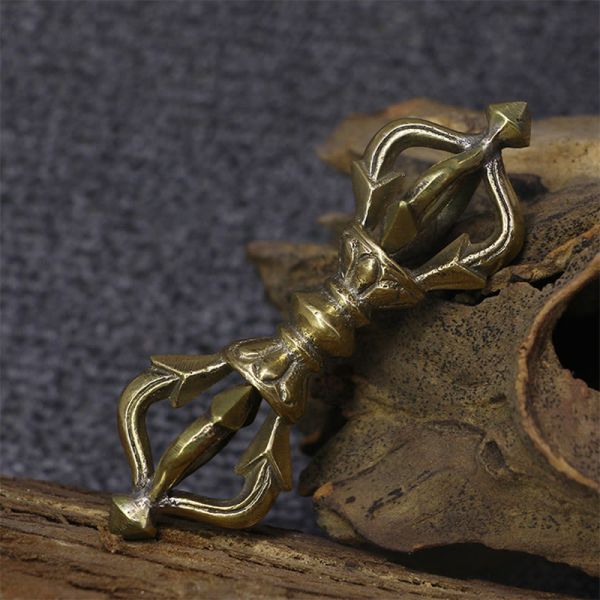
The Handcrafted Nepal Small Five Prong Vajra Dorje is copper and handmade in Nepal. Its listed dimensions are 3 × 9 cm, and its weight is 55 g. The five-pronged form connects with the traditional fivefold symbolism discussed above.
Handmade Nepal Five Prong / Three Prong Vajra Dorje
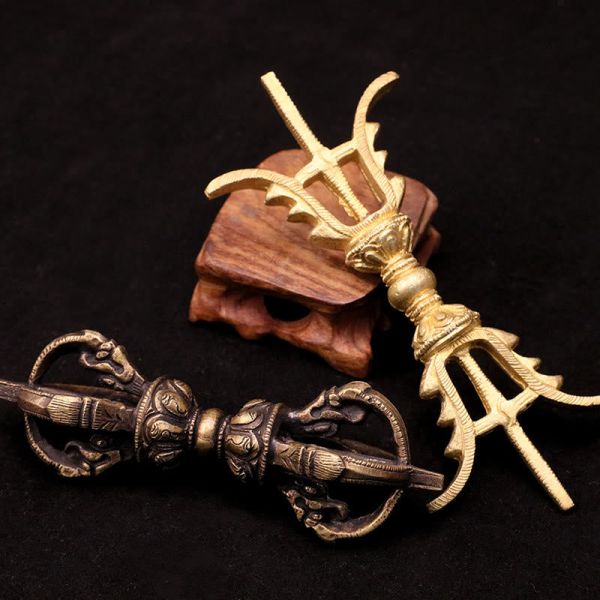
The Handmade Nepal Five Prong / Three Prong Vajra Dorje is copper and handmade in Nepal. Options are Bronze Five Prong 11 cm, Bronze Five Prong 11.5 cm, and Golden Three Prong 14 cm. The listing uses “Bronze” and “Golden” as finish names; the stated material is copper. Listed weights are 130 g and 170 g, without a specific weight assigned here to any size.
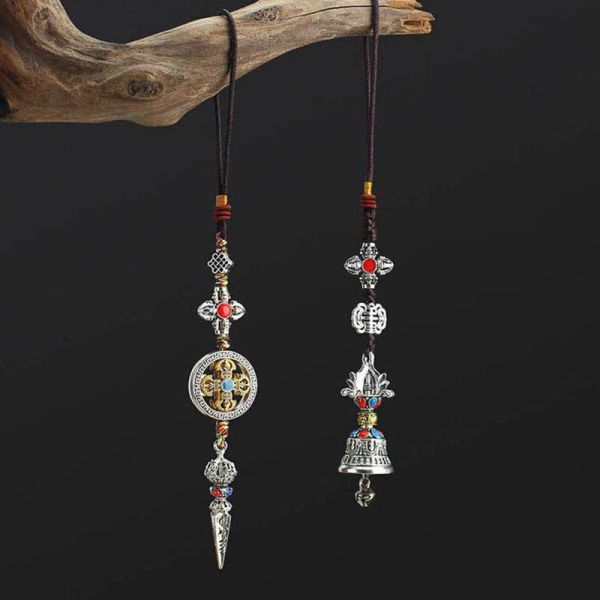
Om Mani Padme Hum Vajra Dorje car hanging
The Om Mani Padme Hum Vajra Dorje car hanging is alloy, with options named Vajra and Vajra Bell. Its listed length is 24 cm. The listing also gives sizes of 5.2 × 1.2 cm and 6.5 × 2.3 cm, without assigning those measurements here to particular options. This is a hanging decoration; its option names should not be read as instructions for ceremonial use.
The defining details remain the center, the outward progression of forms, and the prongs returning inward. Recognizing that structure gives you a specific way to read the vajra while respecting the Buddhist teachings and ritual context it represents.
Shop the story
 Nepal Handmade 5 Prong Double Dorje Copper Strength VajraSpecial Price $35.59 Regular Price $49.43
 Buddha Stones Handcrafted Nepal Small Five Prong Vajra Dorje Strength Copper DecorationSpecial Price $29.59 Regular Price $40.53
 Buddha Stones Handmade Nepal Five Prong Three Prong Vajra Dorje Strength Copper DecorationAs low as $55.59 Regular Price $77.21
 Tibet Om Mani Padme Hum Vajra Dorje Spiritual Car Hanging DecorationAs low as $25.59 Regular Price $35.54