
Panda Symbolism in Chinese Art and Everyday Design
The panda motif pairs rounded ears with dark patches around the eyes. Panda symbolism centers on peace, gentleness, and harmony in Chinese decorative tradition, particularly its modern expressions. A panda beside bamboo often combines that friendly image with a plant associated with upright character. These are cultural readings rather than fixed rules. When a panda decoration is described as lucky or auspicious, that language expresses a traditional wish; it does not guarantee good fortune, wealth, or protection.
Panda symbolism from Chinese animal to decorative motif
The giant panda is native to China, so its appearance in Chinese-themed design begins with a recognizable animal. Its rounded outline and distinctive markings make it easy to identify even when a design uses only a few shapes. A seated panda holding bamboo needs little detail to remain recognizable.
Many familiar panda designs belong to modern popular culture. It is more accurate to describe them as contemporary expressions of affection, friendliness, or harmony than to assign them an ancient ritual meaning. A modern motif can still carry cultural meaning without a founding legend or an unbroken ceremonial history.
This distinction matters when the panda appears beside Buddhist objects. A panda figure does not automatically represent a Buddha, a bodhisattva, or a Buddhist teaching. Closed eyes or crossed legs may suggest a meditation pose in a decorative design, but the pose alone does not establish religious status. We describe that connection as visual association rather than doctrine.
Reading the panda across art, textiles, jewelry, and festivals
Paintings and decorative objects
A panda pictured among bamboo places the animal in a setting associated with its food. The artist can emphasize different qualities through posture: a seated figure suggests stillness, while a climbing or reaching figure introduces playfulness. These are ways of reading the image, rather than universal symbolic definitions.
Composition matters, too. One panda can serve as a simple focal point. Several pandas may suggest companionship or family to a viewer, although the number alone does not establish a traditional blessing. Avoid assuming that a group has a special numerological meaning unless the design identifies one.
Textiles and personal accessories
Panda patterns translate readily into fabric designs because the face remains recognizable at a small scale. Repeated faces create a different effect from a single panda tucked among bamboo leaves. The first emphasizes expression and pattern; the second gives more room to the relationship between animal and plant.
In jewelry, a panda-shaped pendant or charm can express affection for the animal or an interest in Chinese culture. It does not acquire a separate Buddhist meaning merely by being worn. Read the entire design: accompanying symbols may carry their own established associations, while the panda supplies a familiar animal image.
Festival decorations and celebratory imagery
Pandas can appear in contemporary festival displays, souvenirs, and seasonal designs. Their presence does not make them a required emblem of a particular festival. A panda surrounded by lanterns belongs to a celebratory composition, but the lanterns and the animal contribute different parts of its meaning.
The panda is also not one of the twelve Chinese zodiac animals. A panda motif on a New Year accessory should therefore be understood as a decorative choice rather than an animal sign for the year.
What bamboo, contrasting colors, and knots add
Bamboo gives the pairing a cultural layer. The animal-and-plant combination has an obvious basis in the panda's diet. Bamboo also has established associations with integrity, resilience, and upright conduct in Chinese art and literature. Our discussion of bamboo's symbolic meanings considers the plant in its own right. Beside a panda, those associations can sit alongside a more playful animal motif.
Dark and light invite comparison with balance. Some viewers connect the panda's contrasting markings with yin and yang. That is an interpretive comparison, not proof that the panda is a traditional substitute for the yin-yang symbol. Color resemblance alone cannot establish a religious or philosophical meaning.
Decorative knots introduce wishes for connection. Chinese knot designs can carry auspicious associations, including togetherness and continuity. Their particular form matters. A knot beside a panda does not give the animal a new universal definition, and a tassel should not automatically be treated as a specific symbolic knot.
These distinctions let you appreciate a layered design without making every detail into a promise. The panda can remain an affectionate animal motif while bamboo or a recognizable knot contributes a more established cultural reference.
Color-changing panda tea decoration
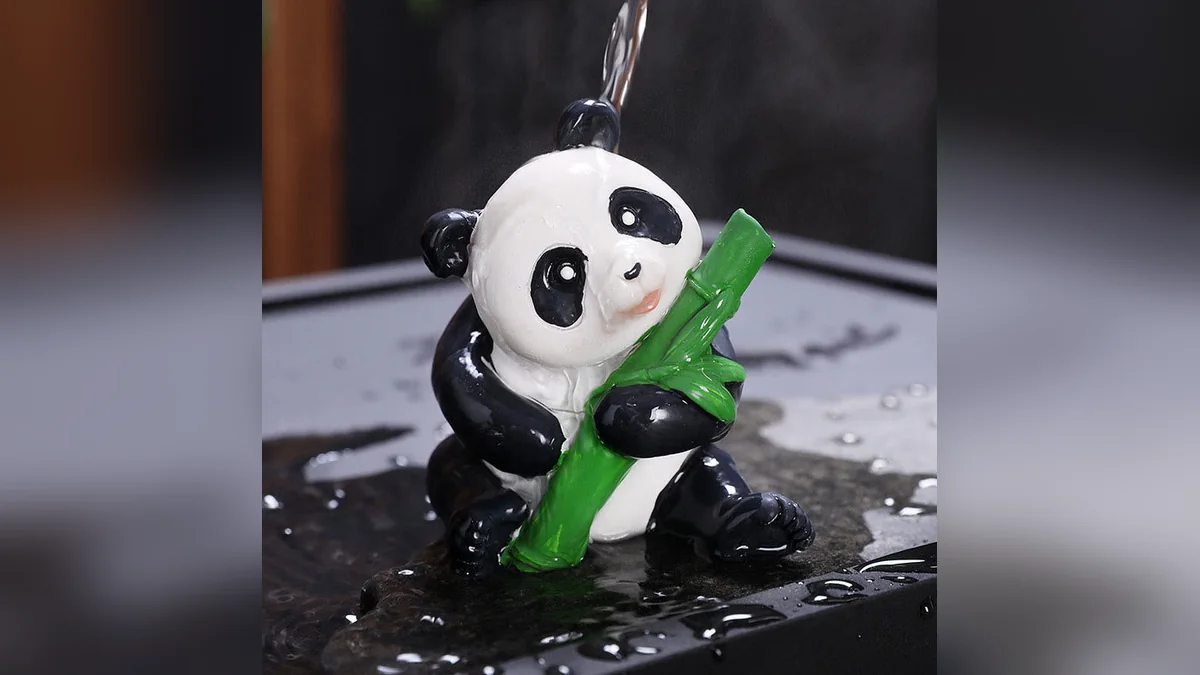
Our color-changing panda and bamboo tea pet is a resin decoration. The sizes are Panda Bamboo 6*6.5*9cm and Panda 6.5*7*8.5cm. Options include individual figures, a two-figure combination, and gift-box versions.
The panda is black when received. Its color-changing effect appears only after it is wetted with water above 45°C. The selected option determines whether the package contains a panda, a panda with bamboo, or both figures.
Panda commuter shoulder bag
The panda commuter shoulder bag measures 34*38cm, uses Pelleted Fabric, and weighs about 175g. Its strap is non-adjustable, and the package contains one bag.
Design options include 3-Grids Emoji, 4-Grids Emoji, 9-Grids Emoji, and Kiss-Kiss. Some options specify a zipper and inner pocket; others carry the wording “no zipper and inner pocket.” The general specifications describe a zipper closure, one main pocket, and one zipper pocket.
Panda bamboo crossbody bag
Our panda bamboo embroidery crossbody bag measures 19.5*16.5*5cm. Its material specifications include polyurethane, cowhide, cotton, a bamboo handle, pearl chain, metal, bead accessories, and a tassel.
The pearl chain strap length is 110cm, and the strap is non-adjustable. The bag has one main pocket, a zipper and magnetic clasp, and a weight of about 400g. The named option is White Bamboo Panda Tassel Pearl Chain.
Ceramic panda incense burner
The panda-shaped home incense burner is ceramic and measures 3.34*2.36*2.75 in (8.5*6*7 cm). Options are Panda Close Eyes, Panda Crossing Legs, Panda Open Eyes, Panda Raise Hand, and Panda Squinting.
The package contains one incense burner. A wooden base and incense are not included.
A familiar face with meaning shaped by context
A panda can stand for a wish for harmony, an affection for wildlife, or simply a favorite animal. Bamboo, posture, and accompanying ornaments help you read the design more closely. Its meaning comes from those relationships and cultural associations, not from a guaranteed result.
Shop the story
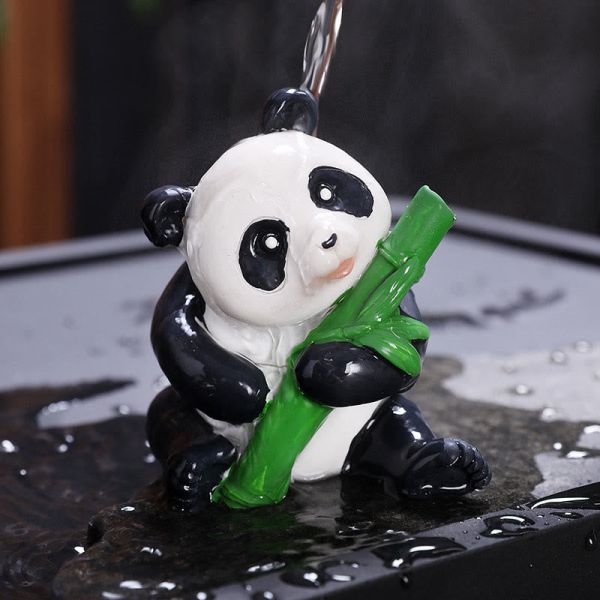 Buddha Stones Color Changing Small Cute Panda Bamboo Tea Pet Resin Home Figurine DecorationAs low as $59.59 Regular Price $79.45
 Buddha Stones Large Capacity Handmade Canvas Cute Panda Commuter Shoulder Bag Shopping BagAs low as $24.59 Regular Price $32.79
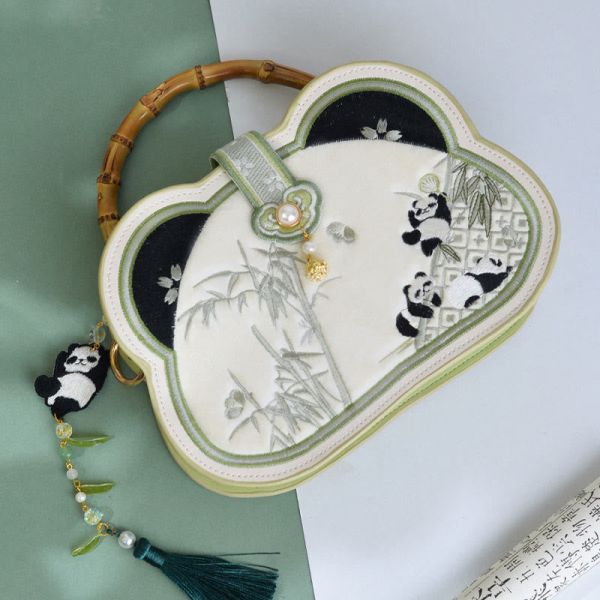 Buddha Stones Panda Bamboo Embroidery Pearl Chain Chinese Knot Tassel Crossbody Bag HandbagsAs low as $138.59 Regular Price $187.28
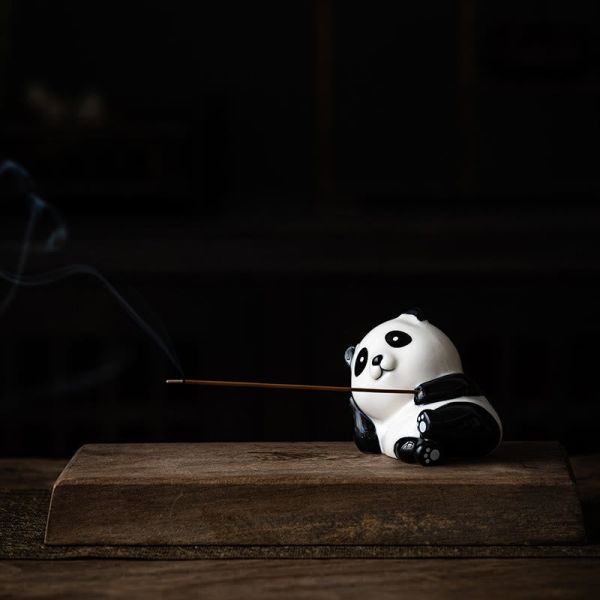 Buddha Stones Panda Shape Home Decoration Incense BurnerAs low as $47.59 Regular Price $67.03