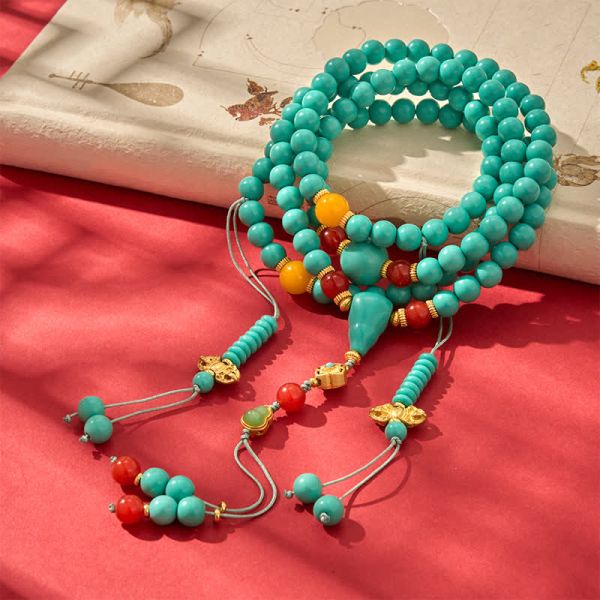
Marker Beads on a Mala: Meaning, Placement, and Use
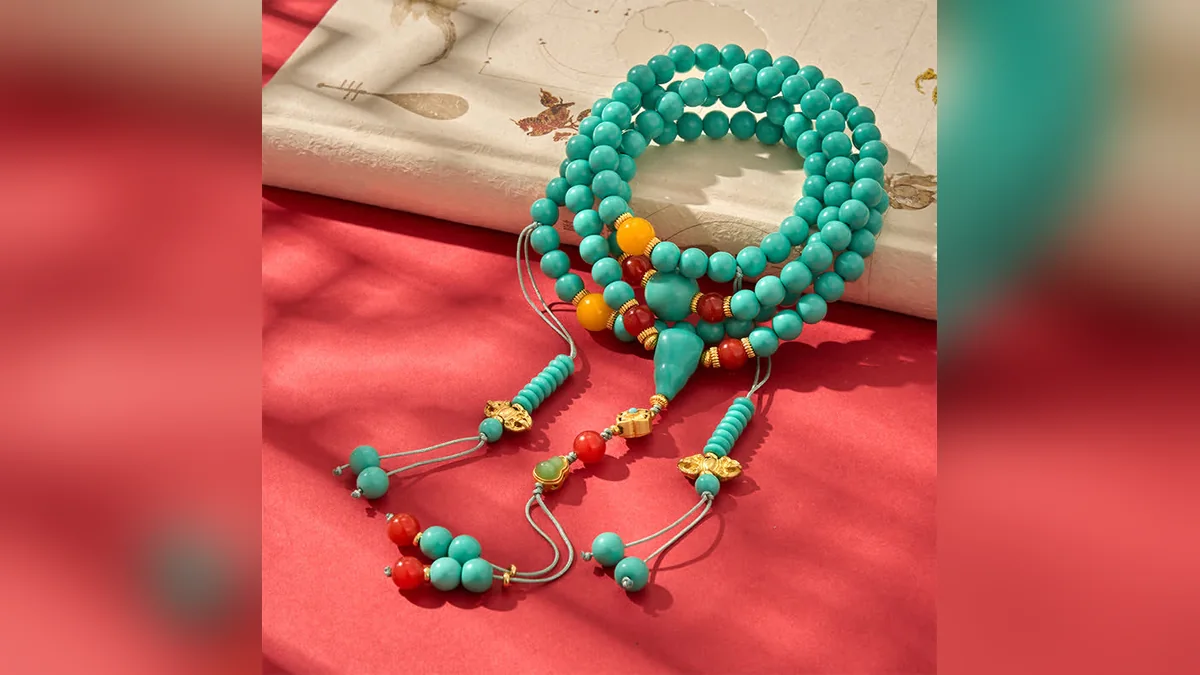
A contrasting bead can interrupt a mala’s repeating row. In Buddhist practice, marker beads on a mala traditionally mark divisions along the strand, identifying intervals in a sequence of recitations. Their meaning begins with this counting role. They are distinct from the guru bead that marks the meeting point of the strand. Associations with luck, wealth, or protection belong to belief and tradition; a bead cannot guarantee those outcomes. At Buddha Stones, we explain these details through their use and context rather than assigning every contrasting bead a fixed symbolic message.
From devotional counting to a visible pattern
The word mala comes from Sanskrit and means garland. Prayer beads are used in Buddhist and Hindu traditions, with differences in arrangement, terminology, and handling. Marker beads belong within that broader practice of counting repeated prayers or mantras. They are a practical detail of a devotional object, rather than a separate emblem with one meaning across religions.
A long Buddhist mala commonly has 108 counting beads. Some Tibetan arrangements include additional dividers that separate the strand into sections. A contrasting color, shape, or size can distinguish a divider from its neighbors. The change can be visible, tactile, or both.
This background matters when reading symbolic explanations. A marker can belong to a meaningful religious practice without representing a particular deity or promise. Its placement may tell you more about its purpose than its material does. Instructions from a teacher or community take precedence over a general description of mala construction.
Reading marker beads on a mala by position
Position is the first clue to function. A bead repeated at intervals around the main loop may divide the counting sequence. A prominent bead at the point where the strand joins may instead be the guru bead. Short strands hanging from the loop can be counters for completed rounds. These parts work at different scales: a divider marks a section, while an attached counter can record progress across rounds.
One familiar arrangement separates 108 counting beads into four groups of 27. That does not make every visually different bead a marker, or every mala a four-part design. Decorative spacers may sit between beads without defining a recitation interval.
Counting conventions also vary. Some instructions exclude additional divider beads from the tally; other arrangements handle them differently. Before treating a contrasting bead as an extra recitation, establish how the strand is organized. For a practice taught within a particular tradition, follow its counting instructions.
Appearance alone does not establish the count. A photograph may show a change in color without revealing whether the bead is part of the counted sequence. A product title containing “108” establishes neither the position nor the number of additional dividers.
The detail in art, textiles, jewelry, and festivals
Painted and stitched representations
Malas appear in Buddhist devotional art, including depictions of figures holding a strand of beads. In a painting or textile image, the strand may be recognizable even when its individual components are too small to distinguish. A visible accent should not automatically be identified as a marker with a specific meaning.
The same caution applies to a beaded pattern on cloth. Repeated circles and contrasting accents can resemble a mala, but resemblance does not establish a religious counting arrangement. Read the whole design and its subject before interpreting a small detail.
Wearable strands and public observances
Jewelry brings the contrast between repeating beads and occasional accents into everyday view. Some strands serve as both jewelry and counting objects. Others use bead combinations decoratively. Neither a change in material nor a larger bead proves that a bracelet follows a particular devotional layout.
Malas may also be carried during temple visits, communal recitation, and religious celebrations. Their presence fits the setting of prayer. Marker beads do not have a universal festival meaning independent of the strand. The relevant context is the practice being performed, rather than the calendar occasion alone.
Companions to the divider: guru beads, counters, and symbols
The guru bead is an important distinction. In Tibetan Buddhist explanations, it can represent the relationship between student and teacher. Many instructions call for reversing direction upon reaching it rather than continuing across it. This meaning belongs to the guru bead and should not be transferred automatically to an interval marker.
Attached counters serve another purpose. They can record completed rounds, while the main strand records individual recitations. A tassel or pendant may accompany these components, but its presence does not establish where a counting section begins.
A lotus motif can add a separate Buddhist reference to purity and awakening. A mantra adds words for recitation; our explanation of Om Mani Padme Hum discusses one familiar example. These elements can share a strand while retaining different roles. The symbol, the words, and the counting structure need to be understood separately.
When considering a mala for a particular practice, look for an explicit description of its layout. Materials and bracelet measurements answer different questions from the placement of dividers.
Our mala and bracelet specifications
Turquoise Tibetan 108-bead mala
Our Turquoise Tibetan Round 108 Beads Strength Mala, SKU BS223542D0D1E, uses synthetic turquoise and copper alloy with premium elastic string. Wrist circumference is approx. 6.3–7.1 in (16-18 cm). It typically wraps 2–4 times around the wrist, depending on bead size and wrist circumference. The package includes 1 × Mala. Color, details, and overall appearance may vary slightly.
Black Glitter Stone Lotus bracelet and mala
The 108 Mala Beads Multi-layer Natural Black Glitter Stone Lotus Positivity Bracelet, SKU BS10868D68788, is categorized as both bracelet and mala. Its specifications give 108 beads, an 8mm bead size, and a 14-16cm wrist circumference. Materials are Black Glitter Stone and alloy. The band uses premium elastic string, and the design is unisex.
Tiger Eye bracelet with Cyan Jade
Our Tiger Eye Malachite Cyan Jade Green Agate Courage Bracelet, SKU BS21540D731E9, combines Tiger Eye, Malachite, Cyan Jade, and Green Agate. It has 8mm beads and premium elastic string. Wrist circumference is 5.9–6.3 in (15–16 cm). Included: 1 × Bracelet. The natural materials may show slight differences in color, details, and overall appearance.
Tiger Eye, Malachite, and Green Agate bracelet
The Tiger Eye Malachite Green Agate Strength Beads Bracelet, SKU BS21541D731E9, contains Tiger Eye, Malachite, and Green Agate. Bead size is 8mm, with premium elastic string and wrist circumference of 5.9–6.3 in (15–16 cm). The package contains 1 × Bracelet. Slight variations in color, details, and overall appearance are noted for its natural materials.
A small distinction worth recognizing
A marker bead gives structure to repetition. Recognizing its place beside the guru bead, counters, and decorative elements makes a mala easier to read as a devotional object. The useful question is what that bead does within its particular strand. Its meaning rests in that relationship and in the tradition of practice surrounding it.
Shop the story
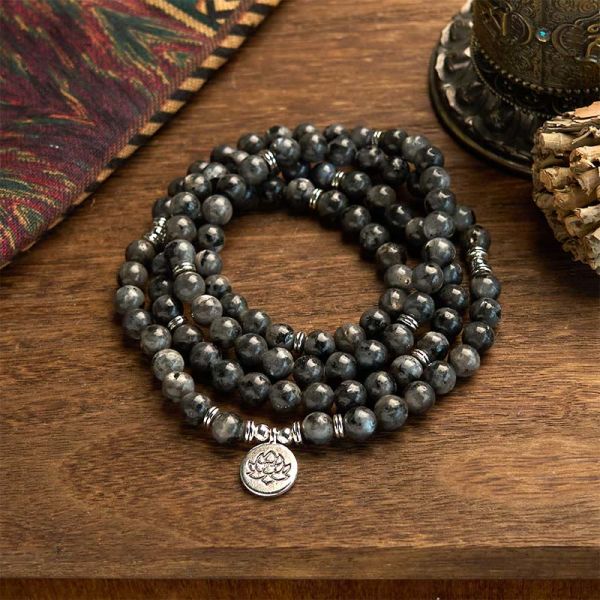 Buddha Stones 108 Mala Beads Multi-layer Natural Black Glitter Stone Lotus Positivity BraceletSpecial Price $25.59 Regular Price $35.54
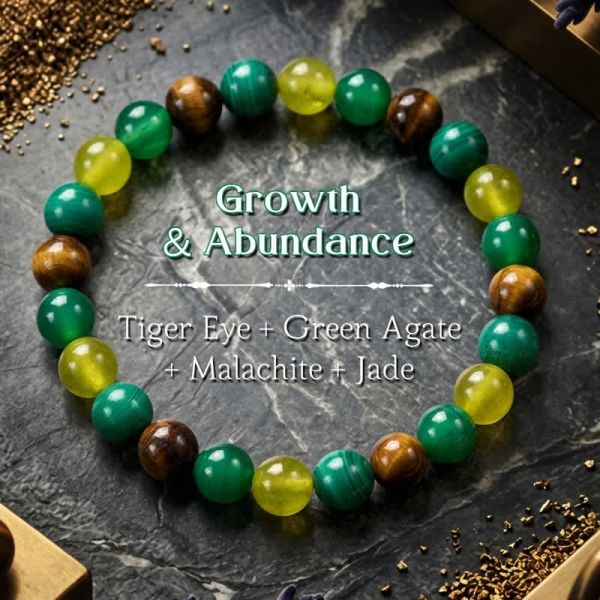 Buddha Stones Tiger Eye Malachite Cyan Jade Green Agate Courage BraceletSpecial Price $25.59 Regular Price $35.54
 Buddha Stones Tiger Eye Malachite Green Agate Strength Beads BraceletSpecial Price $25.59 Regular Price $35.54