
Hematite Meaning: Mineral Facts and Bracelet Guide
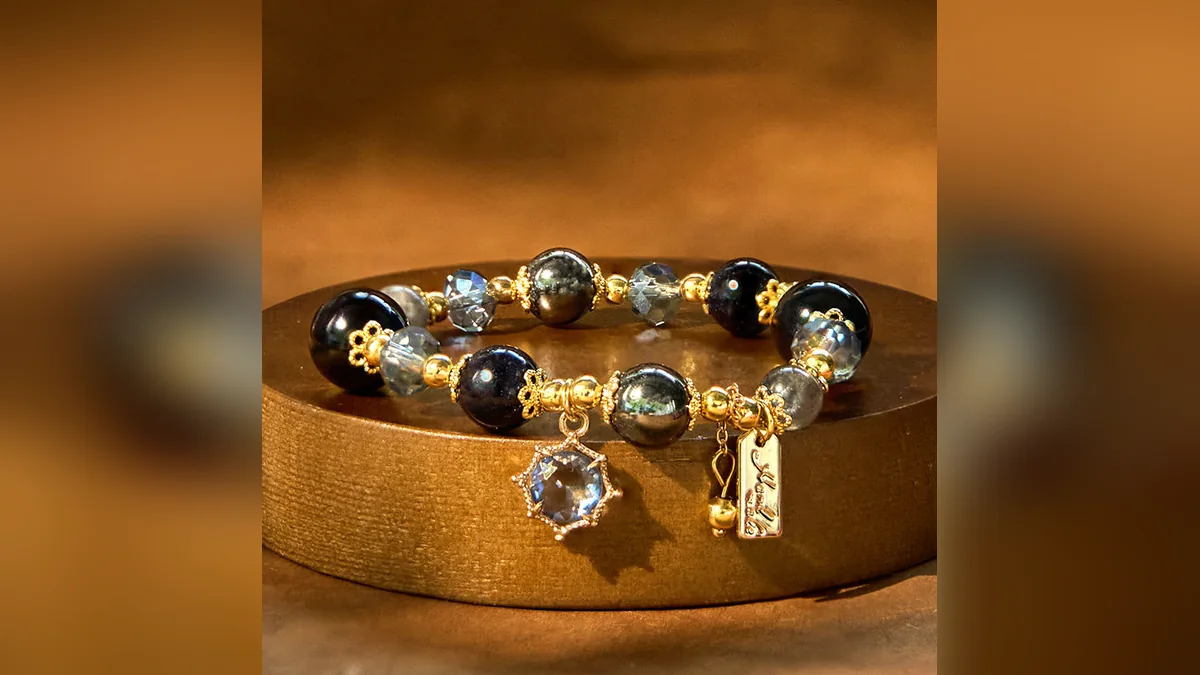
Hematite looks like dark metal when polished. The mineral is an iron oxide (Fe2O3) and a major iron ore. Its name comes from the Greek word for blood because its powder and streak are red-brown. In modern bead culture, hematite meaning centers on steadiness and strength; these associations are beliefs, not proven effects.
- Chemical composition: Iron oxide, Fe2O3.
- Mohs hardness: 5.5-6.5.
- Luster: Metallic in polished and crystalline forms; dull or earthy in some other forms.
- Streak color: Red-brown.
- Main industrial use: A major ore used to produce iron for steelmaking.
Where hematite gets its name
The connection with blood makes more sense when you consider the mineral's powder than when you look at a dark, reflective bead. The Greek word haima means blood. Hematite can have a gray, black, or reddish appearance, but its red-brown streak is a useful identifying characteristic.
A mineral's streak is the color of the powder it leaves when rubbed across an unglazed porcelain surface. That color can differ considerably from its outer appearance. This explains how a mineral that resembles metal in jewelry came to have a name associated with red.
Hematite also connects jewelry with a much older use of mineral color. Red ochre pigments, colored by hematite, were used in prehistoric art. Those pigments and a polished bead present very different surfaces, yet the same iron oxide helps explain both. The red pigment also shows why surface color alone tells only part of the mineral's story.
Natural hematite versus magnetic “hematite” beads
Natural hematite is at most weakly magnetic. Beads that cling strongly to a magnet, or pull firmly toward one another, are usually made from man-made material sold under the hematite name. A dark metallic appearance alone does not establish what a bead contains.
The distinction matters because a mineral name and a jewelry trade label do not always describe the same thing. A strongly magnetic bead should not be presented as proof of natural hematite. Equally, the absence of strong magnetism is not enough by itself to identify a material.
When reading a description, separate three questions: what material is named, whether magnetic behavior is mentioned, and what information supports the identification. If the wording is unclear, ask about composition before treating the trade name as a mineral identification. A precise material listing tells you more than assuming that a metallic finish identifies the mineral.
Hematite meaning in modern bead traditions
Modern bead traditions often associate hematite with steadiness and strength. These are symbolic interpretations rather than established properties of wearing the mineral. Someone might choose hematite to represent perseverance, resolve, or a commitment they value, just as a design or inscription can stand for a personal principle.
Those meanings are not a single universal teaching. They can vary between sellers, communities, and individual wearers. Nor should a modern jewelry association automatically be described as an ancient Buddhist practice. The mineral's physical characteristics are distinct from the beliefs attached to it.
The difference is straightforward: iron oxide composition describes the material; strength describes an idea people may associate with it. Neither a bead's shine nor its mineral identity guarantees an outcome. The symbolism can be enjoyed as symbolism, with no expectation that the bracelet acts for you, and you can choose the material simply because you like its appearance.
How hematite pairs with other stones
Hematite's metallic-looking surface gives bead combinations a clear visual contrast. Black obsidian offers another dark surface, while tiger eye introduces banding and warmer or cooler color choices. The proportions matter too: a small accent and a larger bead can give the same materials very different roles in a design.
For the traditions associated with those companion materials, our posts on tiger eye bracelet meaning and black obsidian bracelet meaning discuss their symbolism separately. Combining materials does not establish an additional effect or make a traditional wish a certainty.
Blue sandstone needs a different kind of clarification. The name is usually a trade term for blue goldstone, a man-made glass with sparkling metallic inclusions. It should not be assumed to be a geological sandstone. A bracelet can combine mineral beads and manufactured glass; the useful question is what its material description actually says.
Hematite bracelets to compare
Our bracelets below combine hematite with different companion materials. “Strength” and “Protection” in their names express traditional wishes only. Neither term guarantees personal safety or success.
Black obsidian, hematite, and blue sandstone
The Natural Black Obsidian Hematite Blue Sandstone Bracelet is a women's bracelet strung on premium elastic for 15-16 cm wrists. Its black obsidian beads measure 12 mm; that measurement applies specifically to the black obsidian beads.
The materials are black obsidian, hematite, blue sandstone, and copper plated with 18k gold. Blue sandstone is the trade name discussed above, so it should be read with that distinction in mind.
Black obsidian, tiger eye, and hematite
The Black Obsidian Tiger Eye Hematite Faceted Bracelet combines hematite, black obsidian, and tiger eye. It has 8 mm beads and premium elastic string. It is sized for wrists of 15 to 16 cm. This combination includes both black obsidian and tiger eye alongside hematite.
Tiger eye and hematite options
The Tiger Eye Hematite Faceted Bracelet has 8 mm beads, premium elastic string, and fits a 15–16 cm wrist. There are three options: yellow tiger eye, blue tiger eye, and a black option labeled black onyx.
The materials specification includes black agate, while the black option uses the name black onyx. We preserve that naming difference here rather than treating the two labels as interchangeable. The materials also include tiger eye, hematite, and blue tiger eye; the selection depends on the option.
Tiger eye, lava rock, and hematite
The Tiger Eye Lava Rock Hematite Beads Bracelet uses tiger eye, lava rock, hematite, and copper, with 8 mm beads strung on premium elastic string. It fits a 16–17 cm wrist, a different size specification from the bracelets above.
How to care for hematite jewelry
Hematite is fairly brittle and can chip or crack if dropped. Its Mohs rating does not tell you how well a bead will withstand an impact. Treat the beads, string, and any metal components as parts of the same piece when deciding how to handle it.
- Wipe hematite with a soft dry cloth.
- Remove a bracelet before washing or activities that could knock it against a hard surface.
- Place it in a padded compartment or pouch so the beads do not strike other jewelry.
- Ease a stretch bracelet on by rolling it, rather than yanking the cord wide.
A little care preserves the surface that makes hematite distinctive: a mineral finish that can look remarkably like dark metal.
Shop the story
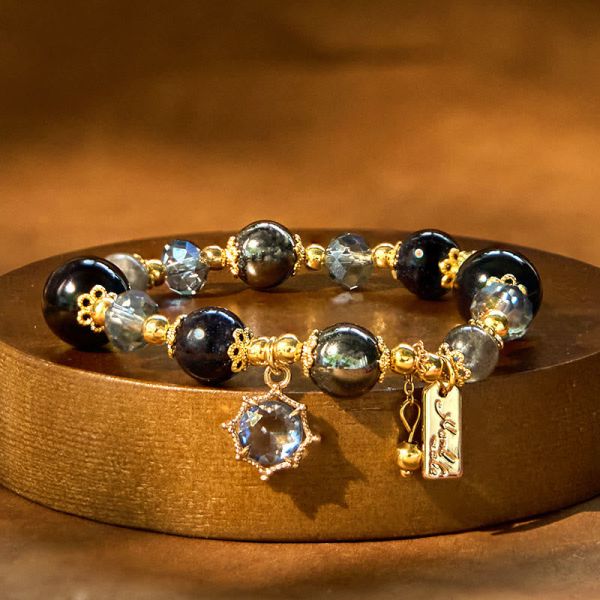 Buddha Stones Natural Black Obsidian Hematite Blue Sandstone Strength BraceletSpecial Price $27.59 Regular Price $38.86
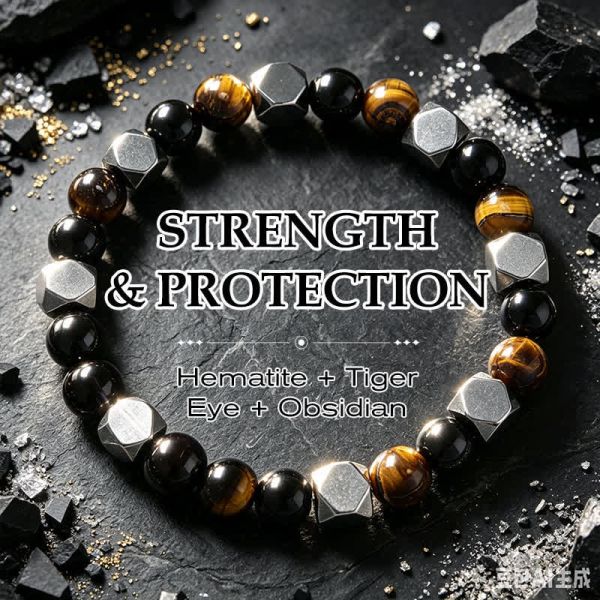 Buddha Stones Black Obsidian Tiger Eye Hematite Faceted Protection BraceletSpecial Price $25.59 Regular Price $35.54
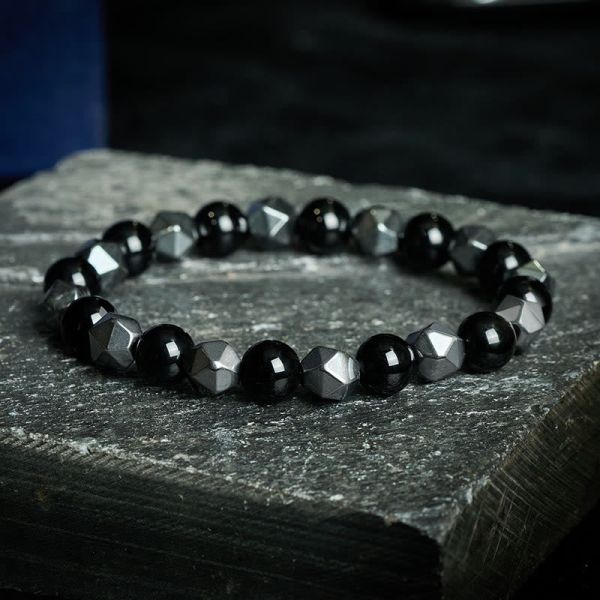 Buddha Stones Tiger Eye Hematite Faceted Strength BraceletAs low as $25.59 Regular Price $34.12
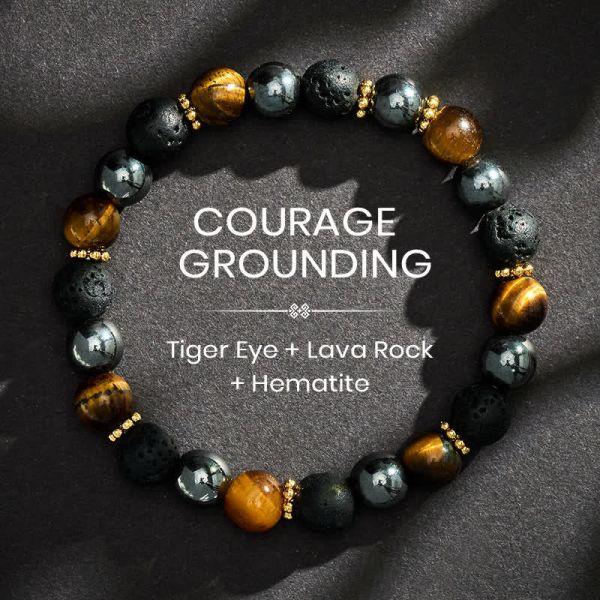 Buddha Stones Tiger Eye Lava Rock Hematite Beads Strength BraceletSpecial Price $25.59 Regular Price $35.05