
Bodhi Symbolism in Buddhist Art, Leaves, and Beads
A bodhi leaf has a heart-shaped outline and a long, tapering tip. In Buddhist tradition, bodhi symbolism centers on awakening: the leaf and tree recall the Buddha’s realization beneath the Bodhi Tree. They also represent wisdom and the possibility of awakening through Buddhist practice. Associations with luck, wealth, or protection belong to beliefs and traditional wishes; none is guaranteed. At Buddha Stones, we read the motif through its setting, because a leaf above a seated Buddha carries a different emphasis from a bodhi seed strand.
Bodhi symbolism begins beneath a tree
The Sanskrit word bodhi means awakening. Buddhist tradition places the Buddha’s awakening beneath a sacred fig tree at Bodh Gaya, in present-day India. The tree therefore marks a particular event in the Buddha’s life, giving its branches and leaves a meaning beyond growth or greenery.
The tree is part of the setting of awakening, rather than its cause. A depiction of its canopy can recall the Buddha’s resolve and the teaching associated with that event. This distinction matters when a sacred image becomes a decorative motif: owning its outline is not the same as attaining what it represents.
The complete tree, a single leaf, and a representation of the place beneath its branches can all refer to the same story. The leaf’s pointed shape makes a small version recognizable even when the rest of the scene is absent.
How the setting changes what you see
A canopy or empty seat in Buddhist art
In some early Buddhist art, an empty seat beneath the Bodhi Tree refers to the Buddha and his awakening without showing him in human form. The surrounding scene supplies the meaning: a tree, a seat, and figures paying respect belong together.
Other images show the Buddha seated beneath spreading branches. Here, the canopy identifies the event rather than serving only as background scenery. If you encounter an isolated leaf in a painting or decorative panel, look for nearby Buddhist imagery before assigning it the same meaning. A heart-shaped leaf alone is not enough to establish a religious reference.
A repeated leaf on textiles
On a hanging, printed cloth, or embroidered textile, a bodhi leaf can become a repeating pattern. Repetition changes the composition: instead of presenting one narrative scene, the design carries a reference across the fabric’s surface.
A cloth used in a Buddhist setting has context that a similar household pattern may lack. Consider the design’s description and intended use alongside its outline. Color alone does not establish the motif’s meaning, and there is no single color code that you need to apply to every bodhi design.
A motif or material in jewelry
Jewelry can refer to bodhi through a leaf design, through beads described as bodhi seed, or through a combination of Buddhist symbols. These forms deserve separate attention. A leaf is an image of the tree; a bead strand belongs to the context of counting and devotional practice.
A product’s bodhi name should not be treated as botanical identification. Read the supplied material description, and distinguish a symbolic connection from a claim about a seed’s source. The religious association does not establish that beads came from the tree at Bodh Gaya.
A living tree during observances
A living bodhi tree can also be a place of reverence within temple grounds. Offerings and gatherings give the tree a role that a printed leaf cannot fully convey: it becomes part of a shared religious setting.
Vesak commemorates the Buddha’s birth, awakening, and passing in many Buddhist communities. Bodhi imagery can recall the awakening within these observances, although customs differ by community. It is more accurate to describe the local practice than to assume that every Buddhist festival uses the motif in the same way.
Reading bodhi beside other Buddhist symbols
Bodhi and lotus: the tree points to the setting of awakening, while the lotus traditionally represents purity and awakening through the image of a flower rising above muddy water. Together, they bring two familiar Buddhist references into one design. Our explanation of the lotus flower’s meaning in Buddhism considers the flower separately.
Bodhi and the seated Buddha: a leaf or canopy can locate the figure within the awakening story. The posture, seat, and surrounding details help distinguish a narrative scene from a more general devotional image.
Bodhi and a mala: beads connect the reference to a form used for counting recitations. The familiar count of 108 has several traditional interpretations, so it should not be reduced to one universal explanation. A strand’s appearance also does not tell you which recitation, if any, its owner follows.
Read a pairing as a relationship between symbols. Two motifs beside one another do not create a stronger promise of luck or another result.
Bodhi seed pieces from our product pages
Our product pages identify the following materials and sizes. In the mala’s name, “Wealth” expresses a traditional wish; it does not promise a financial result.
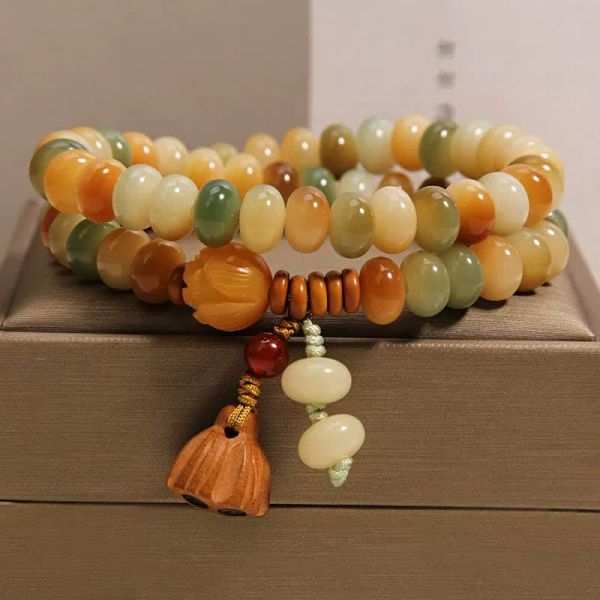
Lotus Purity double wrap
Our Buddha Stones White Bodhi Seed Lotus Purity Double Wrap Bracelet uses Bodhi Seed and Premium Elastic String. Bead size: Approx. 6mm. Wrist circumference: 5.5-5.9 in / 14-15cm. Grain and color may vary, and a natural patina may develop with wear. Avoid water exposure.
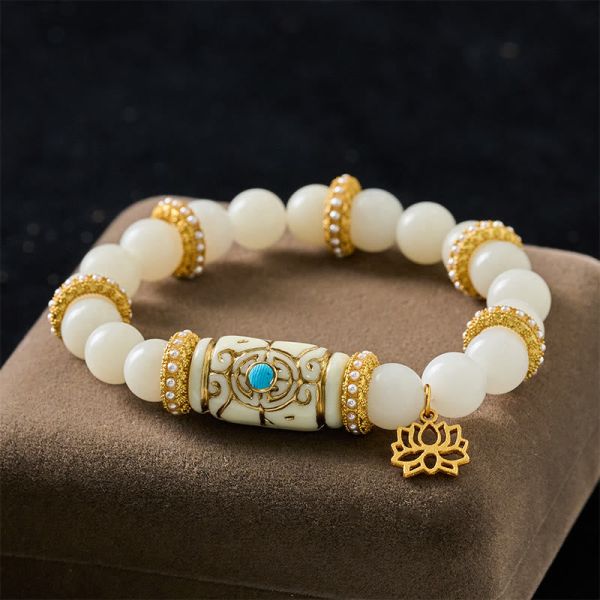
Resin barrel bead and lotus pendant
The Buddha Stones White Bodhi Seed Resin Barrel Bead Lotus Pendant Round Meditation Bracelet uses White Bodhi Seed, Resin, and Copper Alloy, with Premium Elastic String. Bead size: Approx. 10mm. Wrist circumference: 6.3–6.7 in (16–17 cm). Slight variations in color, details, and overall appearance may occur.
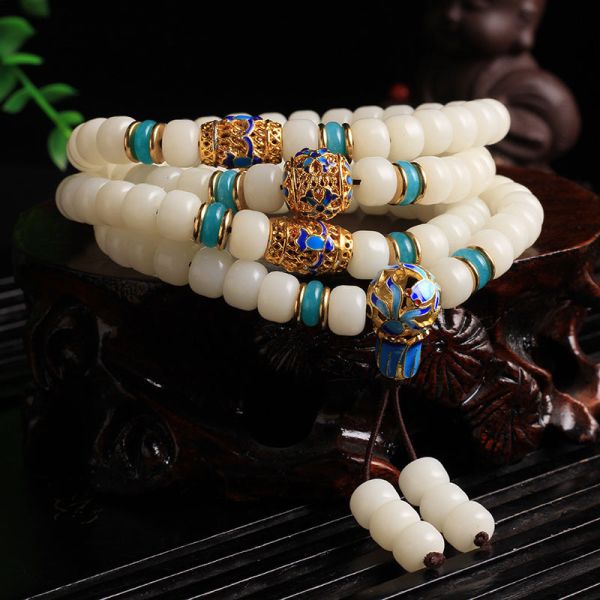
White bodhi seed mala
The Buddha Stones Natural White Bodhi Seed Mala 108 Beads Wealth Bracelet is described as both a bracelet and necklace. The material is Bodhi Seed, and the design is unisex. Bead size options are 6*8mm, 7*9mm, and 8*10mm.
Tiger eye and bodhi seed
Our Buddha Stones Handmade Tibetan Tiger Eye Bodhi Seed Peace Bracelet combines Bodhi Seed and Tiger Eye. This unisex bracelet has 108 beads, with bead size options of 6*8mm, 7*9mm, and 8*10mm.
Keeping the awakening story in view
The bodhi motif is easiest to understand when its setting remains visible. Look at what surrounds the leaf, how a tree appears in a scene, or how beads are described. The connection to awakening gives these different forms their shared reference while leaving room for local traditions and individual uses.
Shop the story
 Buddha Stones White Bodhi Seed Lotus Purity Double Wrap BraceletAs low as $25.59 Regular Price $34.12
 Buddha Stones White Bodhi Seed Resin Barrel Bead Lotus Pendant Round Meditation BraceletSpecial Price $27.59 Regular Price $38.86
 Buddha Stones Natural White Bodhi Seed Mala 108 Beads Wealth BraceletAs low as $38.59 Regular Price $52.86
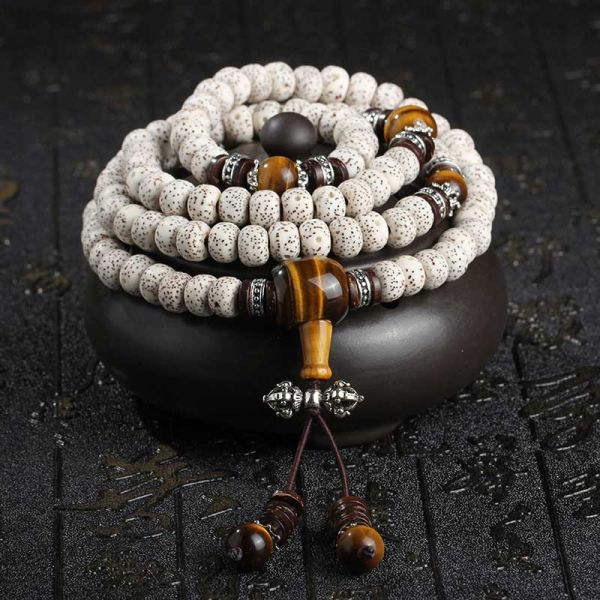 Buddha Stones Handmade Tibetan Tiger Eye Bodhi Seed Peace BraceletAs low as $52.59 Regular Price $72.04