Bagua Meaning: Eight Trigrams, Symbols, and Decor
Bagua is a set of eight three-line figures. The term bagua (八卦) means “eight trigrams.” To understand bagua meaning, start with its lines: solid represents yang, and broken represents yin. Each trigram stacks three lines; paired, they form the 64 hexagrams of the I Ching, also called the Yijing.
Decorative designs often arrange the eight trigrams around a yin yang symbol. The lines and their arrangement carry different information, so recognizing both helps you read the design. Although bagua motifs sometimes appear beside Buddhist objects, their foundation is Chinese cosmology and the Yijing tradition.
Bagua Meaning: Reading Lines and Trigrams
A solid line runs continuously across the figure. A broken line has a gap in the middle; its two parts count as one line. Read a trigram from the bottom upward. This direction matters because the same kinds of lines in a different order form a different trigram.
Zhen, for example, has a solid bottom line followed by two broken lines. Gen reverses that pattern: two broken lines sit below a solid top line. Both contain one solid line and two broken lines, but they have different names and images in nature.
Three positions, with two possible line types in each position, produce eight combinations. Stacking one trigram above another produces a six-line hexagram. The lower and upper trigrams remain recognizable within that larger figure. The I Ching uses these hexagrams in a tradition of interpretation and divination; a decorative trigram ring does not itself present a complete hexagram reading.
The Eight Trigrams at a Glance
The table gives the common English renderings of the trigrams’ images in nature. Keep the reading direction in mind: the first word in the last column describes the bottom line, not the top.
| Trigram name | Chinese | Image in nature | Lines from bottom to top |
|---|---|---|---|
| Qian | 乾 | heaven | solid-solid-solid |
| Kun | 坤 | earth | broken-broken-broken |
| Zhen | 震 | thunder | solid-broken-broken |
| Kan | 坎 | water | broken-solid-broken |
| Gen | 艮 | mountain | broken-broken-solid |
| Xun | 巽 | wind | broken-solid-solid |
| Li | 离 | fire | solid-broken-solid |
| Dui | 兑 | lake | solid-solid-broken |
These names identify the figures wherever they appear. A trigram does not become a different trigram simply because its position around a central symbol changes.
Earlier Heaven and Later Heaven Arrangements
Two familiar arrangements place these same eight figures in different sequences. They are commonly called Earlier Heaven and Later Heaven. These names identify traditional patterns, rather than an older and newer version of a particular ornament.
Earlier Heaven: attributed to Fuxi
Tradition attributes the Earlier Heaven arrangement to Fuxi, a legendary culture figure. It emphasizes complementary pairs: heaven faces earth, water faces fire, thunder faces wind, and mountain faces lake. In each pair, solid and broken lines exchange places at corresponding levels. This makes the arrangement useful for recognizing relationships between the line patterns.
Later Heaven: attributed to King Wen of Zhou
The Later Heaven arrangement is traditionally attributed to King Wen of Zhou. It organizes the trigrams through a sequence associated with directions, seasons, and cycles of change. This arrangement is widely used in feng shui. The attributions belong to traditional accounts; they should not be read as verified claims that either figure designed a particular surviving diagram.
Traditional Chinese diagrams often put south at the top, unlike many modern maps. Before comparing two diagrams, check their direction labels and orientation. A different figure at the top does not, by itself, establish which arrangement you are seeing.
Bagua in Feng Shui and Home Decor
In feng shui, the bagua provides a framework of correspondences used to interpret a space. Methods vary: some use compass directions, while others align a map with the entrance. A diagram used for a room needs the context of a particular method. The same motif on jewelry can serve a decorative or symbolic role.
The custom of hanging a bagua mirror above an exterior door is a folk feng shui practice. Some traditions associate it with protection. That association is a matter of belief, and a mirror cannot guarantee protection. A decorative bagua object without a mirror should not automatically be treated as the same kind of object.
For ordinary home decor, start with what is actually shown: eight trigrams, their order, and any central motif. Our yin yang symbol guide explains the familiar center design separately. You can display a bagua motif as a reference to Chinese symbolism without treating its placement as a promise about future events.
Bagua pieces to compare
Our selection includes hanging decor, an incense burner, a bracelet, and a keychain. Words such as “Blessing” and “Protection” in product names express traditional wishes. These wishes carry no guarantee of luck, wealth, or protection.
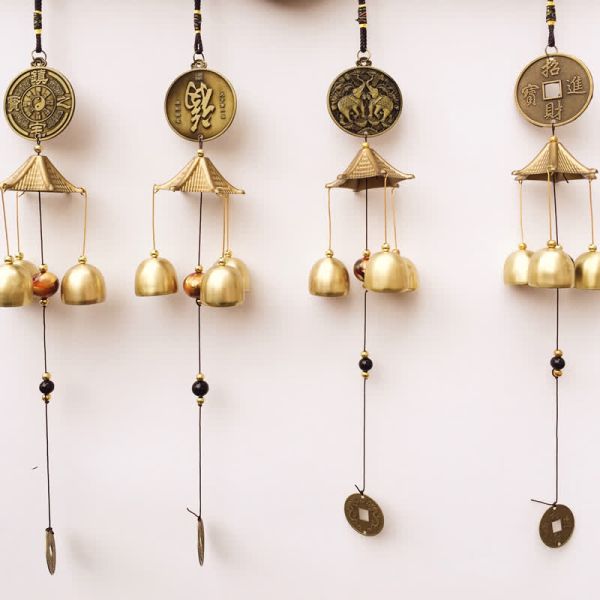
Wall hanging chime bell
The Bagua wall hanging chime bell has four options: auspicious coin, bagua, blessing letter, and elephant. Choose the bagua option when that is the motif you want; the option names describe different designs. The specified materials are copper, alloy, and acrylic beads. Its length is 46 cm, its weight is 80 g, and the package contains one bell.
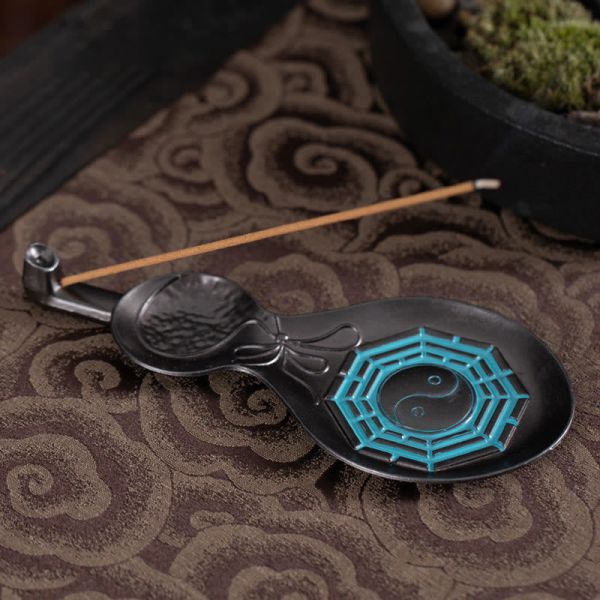
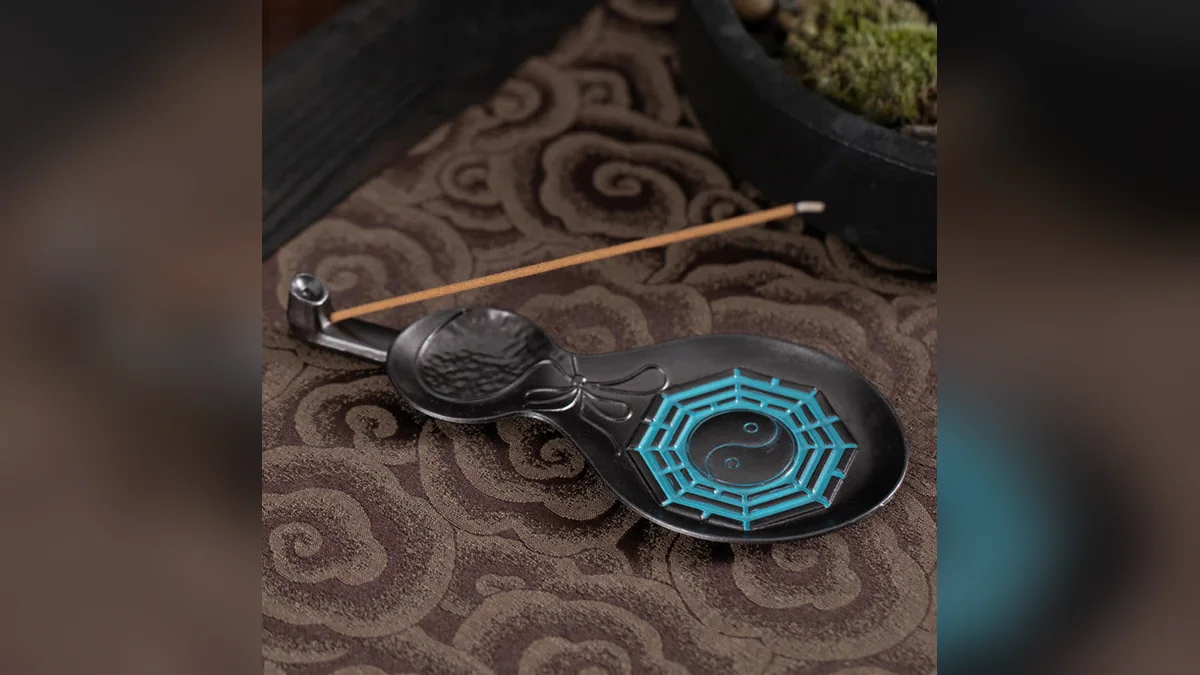
Gourd incense burner decoration
The Gourd Yin Yang Bagua incense burner decoration is copper alloy. Its listed size is 13.8 × 6 × 1.5 cm (L × W × H) at 50 g. Its dimensions give you a way to plan tabletop space before choosing a display position.
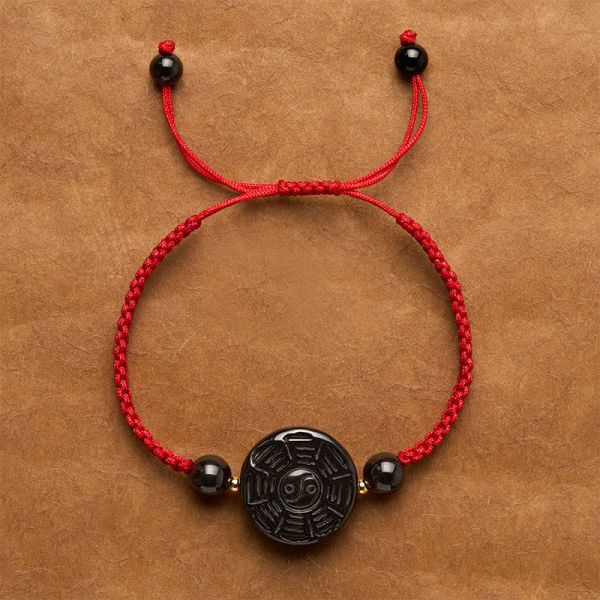
Red string and black obsidian bracelet
The Red String Black Obsidian Round Bagua bracelet uses string and black obsidian with an adjustable cord. The specified wrist measurement is 15–17 cm / 5.9–6.7 in. Compare that measurement with your wrist before choosing it; an adjustable cord still has a stated fitting interval.
Vintage brass keychain
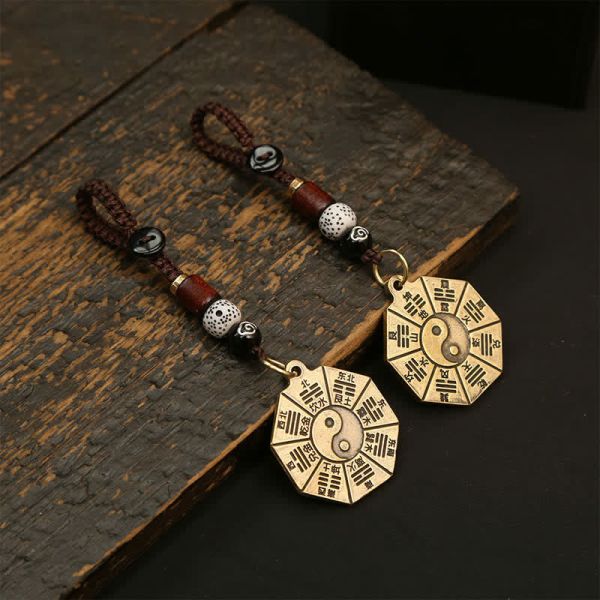
The Vintage Brass Bagua keychain comes as a bagua plaque alone, plus a gourd, plus a gourd with the coin set, or plus gourd, coins and a pi xiu charm. These are options, so the additional motifs depend on your selection.
The bagua pendant measures 35 × 35 × 2 mm and weighs about 13 g; the rope is about 65 mm. The product specifications list brass, rope, copper alloy, wood, ebony and star moon bodhi seed. Avoid water exposure.
Reading the bagua starts with three lines, then moves outward to the relationships among eight figures. Begin at the bottom of a trigram and work upward; next, consider how its neighbors and opposite figure fit the arrangement. On a decorative object, these details connect a small pattern to a much broader tradition. The form remains recognizable across a wall hanging, a tabletop ornament, or a piece of jewelry.
Shop the story
 Buddha Stones Red String Black Obsidian Round Bagua Blessing BraceletAs low as $25.59 Regular Price $34.12
 Buddha Stones Vintage Brass Bagua Pi Xiu Five Emperor Coins Pendant Protection Yin Yang KeychainsAs low as $25.59 Regular Price $35.54