
Yin Yang Symbol Meaning: Shapes, Colors, and Balance
Two teardrop shapes curl around each other inside a circle, one black and one white, and each holds a small dot of the opposite color at its widest point. That image, more than any explanation, is where yin yang symbol meaning actually starts. The shapes are not static halves glued together; they look like they are moving, each one tapering into the other, and that sense of motion is the point.
Yin Yang Symbol Meaning: Where the Words Come From
Yin and yang originally described something very plain: the shaded side of a hill and the sunny side of a hill. Yin was the slope in shadow, cool and turned away from the light. Yang was the slope catching the sun, warm and exposed. As the words spread into Chinese philosophy, they stopped describing one particular hill and started describing a way of looking at anything that has two sides — shade and light, stillness and motion, the inside of a thing and its surface.
This is the part of yin yang symbol meaning that gets flattened the most in casual use: yin and yang are not opposing teams. They are not good and evil, not right and wrong. They are better understood as two ends of a relationship that only make sense next to each other. A day cannot be measured without a night to compare it to. Rest only means something because activity exists. Each half needs the other half to be visible at all, the same way a shadow needs a light source.
The circle itself is called the taijitu, a term that simply refers to this particular diagram of the supreme or ultimate. It did not arrive as a logo; it grew out of centuries of thinking recorded in Chinese philosophy and Daoist texts, and it shows up as a visual summary of ideas found in older classics such as the I Ching, or Book of Changes, where change itself — not any fixed state — is treated as the basic fact of existence.
Two details in the symbol carry most of the meaning. The small dot of black inside the white half, and the dot of white inside the black half, show that neither side is ever pure. Even at its most active, a situation holds a trace of stillness inside it; even at its calmest, something is already stirring. The curved line dividing the circle is not straight, because the change between the two states is never abrupt. One does not flip into the other. It curls, the way day eases into evening rather than snapping into night.
Classic Pairings: A Working List
Teachers and writers have used the same handful of comparisons for generations to make the idea concrete. Here are some of the more common ones.
| Yin | Yang |
|---|---|
| Dark | Light |
| Moon | Sun |
| Water | Fire |
| Cool | Warm |
| Rest | Activity |
| Earth | Heaven |
| Night | Day |
| Receptive | Active |
None of these pairs is fixed in place. Water is yin next to fire, but water in motion, say a rushing river, can be described as more yang than a still pond. The table is a set of relationships, not a set of permanent labels, and the same object can sit on either side depending on what it is being compared to.
The Bagua Around the Circle
Many versions of the yin yang symbol are surrounded by a ring of eight trigrams, a pattern known as the bagua. Each trigram is a stack of three lines, and each line is either broken or unbroken. A broken line stands for yin, an unbroken line for yang. Arranged in eight different combinations, the trigrams form a ring that circles the taijitu the way the hours circle a clock face. Where the center of the symbol shows two forces in relationship, the ring around it shows eight possible arrangements of those same forces, traditionally used in feng shui to think about balance across different areas of life and home. Because the eight sections sit in a closed circle, the bagua also reads as a cycle, echoing the idea that the arrangement of yin and yang is never locked into one position.
Mistake One: Treating It as Dualism
Western dualism usually splits the world into two separate, competing substances, like light against dark in a battle. Yin and yang are not at war and neither one is meant to win. They are one system described from two angles.
Mistake Two: Reading the Dots as Decoration
The small dots are sometimes skipped or enlarged purely for visual balance in a design. In the original idea, they are not decorative; they are the clearest statement that each side already contains a seed of its opposite.
Mistake Three: Assuming the Line Down the Middle Is Straight
A straight line through the middle would turn the circle into two fixed halves, which is exactly what the symbol argues against. The S-curve is what makes it a picture of change instead of a picture of division.
Carrying the Idea in Daily Objects
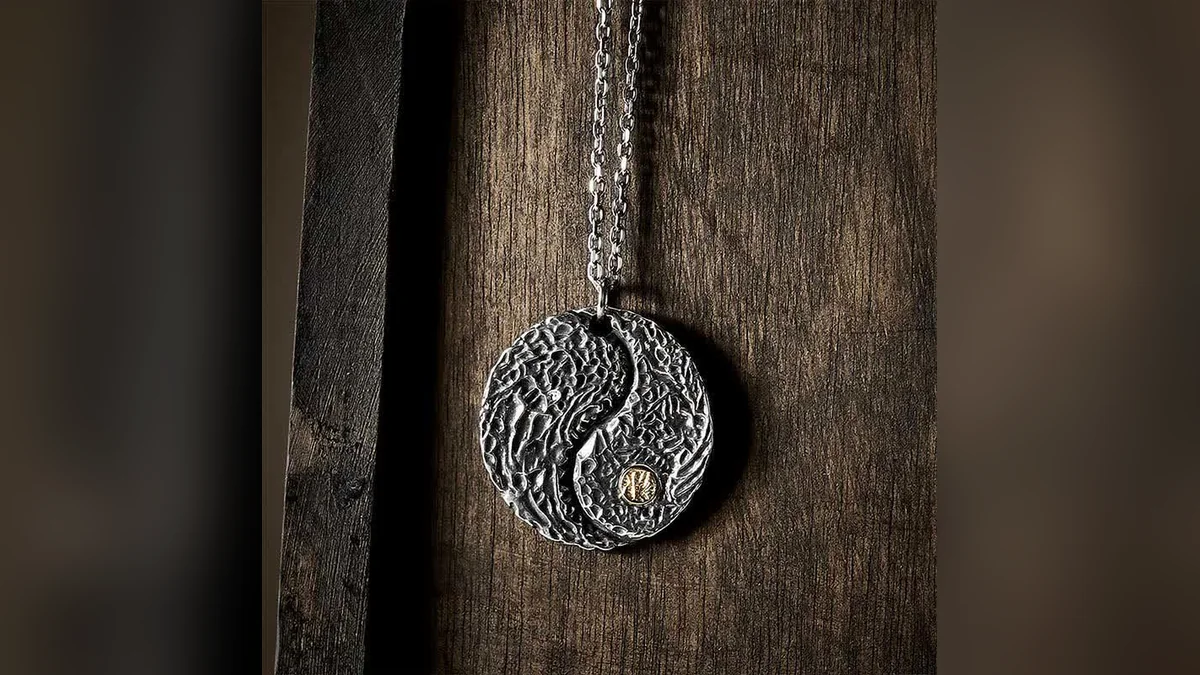
The symbol turns up often in jewelry and home pieces, partly because a circle this balanced reads clearly at a small size. Our copper yin yang pendant necklace is one example: a round, engraved pendant about 3 cm across on an 18-inch chain with a small extender for adjusting the fit.
The titanium steel Bagua rotating ring brings the bagua and the yin yang motif together in a rotating design worn on the hand, a small, physical nod to the idea that the eight arrangements keep cycling. It comes in gold, silver, and two-tone finishes, in US sizes 7 through 12.
For a softer presentation of the same motif, the blue and white porcelain yin yang bracelet strings 8mm beads on elastic cord. It is made to a smaller wrist size, about 5.9 to 6.3 inches (15 to 16 cm) around, so a quick wrist measurement first will tell you whether it fits.
On a larger scale, our minimalist iron wall decor renders the symbol as a flat metal disc, one half solid and the other cut into an open pattern. Sizes run between roughly 25 and 60 cm in diameter, which covers anything from a narrow hallway accent to the main piece above a sofa. Anyone furnishing a shared space might also look at our broader wall art selection, and the ring sits alongside other designs in our rings category.
Shoppers after this symbol across categories can browse everything grouped under yin yang pieces in one place.
None of this means a necklace or a ring produces balance on its own. The symbol is a reminder, not a mechanism. Chinese philosophy has long treated balance as something maintained through ordinary choices — how a day is paced, how work and rest are divided, how one mood is allowed to settle before the next one arrives. A small object worn or hung on a wall can keep that idea in view, but the practice of it happens in the routine of a day, repeated often enough that it stops needing to be thought about at all.
Shop the story
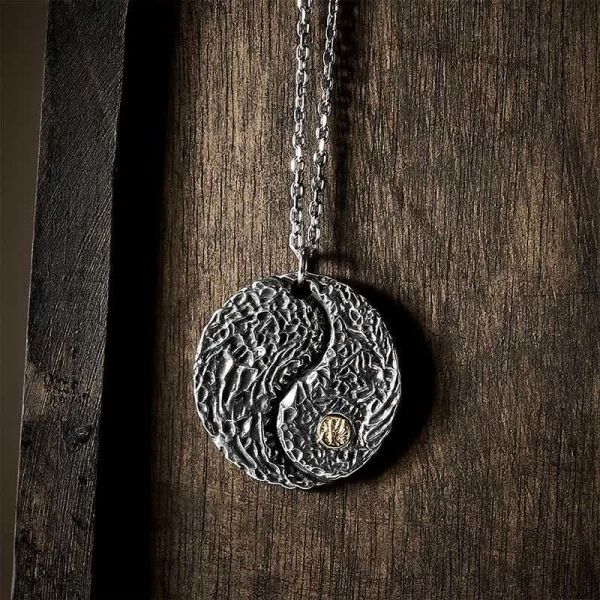 Buddha Stones Copper Yin Yang Balance Round Engraved Pendant NecklaceSpecial Price $25.59 Regular Price $34.12
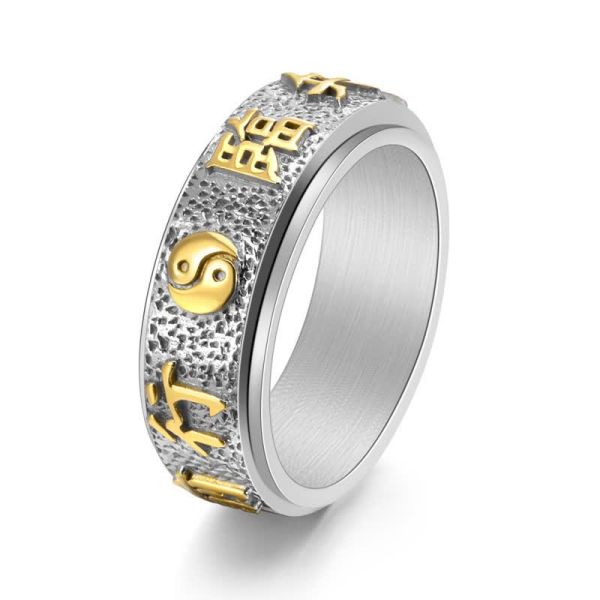 Buddha Stones Titanium Steel Yin Yang Bagua Balance Rotating RingAs low as $25.59 Regular Price $35.54
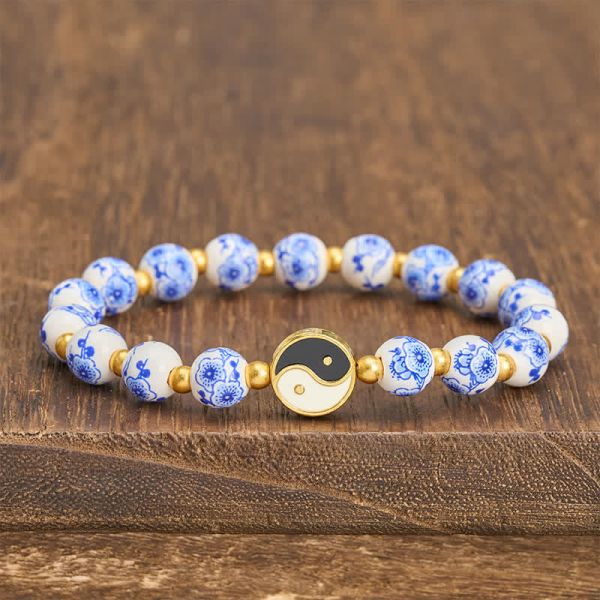 Buddha Stones Elegant Blue and White Porcelain Yin Yang Balance BraceletSpecial Price $25.59 Regular Price $34.12
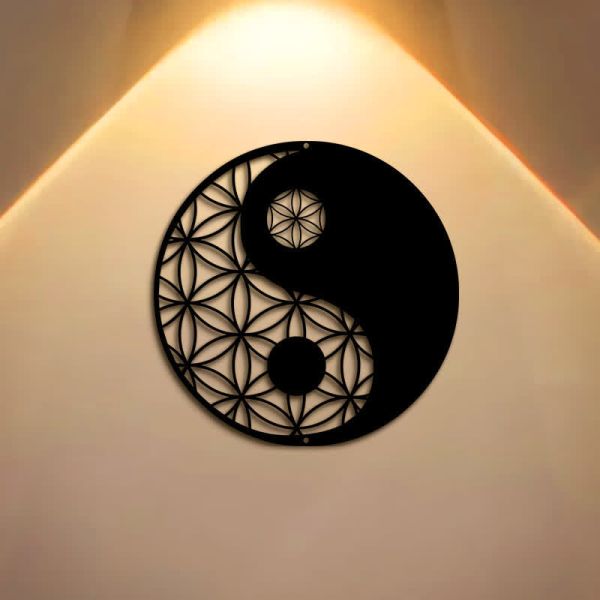 Buddha Stones Minimalist Yin Yang Balance Iron Metal Wall DecorAs low as $25.59 Regular Price $34.58