
What Is Obsidian? From Volcanic Glass to Jewelry
Early toolmakers struck flakes from obsidian to create cutting edges. The dark glass broke along curved surfaces, leaving edges useful for everyday work. Long before it became a bead on a bracelet, its value lay in what a carefully shaped fragment could do.
So, what is obsidian? It is volcanic glass formed when lava cools rapidly. In contemporary jewelry traditions, it commonly symbolizes protection, while some associations include luck and wealth. These are beliefs; wearing obsidian cannot guarantee any of those outcomes. Its material history offers another reason to take an interest in it.
What is obsidian? The glass behind the bead
Although people commonly call obsidian a stone, it is glass rather than a mineral crystal. Its formation gives it a different structure from crystalline materials such as quartz. That distinction helps explain the curved fractures that made it useful to toolmakers.
Black is its familiar color, but obsidian does not always look uniformly black. Some varieties show a gold or silver sheen as the viewing angle changes. A name such as silver sheen obsidian describes that visual character, rather than a coating of silver metal.
There is a considerable change between a broken fragment and a rounded jewelry bead. The cutting edge belongs to one use of the material; a smooth, polished surface belongs to another. Following that change keeps the discussion rooted in objects and workmanship, even when symbolic meanings enter the story.
Craft traditions that begin with a fracture
Knapping is the practice of shaping stone or glass by removing flakes. Obsidian was one of the materials used for this work, alongside other stones that could produce useful edges. A toolmaker worked with the way the material broke, directing fractures rather than simply scraping a lump into shape.
This history matters because it gives obsidian a practical identity beyond jewelry. A blade and a bead can share a material while asking very different things of it. One depends on a thin edge; the other calls for a rounded form, a hole for stringing, and a finished surface.
Grinding, drilling, and polishing belong to bead-making traditions. Those general processes explain how a hard fragment can become something suitable for stringing. They do not establish how any particular bracelet was produced. We keep that distinction clear when describing our products: a material name alone does not tell you who made a piece or which tools were used.
The change from edge to ornament also changes what the eye follows. On a tool, attention goes to the point or blade. On a bead, it follows the curve and the way light meets the surface.
Modern jewelry gives the material another role
In a bracelet, obsidian becomes part of a composition. Dark beads can sit beside contrasting materials, while gold or silver sheen varieties introduce a different surface appearance. Bead size and the arrangement of a strand also affect how the design looks, without changing what obsidian itself is.
Symbolism adds a separate layer. A wearer may choose a traditional protection motif, or give jewelry with a wish for prosperity. The wish belongs to the giver and the tradition. It does not establish a result that the bracelet can deliver. Words such as Protection and Wealth in product names express those traditional wishes.
At Buddha Stones, we separate these associations from practical details. Materials, bead size, and the specified fit give you concrete points to compare. A symbolic name should never substitute for checking those details.
When considering a design, start with the combination you prefer, then check the available options. A product title can include several materials or styles, so read the specifications alongside the option names. Avoid assuming that a metal-colored word means a precious metal, or that elastic string makes sizing irrelevant.
Four obsidian bracelets in our collection
These designs show several ways obsidian appears in jewelry. Their differences are easiest to understand through the materials and measurements supplied for the individual product.
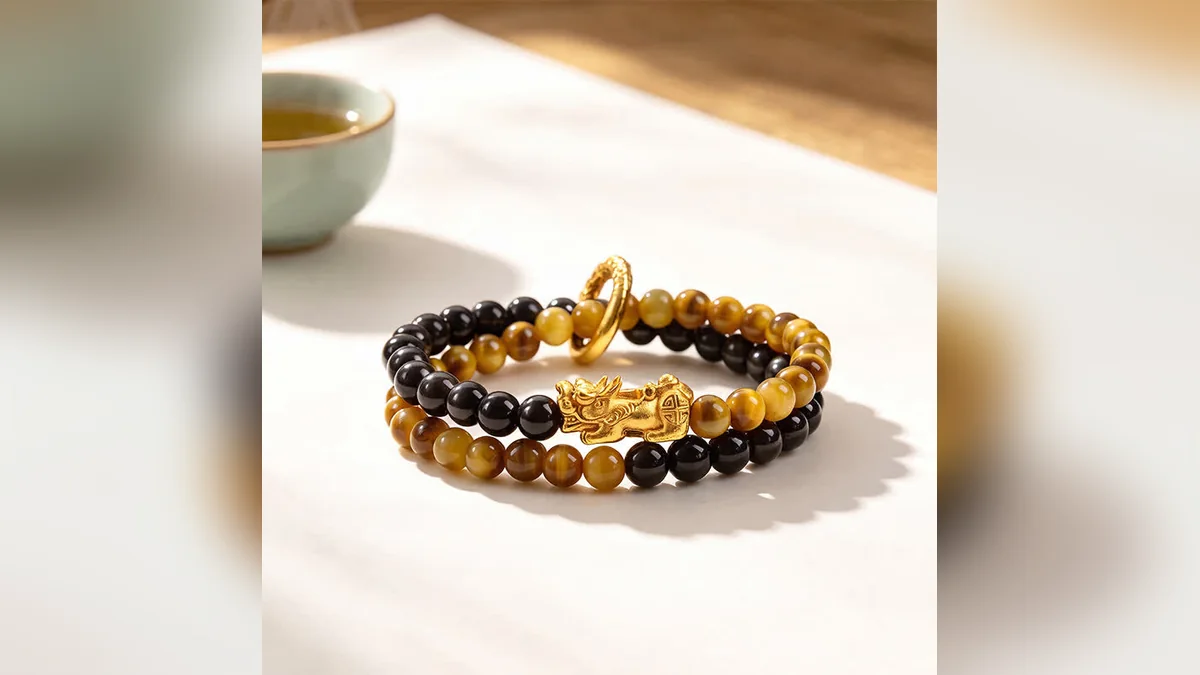
Tiger eye with silver sheen obsidian and Pi Xiu. Our Tiger Eye Silver Sheen Obsidian Pi Xiu Double Wrap Bracelet combines Tiger Eye, Silver Sheen Obsidian, and Copper Alloy. It has 6mm beads and Premium Elastic String. Wrist circumference: 5.9–6.3 in (15–16 cm).
The option names are Blue Tiger Eye Silvery Pi Xiu, Tiger Eye Gold Pi Xiu, Tiger Eye Silvery Pi Xiu, Yellow Tiger Eye Golden Pi Xiu, and Yellow Tiger Eye Silvery Pi Xiu. Gold and silvery wording in those names does not establish gold or silver content; the material specification names Copper Alloy. Pi Xiu traditionally carries wishes for prosperity, without promising financial results.
Round obsidian beads with wrap choices. The Black Obsidian Single Double Layer Round Bead Protection Bracelet uses Obsidian and Copper Alloy with Premium Elastic String. Its options include 10mm Black Obsidian, 8mm Black Obsidian, Double Wrap, and Single Wrap.
The specifications give bead sizes of 8mm /10mm and wrist circumferences of 5.9–6.3 in (15–16 cm) / 6.3–6.7 in (16–17 cm). Check the selected option rather than assuming every size applies to every wrap style. Protection in the name is a traditional wish.
Tiger eye, blue tiger's eye, and black obsidian. Our Tiger Eye Blue Tiger's Eye Black Obsidian Beads Courage Bracelet brings together Tiger Eye, Blue Tiger's Eye, Black Obsidian, and Copper. Its 8mm beads are strung on Premium Elastic String, with wrist circumference specified as 6.3–6.7 in (16–17 cm). Courage appears here as a symbolic name.
Gold sheen obsidian with black tourmaline. The Gold Sheen Obsidian Black Tourmaline Wealth Bracelet pairs Gold Sheen Obsidian and Black Tourmaline. It is a unisex bracelet with 8mm beads and premium elastic string. Its wrist circumference specification is 15-20cm. Wealth refers to a traditional prosperity wish, with no promise of money or success.
FAQ: Material, meaning, and everyday care
Is obsidian a crystal?
Obsidian is volcanic glass, so it does not have the ordered structure of a mineral crystal. Jewelry shops may group it with crystals for browsing, but that retail grouping does not change the material.
Does a gold or silver sheen mean precious metal?
No. Those terms describe an appearance in obsidian. For metal components in a bracelet, use the product's material specification rather than drawing conclusions from a sheen name or an option's color wording.
How should an obsidian bracelet be cared for?
Use a clean, slightly damp cloth for gentle wiping, then dry the bracelet. Avoid soaking mixed-material jewelry or exposing it to harsh cleaners. Keep it in a padded pouch where loose objects cannot knock against it. Glass can chip, so handle beads with care.
The material that once supplied a cutting edge now appears in rounded beads. That change of form is a useful thread to keep: obsidian has a physical history you can understand, alongside traditions you may choose to honor.
Shop the story
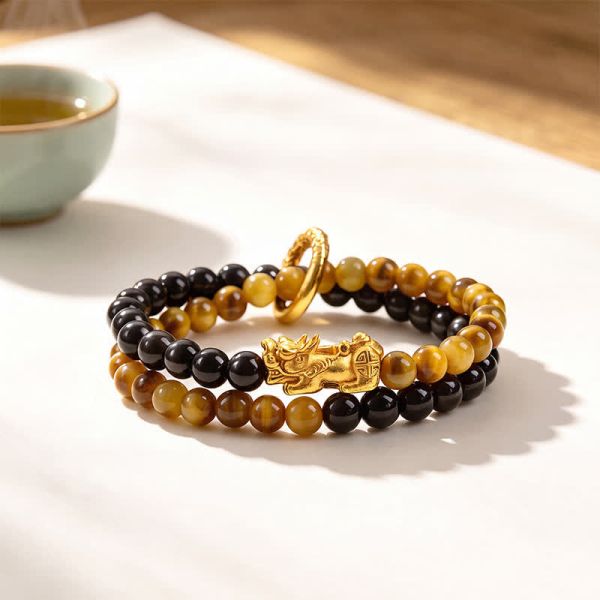 Buddha Stones Tiger Eye Silver Sheen Obsidian Pi Xiu Double Wrap Auspicioisness BraceletAs low as $28.59 Regular Price $38.12
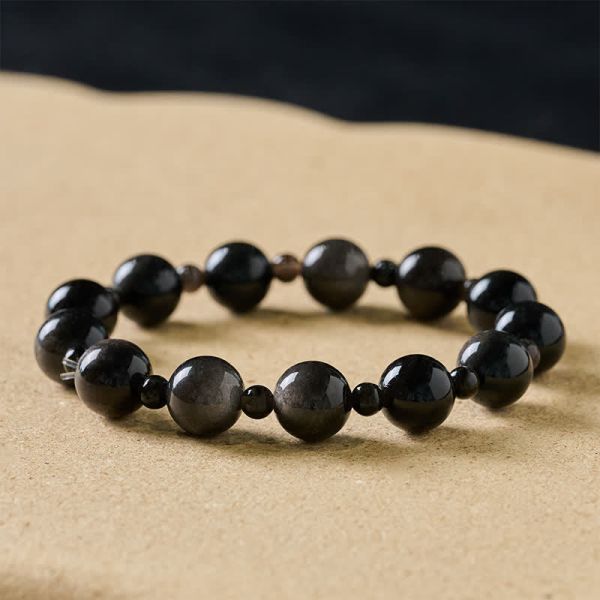 Buddha Stones Black Obsidian Single Double Layer Round Bead Protection BraceletAs low as $25.59 Regular Price $35.54
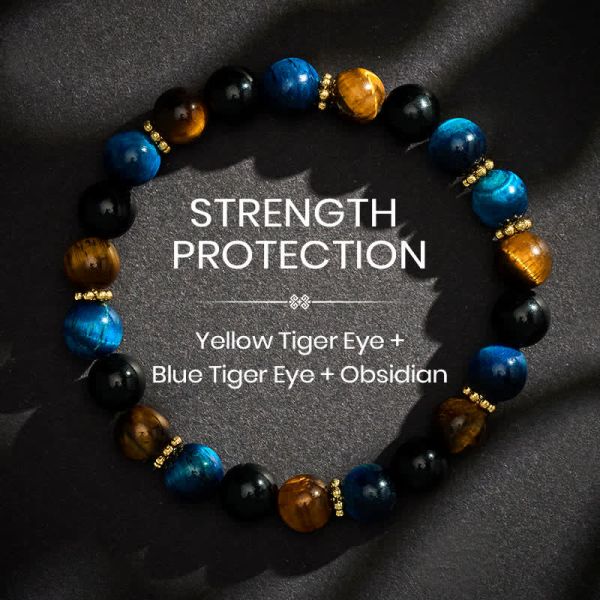 Buddha Stones Tiger Eye Blue Tiger's Eye Black Obsidian Beads Courage BraceletSpecial Price $25.59 Regular Price $34.12
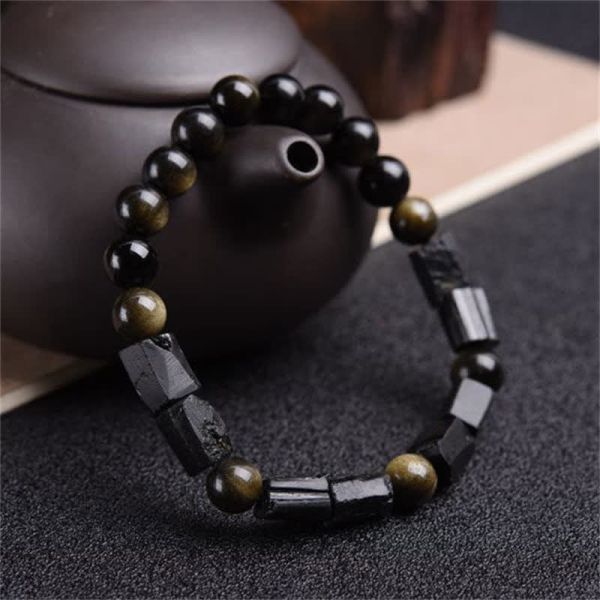 Buddha Stones Gold Sheen Obsidian Black Tourmaline Wealth BraceletSpecial Price $34.59 Regular Price $48.04