
Dzi Bead Guide: 10 Answers on Meaning, Age, and Care
Black and white bands wrap around a long, barrel-shaped bead, interrupted by circular “eyes” that make its pattern distinctive. Dzi beads (pronounced “zee”) are patterned stone beads, usually agate, prized in Tibetan culture and traditionally worn as amulets. That description reflects their cultural role and traditional beliefs. The familiar eye pattern also appears in modern jewelry, where a newly made bead can stand alone or sit among smaller beads on a strand. Understanding the difference between a traditional design and an antique object is a useful place to begin.
Dzi beads, question by question
What does the word dzi mean?
The Tibetan word gzi, often written dzi in English, is commonly glossed as “shine” or “brightness.” The spelling looks less familiar than the pronunciation: “zee” is the usual English guide.
The name belongs to a bead tradition, rather than a single mineral species. Agate describes the stone commonly used; dzi describes the culturally recognized bead. Keeping those terms separate helps when reading a listing. A material description tells you what a bead is made from, while a pattern name identifies its design. Neither detail, by itself, establishes age.
How old are the oldest examples?
Some surviving examples are very old, but their precise origins remain uncertain. Researchers still debate where early examples were made and how their makers produced particular patterns. There is no single securely established account that explains every surviving bead.
It helps to distinguish the age of the tradition from the age of an individual object. A familiar design may have a long history while the bead carrying it was made recently. Without reliable evidence about a particular piece, an exact date would suggest more certainty than is justified. Describing a style as traditional does not date the object.
How are the white patterns made?
A common explanation is that an alkaline paste is applied to agate in the desired design, then the bead is heated so the pattern whitens and bonds into the surface. Sometimes this happens against a darkened background, producing a strong contrast between the lines and the surrounding stone.
You may see this described as “etching,” although that word can suggest a design cut into the surface. Here, it commonly refers to a treatment that changes the stone’s appearance. Methods can differ, and this general explanation does not establish the manufacturing process of a specific bead. Knowing the broad technique helps explain the contrast while leaving room for unresolved questions about older examples.
What do the eyes mean?
The eyes are circular motifs, and their number is read differently across traditions and interpretations. Three-eyed and nine-eyed designs are among the most popular. Some interpretations associate three eyes with the Buddhist Three Jewels—Buddha, Dharma, and Sangha—and nine eyes with completeness; these are symbolic beliefs, with no promised outcome.
There is no need to treat an eye-count chart as a universal rule. A useful description identifies the pattern first, then explains any association in its cultural context. You can appreciate the arrangement of circles and bands without treating a symbolic reading as a prediction.
Are modern beads real dzi?
Modern beads are new beads made in the old style. They can be described honestly as contemporary examples of that design tradition. The important distinction is between a newly made patterned bead and an antique whose age and history require evidence.
Our beads are modern. Antique dzi are rare and command very high prices, so treat any “ancient” claim with care. A traditional pattern, an aged appearance, or a Tibetan-style product name does not establish antiquity. When comparing listings, look for a clear statement about materials and age rather than assuming that “real” always means “old.”
Can photographs prove that a bead is antique?
Photographs can show the pattern, visible wear, and overall condition, but they cannot establish age on their own. Surface marks and softened edges need context. A bead’s appearance is only part of the evidence, and a seller’s description should make clear what supports an age claim.
For a costly antique, ask about provenance: the documented history of ownership or collection. Consider an independent assessment from someone experienced with this bead tradition. For a modern piece, the questions are more straightforward: what materials are listed, what dimensions are given, and how will the bead be used? These are separate purchasing decisions.
How can a dzi bead be worn?
A single bead can hang on a cord, form the centerpiece of a necklace, or serve as a spacer within a mala. Its longer shape gives it a distinct place among round beads. The arrangement can reflect personal taste or a wearer’s practice, without requiring one universal placement.
Our 108-bead jade bracelet with three-eyed and nine-eye dzi combines both patterns with bodhi seed, jade, liuli, and alloy. Its listed bead size is about 10 × 8 mm, with a wrist fit of 14–17 cm. It provides an example of two eye patterns incorporated into a longer strand, rather than presenting one bead alone.
What should you check before wearing a mala around your wrist?
Check the listed wrist range and string type before deciding how a strand will sit. Bead count alone does not tell you the fit, and a non-elastic strand should never be pulled as though it were elastic.
Our lapis lazuli and three-eyed dzi mala lists lapis lazuli/lazurite, a three-eyed dzi bead, and alloy, with 8 mm beads and non-elastic string. On a 16–18 cm wrist, it is listed to wrap two to four times.
The 108-bead black onyx and three-eyed dzi bracelet lists black onyx, a three-eyed dzi bead, ebony wood, tiger eye, copper, and sterling silver. Its bead-size options are 6 or 8 mm, and its listed wrist range is 15–18 cm. Use those stated dimensions when comparing the designs.
Does a bead have to be part of jewelry?
No. A patterned bead can also be a decorative object. Its bands and eyes can be appreciated without incorporating it into a necklace or bracelet.
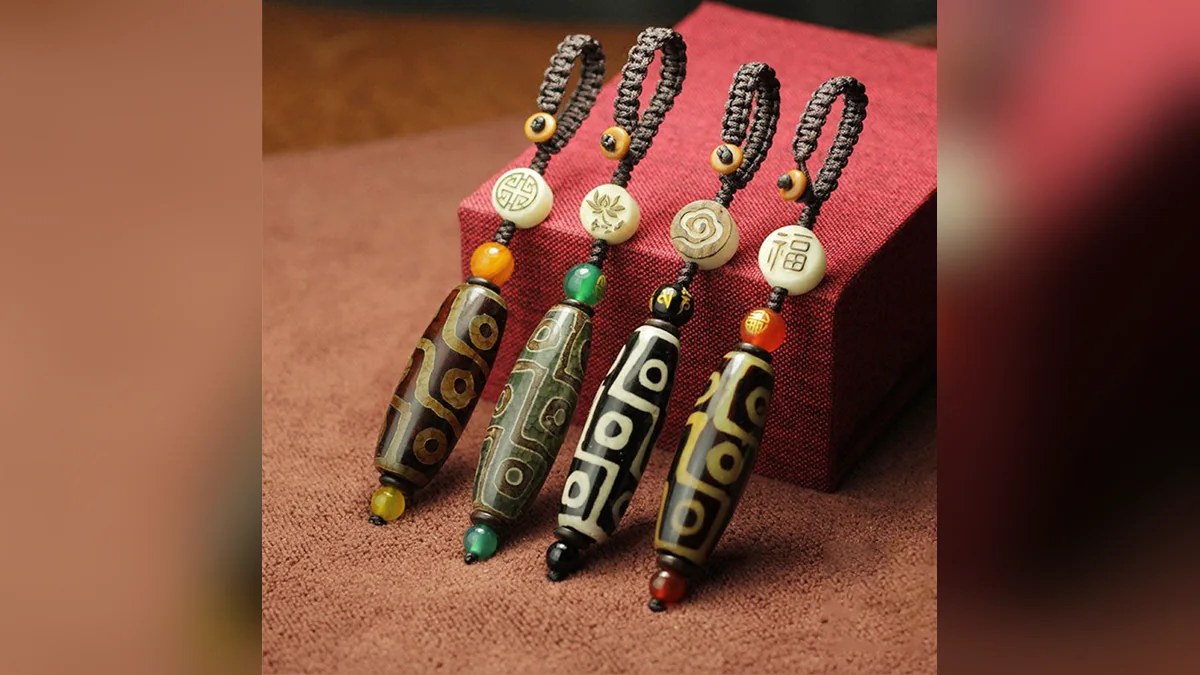
Our Tibetan nine-eye dzi bead decoration lists a nine-eye dzi bead and agate, with brown, green, and red color options. We describe it as a decoration. If you intend to use a decorative bead in another arrangement, check that the product information supports that use; the name alone does not tell you what fittings are included.
How should you care for the bead?
Wipe it gently with a soft cloth. Avoid knocks, drops, abrasive cleaning, and harsh chemicals. Agate is fairly hard, but it can still chip, particularly where an edge strikes a hard surface. Store the piece where it will not knock against other jewelry.
For a mixed-material strand, consider every component, including the string and any metal or wood beads. Avoid soaking the whole piece to clean one stone. Inspect the cord periodically, especially near bead holes, and stop wearing it if you notice fraying or damage. Gentle handling is more useful than vigorous polishing.
A clear description separates the stone, the pattern, and the claimed age. With those distinctions in place, a modern bead can be appreciated for its design and its connection to a respected Tibetan tradition.
Shop the story
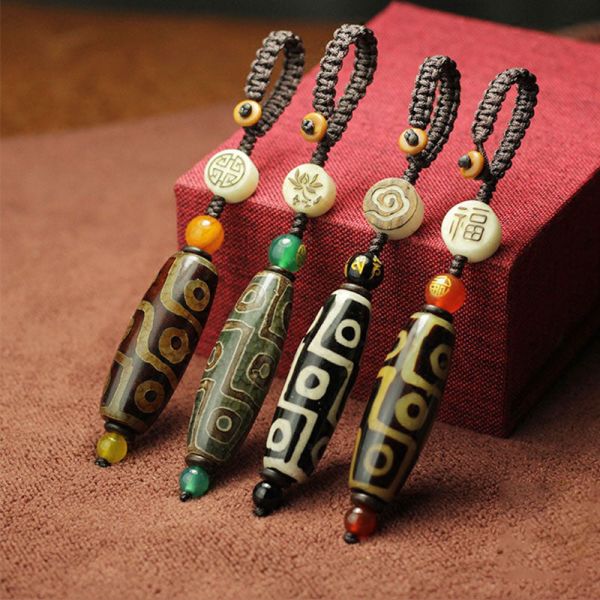 Buddha Stones Tibetan Nine-Eye Dzi Bead Wealth DecorationAs low as $25.59 Regular Price $35.05
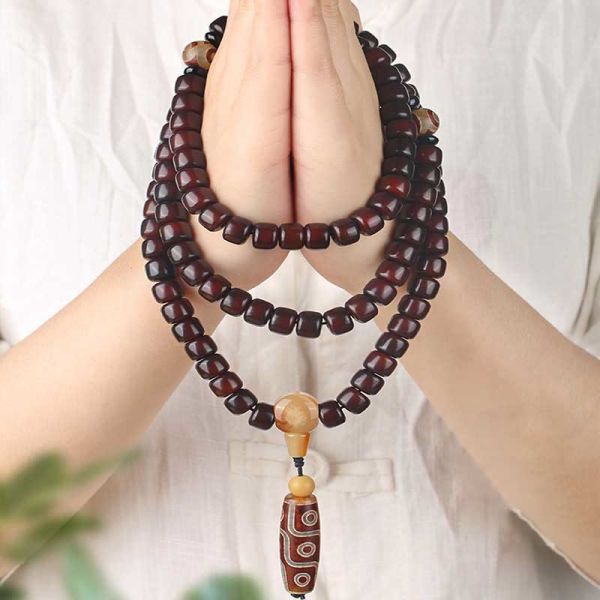 Buddha Stones 108 Mala Beads Three-eyed Dzi Bead Nine-eye Dzi Bead Jade Luck BraceletSpecial Price $39.59 Regular Price $52.79
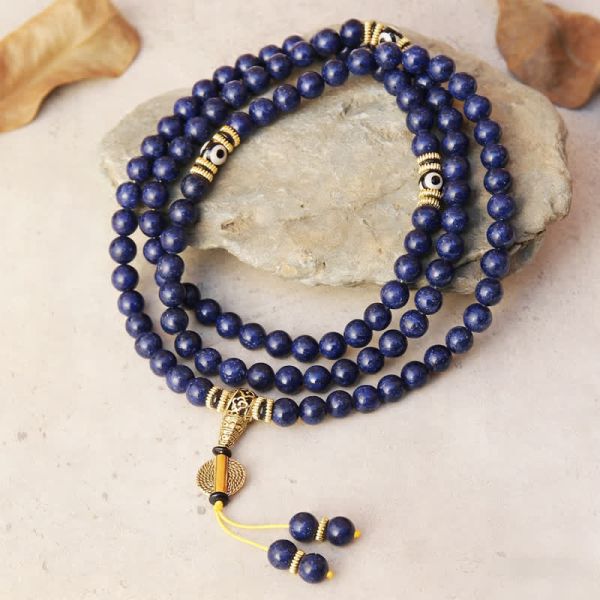 Buddha Stones 108 Beads Lazurite Lapis Lazuli Three-eyed Dzi Bead Positive MalaSpecial Price $27.59 Regular Price $38.86
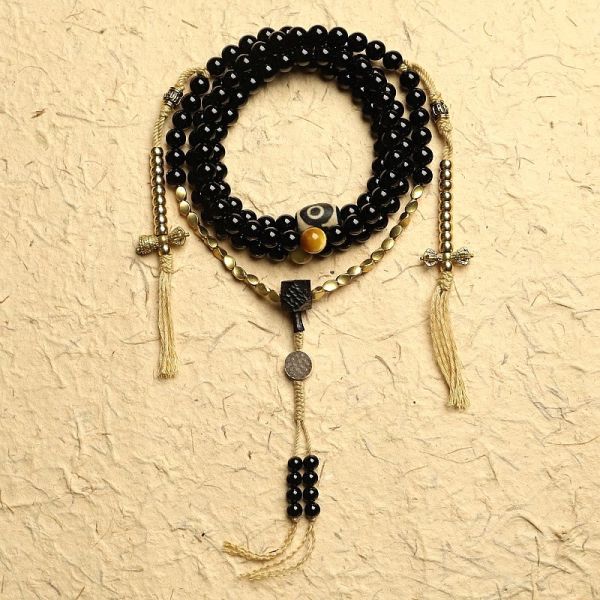 Buddha Stones Tibetan 108 Mala Beads Black Onyx Three-eyed Dzi Beads Protection BraceletAs low as $229.59 Regular Price $323.37