
Tree of Life Meaning Across Cultures and Traditions
Few images travel as widely as a tree with roots below and branches above. Norse poets, biblical scribes, Jewish mystics, and modern jewelry designers have all reached for roughly the same outline to describe how a person, a family, or a universe holds together. The tree of life meaning that most people reach for today is some version of connection: what grows above stays fed by what remains hidden below, and nothing in the design stands apart from the rest. Buddhist tradition tells a related but distinct story about one particular fig tree, which we will come back to. First, it helps to see where the wider symbol comes from and how differently it has been drawn.
A Shared Shape Behind the Tree of Life Meaning
Strip away the specific myths and most tree-of-life images share the same three parts: roots set in the ground, a trunk that lifts upward, and a crown that spreads into branches and leaves. Readers of these images, across very different centuries and continents, tend to land on a similar handful of readings. Roots are often read as ancestry or memory, the trunk as a single unbroken line connecting generations, and the crown as growth that keeps branching outward without ever separating from where it started. Family trees borrow the same logic, and so does the common idea that a person stays connected by staying close to where they came from.
None of these readings require believing the tree is literal. They work more like a visual argument: that connection and growth happen together, not instead of each other. That argument shows up in some of the oldest written traditions we have, and it looks different every time it appears.
| Tradition | Tree or image | What it is often taken to mean |
|---|---|---|
| Norse myth | Yggdrasil, the world ash | Widely read as the axis linking the different realms of the Norse cosmos, holding sky, earth, and underworld together |
| Hebrew Bible | The tree of life in the Garden of Eden | Generally understood as a symbol of life itself, set apart from the other trees named in the garden story |
| Kabbalah | The sefirot diagram, known as the tree of life | Used as a map of divine attributes, often read as a path connecting the human and the divine |
| Celtic-style knotwork | An interlaced tree motif | Popular in modern Celtic-inspired design as a way of showing roots and branches as one continuous, unbroken line |
| Buddhism | The Bodhi tree | A specific fig tree under which the Buddha is said to have reached awakening; it is its own symbol rather than a tree of life in that same sense |
| Ancient Mesopotamian art | Sacred tree motifs | Carvings and reliefs from this and other ancient traditions also show stylized sacred trees, generally thought to carry related ideas of life and abundance |
Put side by side, the differences are real. Yggdrasil is a specific tree holding up a specific cosmology; the Eden story treats its tree of life as one tree among several in one garden; Kabbalah uses the phrase for a diagram rather than a plant at all; and the Bodhi tree is a single historical tree tied to one event, not a stand-in for life in general. What carries across traditions is less a shared doctrine than a recurring instinct: draw roots and branches together, and people tend to read unity into the picture.
Why the Shape Repeats
Trees were simply around. Most early societies lived close enough to forests and orchards to notice how a tree keeps standing through storms and seasons by staying rooted, and how it keeps producing new growth without starting over. Borrowing that shape to talk about family, continuity, or the structure of the cosmos did not require elaborate explanation; it was already in front of people.
Why the Tree of Life Suits Jewelry and Wall Art
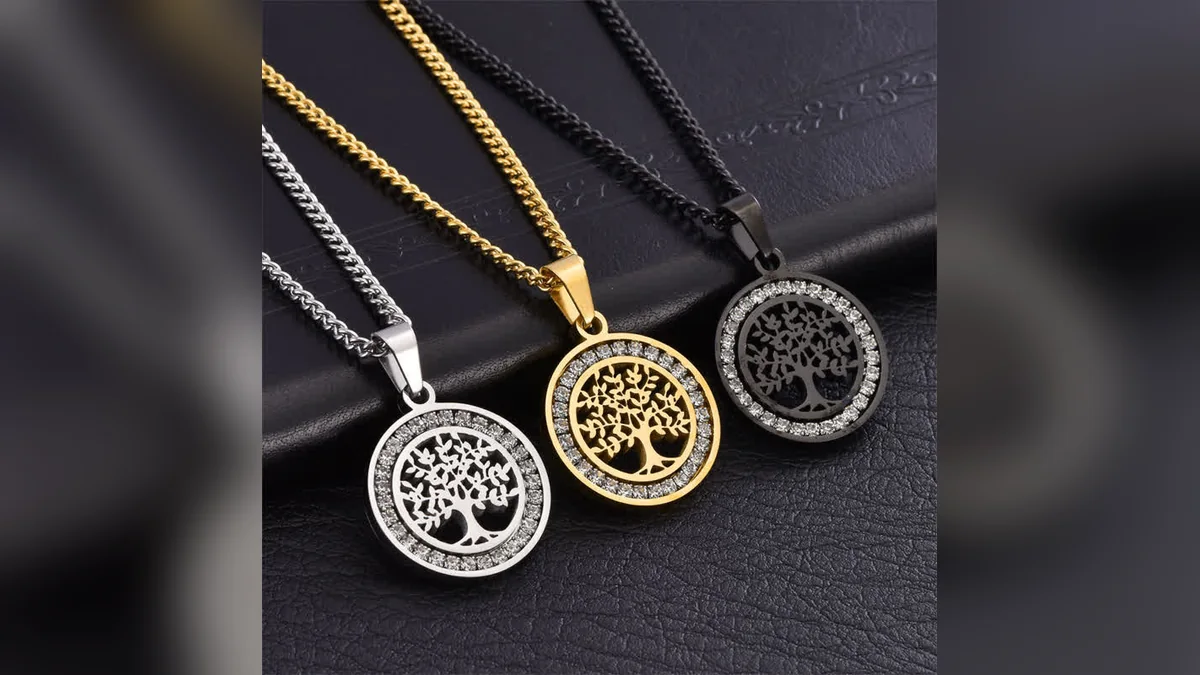
A tree drawn in full, from root tip to topmost branch, is a tall and narrow shape. Jewelry and wall art tend to favor something more compact, so designers often bend the whole tree into a circle, letting the branches curve back down to meet the roots. The result reads as one closed line: nothing begins or ends, and the roots and crown sit at an equal distance from the center. That framing device, more than any single myth, is what keeps the tree of life meaning flexible enough to sit comfortably on a pendant, a cuff, or a piece of wall decor.
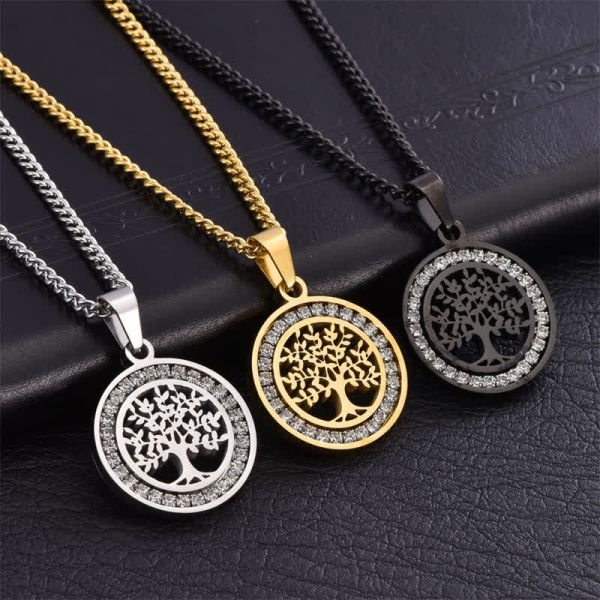
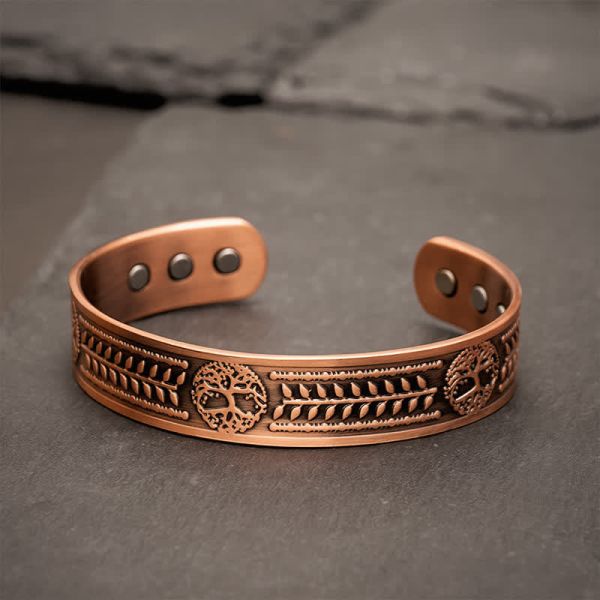
Our titanium steel tree of life pendant necklace takes this circular approach directly, with a round pendant about 25 mm across hung from a 60 cm (24 in) chain. The red copper tree of life cuff bracelet uses the same engraved motif on an open band instead, with an inner diameter of about 58 mm, a perimeter near 18.5 cm, and a width of 15 mm. Because a cuff like this is sized by inner diameter rather than a standard bracelet length, it helps to measure the widest part of your palm first and match it against the bangle’s inner diameter, so the open ends sit against your wrist the way you want.
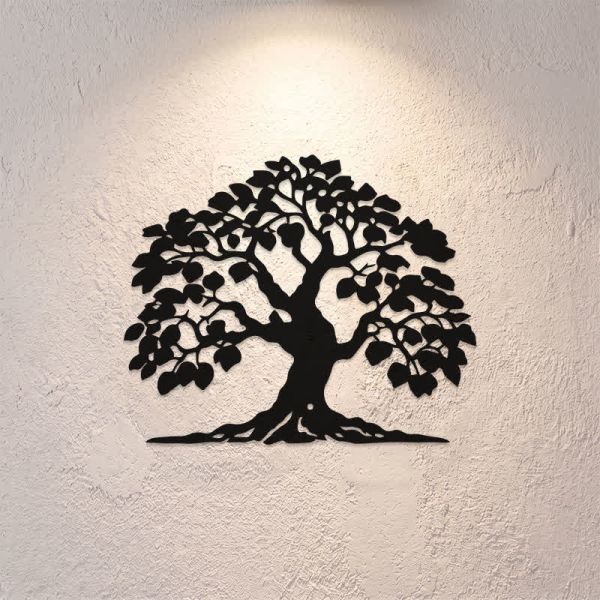
Wall art can afford to let the tree stay tall and uneven instead of closing the loop. Our metal tree of life silhouette wall art is cut from iron, about 1.0 to 1.2 mm thick, with a matte black finish, and comes in sizes starting around 25 x 20.5 cm and running larger from there. Hung against a plain wall, the cut trunk and roots read clearly from across a room, which a small, dense pendant design cannot really manage. If you want to see how the motif looks at different scales, our wall art section carries several sizes side by side.
The same motif turns up on objects that have nothing to do with wearing or hanging. Our 34-key kalimba with a tree of life design is built from black walnut wood, measures 14 x 18 cm, and weighs 1330 g; it comes packaged with a pickup, a package bag, a songbook, a tuning hammer, a storage bag, a note sticker, and a cleaning cloth. Engraved on the body of an instrument, the tree becomes decoration rather than a diagram to puzzle over, which is closer to how most people actually encounter the symbol day to day. A broader set of tree of life pieces, spanning jewelry, wall art, and objects like this one, sits together on our tree of life page.
Materials and sizes above are drawn from current product listings and may vary slightly from piece to piece.
None of this requires settling on one meaning. Yggdrasil, the Eden story, the sefirot, Celtic knotwork, and the Bodhi tree describe different things, and treating them as interchangeable does a disservice to each tradition. What a round pendant or a wall silhouette borrows is simpler: the shape of roots meeting branches, read loosely as connection, family, or growth, however each person chooses to take it.
Shop the story
 Buddha Stones Titanium Steel Tree of Life Connection Round Pendant NecklaceAs low as $25.59 Regular Price $34.58
 Buddha Stones Red Copper Tree of Life Unity Engraved Cuff BraceletSpecial Price $26.59 Regular Price $36.42
 Buddha Stones Metal Tree of Life Unity Silhouette Iron Metal Meaningful Symbols Wall ArtsAs low as $23.59 Regular Price $31.45
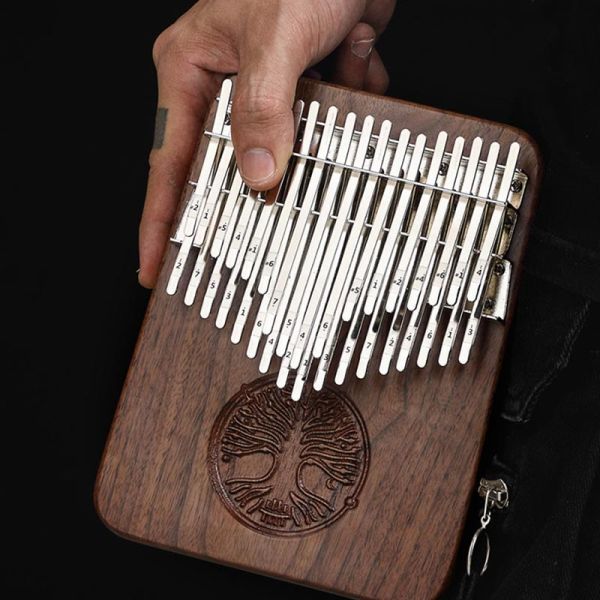 Buddha Stones Kalimba 34 Keys Thumb Piano Tree of Life Design Portable Finger Marimba PianoSpecial Price $232.59 Regular Price $332.27