
Setting Up a Mini Zen Garden: A Practical Guide
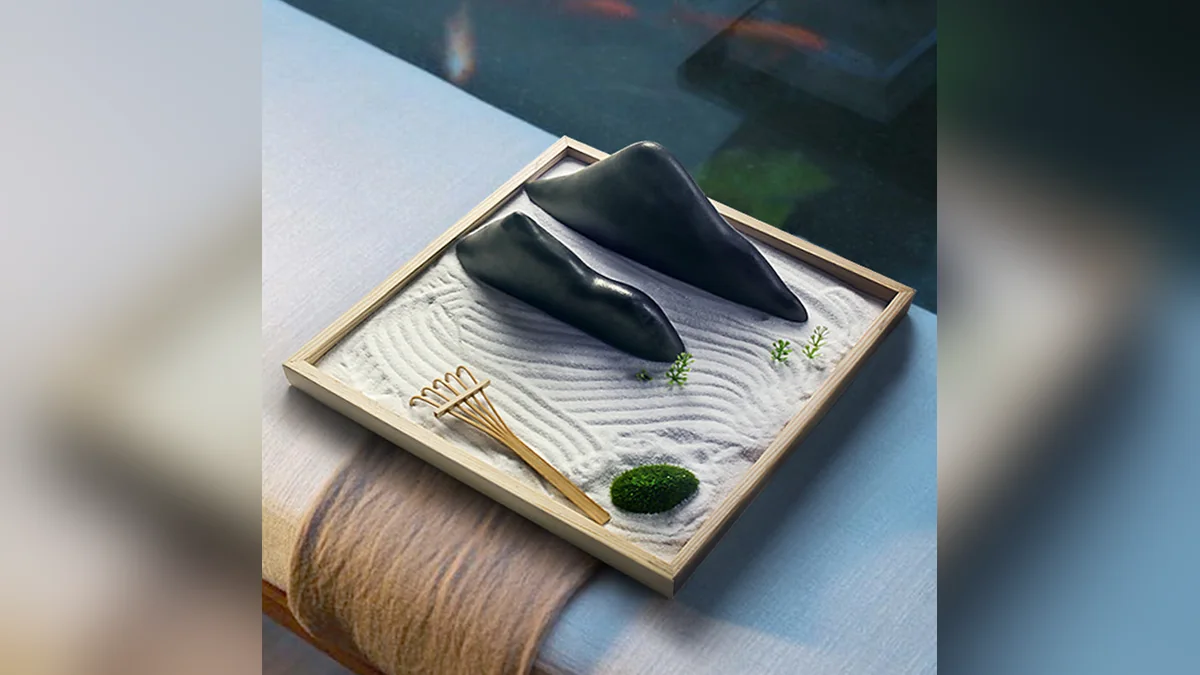
Buddha Stones’ mini zen garden sets scale down a Japanese dry landscape garden to tray size, built for a desk, a shelf, or a small table. Most sets pair a shallow box or base with sand and one or more stones, plus a miniature rake for tracing lines through the surface; the Rocks Landscape design is also sold as a rocks-only option. Some versions add a small bridge, a tree, or a koi shape, turning the tray into a small landscape rather than an open stretch of sand. This guide covers where the layout comes from, how to set one up, the two patterns most often raked into the sand, and how to keep the surface looking deliberate instead of disturbed.
Where the idea comes from
The pattern behind these trays comes from karesansui, the dry landscape gardens built in Japan using raked gravel or sand in place of water and arranged stones standing in for mountains or islands. Straight lines raked across the surface read as the ripple of open water, while circles drawn around a stone suggest the ring that forms when something breaks the surface of a pond. Kyoto’s temple gardens popularized this vocabulary long before smaller versions existed for tables and desks. Visitors to those gardens sit at the edge of the gravel and look at it the way they might look at a painting, since the raked lines are meant to be read rather than walked across. A smaller version keeps the same vocabulary of lines and rings but shrinks the scale down to something raked by hand instead of a long wooden tool.
Setting up a mini zen garden
Getting a tray ready starts before any sand goes into it. The surface underneath needs to be level, since even a slight tilt sends sand sliding toward one corner within a day or two. Once the container sits flat and steady, sand goes in and gets smoothed flat by hand, which also gives a sense of how fine or coarse the sand is before a rake ever touches it.
The Rocks Landscape zen garden is built around this same basic setup. Its One Grass version comes with a square wooden box, a rake, two ceramic rocks, a single grass piece, and 500 grams of sand. The 27 cm square box leaves room to rake a full pattern around the rocks once they are pressed into place, and the grass piece gives the tray a second texture alongside the smoothed sand.
Two basic raking patterns
Most of the raking in a tray this size comes down to two patterns: straight lines and circles. Long, straight strokes pulled across open sand are the simpler of the two. Moving the rake slowly and lifting it at the edge of the tray, rather than dragging it off the surface, keeps the end of each line clean instead of smeared.
Circles work differently. Once a stone sits in the sand, raking a ring around it echoes the ripple that forms around something standing in still water. The motion comes from turning the wrist and letting the rake’s teeth follow a curve instead of a straight path, which takes a bit more control than a straight line, especially close to the base of a stone. Straight lines and circles can share a tray, since nothing stops a line from running up to a stone and a ring from taking over around it.
Adding pieces: bridges, trees and koi
The Tree Small Bridge landscape builds on the open tray with a small bridge, a wayside pavilion, and a tree, with the set listed as medium-density fiberboard. The set measures about 21 centimeters across and weighs 780 grams, and it comes with its own sand and rocks, a rake, and a separate small tool. Pressing each piece gently into the sand before raking helps it stay where it was placed. With the bridge and pavilion in place, raking tends to happen in shorter strokes than in an open tray, since there is less room for the rake to travel in a straight line.
The Koi Fish Small Bridge Grass landscape works at a smaller scale, at about 21.5 by 17.5 centimeters and 380 grams, also in medium-density fiberboard. It includes a koi decoration piece, a patch of grass, a rake, sand, and a single rock. Raking fine lines around its outline reads the same way circles do around a stone: one disturbed spot against an otherwise even surface.
Above the tray
The Metal Zen Circle Pine Bonsai wall art moves the same vocabulary off the tray and onto the wall. It is a flat iron cutout, about 1 to 1.2 millimeters thick, finished in matte black, with the design cut as an enso ring enclosing a bonsai pine silhouette, a small moon disc, and a stack of stones. It comes in square sizes from about 25 by 25 centimeters up to 60 by 60 centimeters, with pre-drilled mounting holes. Hung above a tray on a plain section of wall, the black silhouette gives the sand below it a fixed point to sit under rather than competing with it. More pieces in this style sit in our wall art collection.
Keeping it tidy
Sand holds a raked line until something disturbs it, and the most common disturbance is moving air rather than a stray hand. Keeping a tray away from fans, open windows, and doorways prevents drafts from scattering sand out of a shallow box or softening the edges of a pattern.
Re-raking a tray that has lost its lines is straightforward: smooth the sand flat again with the back of the rake or a hand, then redraw the pattern from scratch rather than trying to repair a broken line or a flattened circle. Starting over takes less time than it sounds, since a flat bed of sand holds a new line more cleanly than one with old marks still showing underneath it.
The temple gardens that popularized this layout were built at a much larger scale, meant to be viewed from a fixed seat at the edge of the gravel rather than touched. A mini zen garden keeps the same two moves, straight lines for water and circles for ripples, but puts them within reach of a hand instead of a rake on a long handle. The scale changes what the pattern is for, but not the pattern itself.
Shop the story
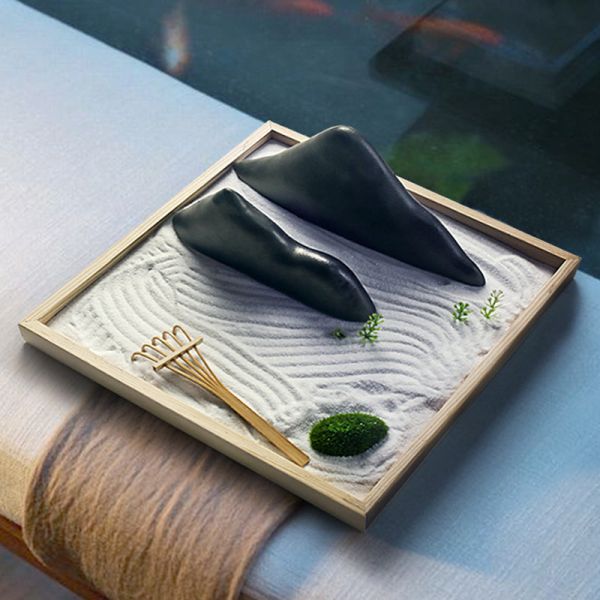 Buddha Stones Rocks Landscape Meditation Enlightenment Zen Garden DecorationAs low as $159.59 Regular Price $224.77
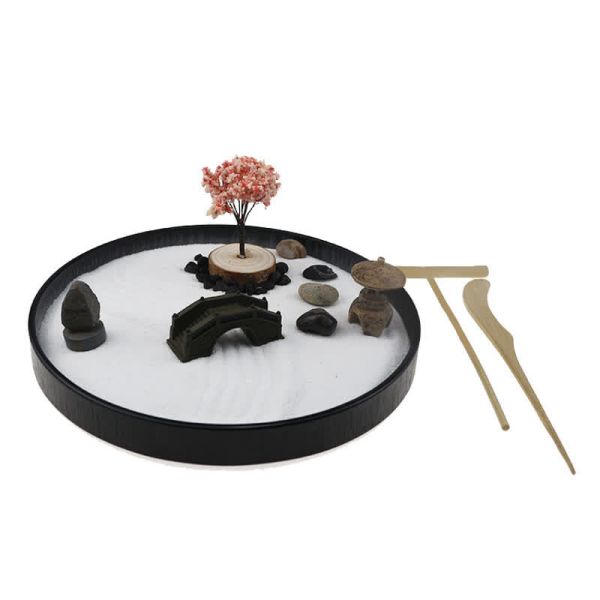 Buddha Stones Tree Small Bridge Landscape Meditation Calm Zen Garden DecorationSpecial Price $79.59 Regular Price $112.10
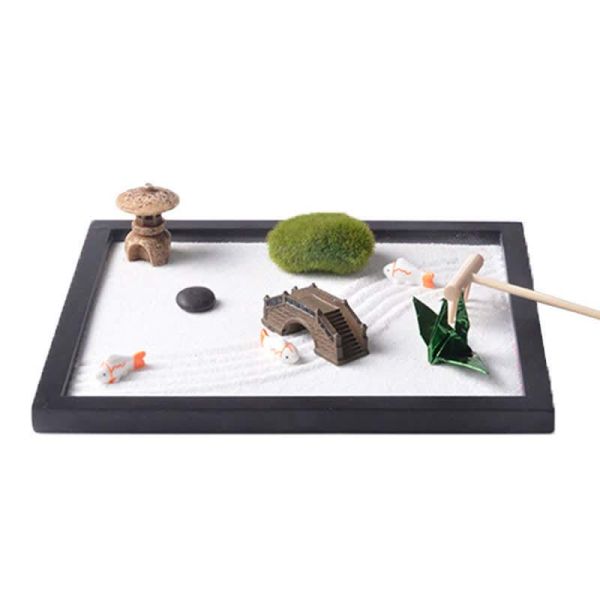 Buddha Stones Koi Fish Small Bridge Grass Landscape Peace Meditation Zen Garden DecorationSpecial Price $54.59 Regular Price $75.82
 Buddha Stones Metal Zen Circle Pine Enlightenment Bonsai Iron Meaningful Symbols Wall ArtAs low as $24.59 Regular Price $33.68