Mala Bead Materials: A Comparison Guide to Wood, Seed and Stone
Pick up a few malas side by side and the first thing you notice isn’t the meaning behind them — it’s the weight and the sound. A strand of wood beads sways and clicks softly against your wrist. A strand of stone or glass sits heavier and cooler against the skin. Mala bead materials shape nearly everything about how a mala feels day to day: the weight on your wrist, how it warms up, how the beads age, even the pitch of the click as you count a mantra. This guide walks through the materials we use most often, based on what is printed on each product page, so you can choose by feel as well as by meaning.
Wood: small leaf red sandalwood, green sandalwood and abelia biflora
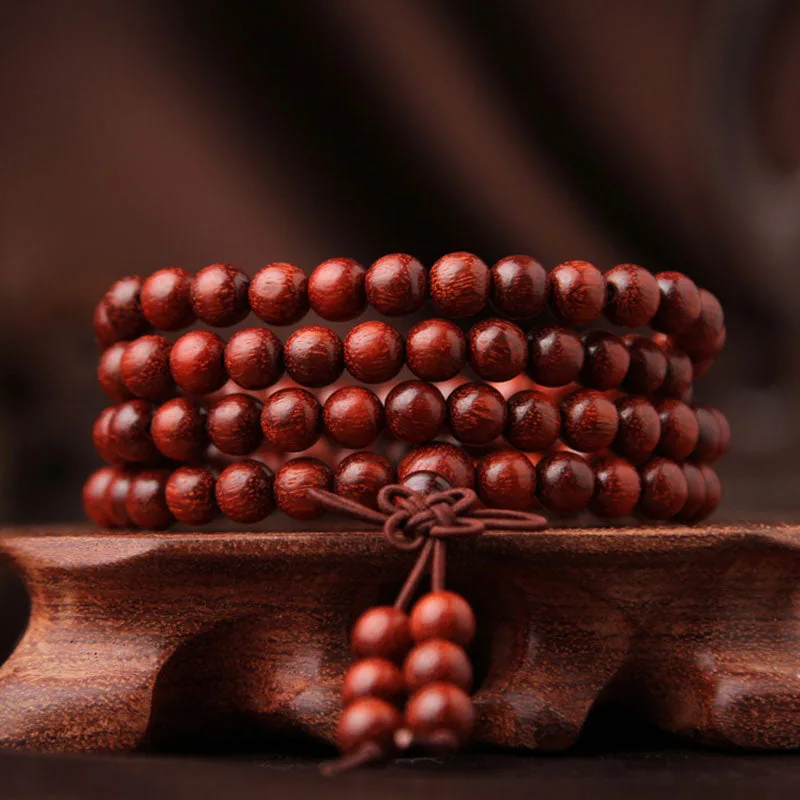
Our Tibetan Small Leaf Red Sandalwood 108 Beads Mala lists a single material: natural small leaf red sandalwood. It is strung as a 108 bead mala with a larger guru bead on a premium elastic string, in a choice of 6mm or 8mm beads, and the product page lists it as a bracelet, necklace or mala, so it can be wrapped around the wrist or worn long. The page describes it as a traditional Buddhist prayer bead accessory used for meditation and chanting mantras, with the 108 beads and guru bead symbolizing enlightenment and the cycle of rebirth. It also notes that, because of the characteristics of small leaf red sandalwood, the color of the wood will vary from piece to piece, and it asks you to take the mala off before you sleep or wash.
The Green Sandalwood Serenity Mala pairs green sandalwood with jade on 6mm beads, also wrist-wrap style. What sets this wood apart, according to its own product description, is that the color is never fixed: freshly cut beads start out yellowish, then slowly oxidize toward green and brown tones over time, so no two pieces look the same at any given stage of wear. The listing says the wood may look yellow at first and turns green with light exposure, and recommends keeping it away from water and out of prolonged direct sunlight.
Natural Abelia Biflora Wood Mala is a 108 bead mala offered in two sizes, 6*8mm and 8*12mm. The product page explains that each bead naturally forms six lines, which is why the wood is traditionally linked to the six-character mantra Om Mani Padme Hum, and why local people also call the beads “Buddhist wooden beads.” The page adds that the wood, also known as Dragon Wood, grows in Shanyin and is best known around Wutai Mountain, a Buddhist holy place in China. As with the other woods here, color and grain vary from bead to bead and can deepen with handling. If you want to compare more wood pieces side by side, our wood collection has the full range.
Seeds: bodhi seed and star moon bodhi
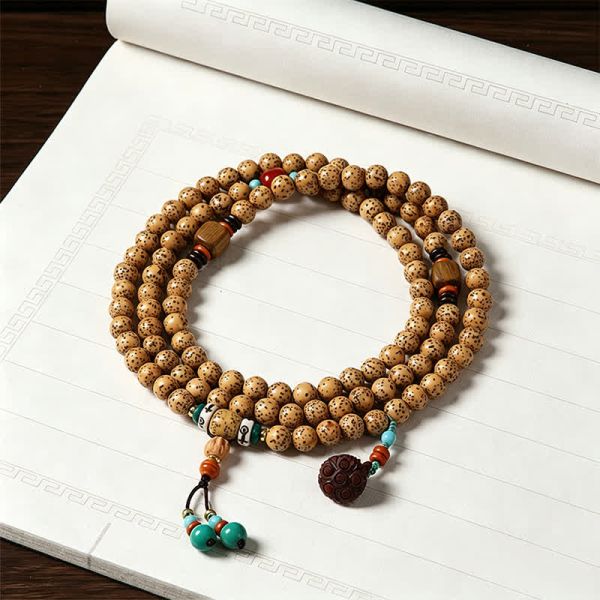
The Star Moon Bodhi Seed Lotus Pod Mala uses star moon bodhi seed beads, about 8mm, set with copper alloy spacers into a 108 bead mala. The product page describes each bead as carrying a sunken circle that resembles a moon, ringed by small dots like stars, a pattern that forms through repeated rounds of polishing. It is finished with a lotus pod charm; the page frames the lotus as a traditional symbol of purity and renewal, a flower often described as pushing up through mud before it opens. Like the woods above, the page notes that slight variation in color and surface is normal for natural seed material, and that it should be kept away from water.
Stone and other materials: turquoise, amber, liuli glass and camel bone
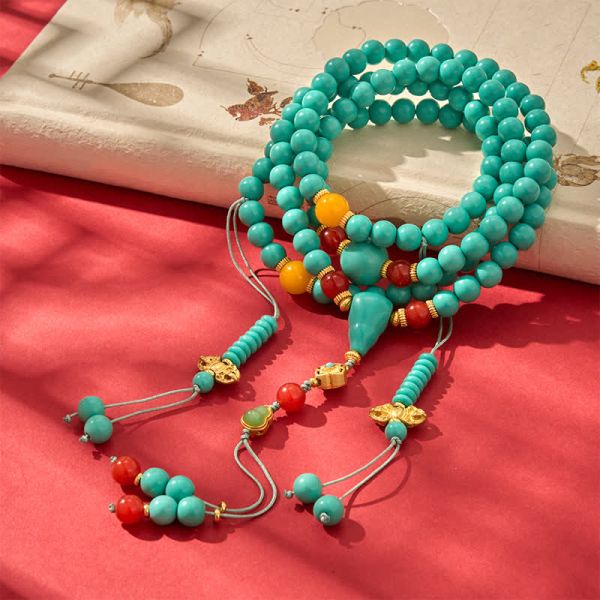
The Turquoise Tibetan Strength Mala is made from synthetic turquoise and copper alloy, strung into a 108 bead mala (the listing does not give an exact bead diameter). The page notes that color and surface detail vary a little from piece to piece. It also carries a gourd charm, which the page describes as a traditional symbol of a vessel that gathers blessings.
The Tibetan Amber Round Bead Mala uses faux amber beads, offered at 6mm, 8mm or 10mm, on a 108 bead strand. The product page is upfront that this is resin crafted to mimic the warm glow of natural amber rather than mined amber, with each bead polished for a smooth, radiant finish, and it positions the piece as the look of amber at an accessible price. Choose it for the warm amber color rather than for the material itself.
Liuli is the traditional Chinese name for colored glaze or glass beads, used in our Liuli Lotus Enlightenment Mala. The listing gives the material simply as liuli, strung into a 108 bead mala with 8mm beads, offered with a choice of string colors. The lotus charm strung alongside it is described on the page the same way as the bodhi mala above: a traditional symbol of purity and new beginnings.
The Camel Bone Luck Tassel Mala combines camel bone with a dzi bead, copper, agate and a tassel, in a 108 bead strand with beads sized about 8.5*7mm. The product page notes that camel bone is one of the materials commonly used in Tibetan jewelry, and that, in Tibetan belief, camels are seen as incarnations of desert gods with a protective energy.
Mala bead materials at a glance
The table below lines up six mala bead materials so you can compare bead count, size and price in one place.
| Material | Mala | Beads & size | Price* |
|---|---|---|---|
| Small leaf red sandalwood | Tibetan Small Leaf Red Sandalwood 108 Beads Mala | 108 beads, 6mm or 8mm | From $25.59 |
| Abelia biflora wood | Natural Abelia Biflora Wood Mala | 108 beads, 6*8mm or 8*12mm | $34.59 |
| Bodhi seed (star moon) | Star Moon Bodhi Seed Lotus Pod Mala | 108 beads, about 8mm | $38.59 |
| Turquoise (synthetic) | Turquoise Tibetan Strength Mala | About 108 beads | $27.59 |
| Faux amber | Tibetan Amber Round Bead Mala | About 108 beads, 6mm/8mm/10mm options | $25.59 |
| Camel bone | Camel Bone Luck Tassel Mala | About 108 beads, 8.5*7mm | $112.59 |
*Prices shown are what each listing displayed on October 31, 2026, and may change.
Which material for whom
If you want something light that barely announces itself on your wrist, wood is the easiest starting point. Small leaf red sandalwood in the 6mm size sits close to the skin, and abelia biflora’s six natural lines give your fingers texture to find while counting.
If you like a mala that visibly changes with you, green sandalwood is built around that idea: expect the color to shift from yellow toward green and brown as it sees light and handling.
If you count beads often and want a tactile seed rather than a polished stone, the star moon bodhi mala’s sunken moon-and-star surface gives your fingers something distinct to locate by feel alone.
If you want color first and don’t need natural stone, the synthetic turquoise and faux amber malas are the lower-priced entries here, and the liuli mala adds a choice of string colors.
If you want a mala built from several materials at once — bone, dzi, agate, copper and a tassel — camel bone is assembled that way, and it is priced accordingly. Whichever material you start with, our mala beads collection and size guide are useful references if you are also deciding on bead size or wrist fit.
Shop the story
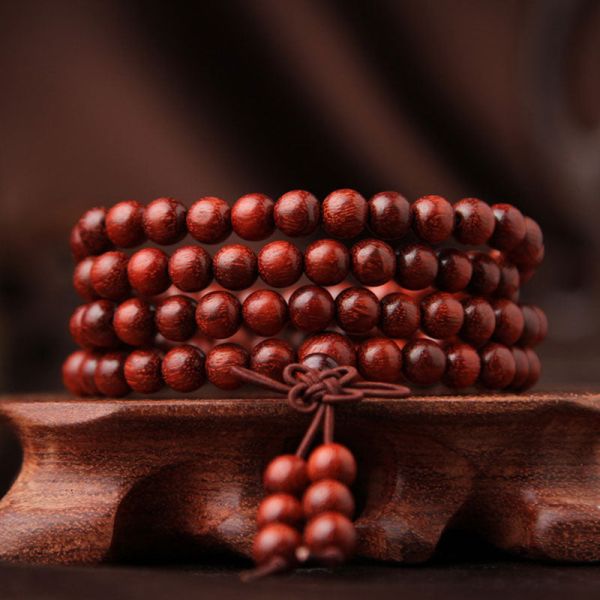 Buddha Stones Tibetan Small Leaf Red Sandalwood 108 Beads Mala Meditation BraceletAs low as $25.59 Regular Price $35.54
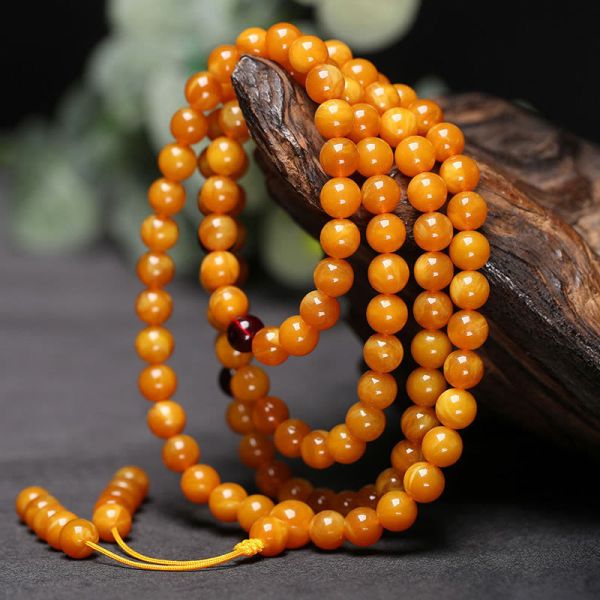 Buddha Stones Tibetan Amber Round Bead MalaSpecial Price $25.59 Regular Price $35.05