
Chinese God of Wealth: A Guide to Caishen Figures
Red paper prints pasted on doors at Lunar New Year often show a smiling official holding a gold ingot. Caishen, the Chinese god of wealth, is less one figure than a family of figures from folk religion and Taoism. He is honored especially around the fifth day of the Lunar New Year, when many households and shops traditionally “welcome the god of wealth.” The familiar name brings together several identities, each with different stories and recognizable features.
That variety explains why two statues bearing the same title may look quite different. One wears the robes of an official; another carries a weapon. At Buddha Stones, we describe these figures through their traditional associations and visible attributes. Recognizing the person represented gives the objects around him more context, too.
Civil and martial gods of wealth
A common division separates the literary, or civil, god of wealth from the military, or martial, god of wealth. “Literary” here points toward the world of officials and learning. “Martial” points toward military figures and their equipment. These are customary groupings, and traditions vary by region, household, and place of worship.
The civil figure is often identified with Bi Gan or Fan Li. The martial figure is often identified with Zhao Gongming or Guan Yu. Their names are useful starting points, but a product labeled simply “God of Wealth” does not necessarily identify one of them. Clothing, facial features, animals, and objects can help distinguish the familiar portrayals.
| Figure | Usually shown as | Common association |
|---|---|---|
| Bi Gan | A civil official in robes and an official hat | Honesty |
| Fan Li | A robed civil figure, sometimes with wealth symbols | Trade |
| Zhao Gongming | A martial figure riding a black tiger and holding a whip | Protection of business |
| Guan Yu | A red-faced warrior with a long beard and halberd | Loyalty |
Bi Gan: the honest official
Bi Gan is remembered in tradition as an upright official. His association with honesty gives the civil wealth figure an ethical dimension: the subject includes how wealth is handled and how people conduct their affairs. His robes and official hat may resemble other civil figures, so an inscription or stated identity can be more helpful than clothing alone.
Fan Li: the merchant figure
Fan Li is traditionally associated with trade and commercial skill. Within the civil grouping, he offers a different emphasis from Bi Gan: the merchant rather than the official. Their shared category does not make their stories interchangeable. When a figure is unnamed, it is reasonable to describe it as a civil god of wealth without assigning a particular identity.
Zhao Gongming: the tiger rider
Zhao Gongming is recognizable in familiar portrayals by his black tiger and whip. His traditional association with the protection of business belongs to religious belief. The tiger, weapon, and martial dress help identify him in a way that an ingot alone cannot, since wealth symbols appear beside several figures.
Guan Yu: the loyal warrior
Guan Yu commonly appears with a red face, long beard, and halberd. His association with loyalty helps explain his place in merchant traditions, where trust between people matters. A portrayal of Guan Yu can carry meanings beyond wealth, so the setting and accompanying symbols also contribute to how the image is understood.
Symbols that travel with him
Wealth figures often share a vocabulary of objects. These symbols can appear in a deity’s hands, around a base, or as separate decorations. Reading them together helps explain a composition without assuming that each object identifies a particular god.
- Gold ingots, or yuanbao: Their familiar boat-like shape represents wealth in traditional imagery. An ingot is a useful first clue to the subject, though it does not establish which wealth figure is shown.
- Strings of copper coins: Coins grouped on a string recall money in circulation and exchange. In decorative imagery, they are conventional symbols of wealth and commerce.
- The treasure bowl: A bowl pictured with treasure expresses abundance in traditional imagery. Its contents and presentation belong to the visual language of plenty.
- The cabbage: The Chinese word baicai sounds like a phrase meaning “a hundred kinds of wealth.” This wordplay explains why a familiar vegetable appears among coins and ingots.
- The gold-swallowing beast: This mythical creature is said in folk belief to take in gold. We describe that story as folklore; the creature belongs among symbolic wealth decorations rather than the named human figures above.
Bringing the Chinese god of wealth home
Choosing a statue starts with distinguishing a named figure from a general wealth-themed design. Our product titles and specifications describe the available objects, while the traditions above provide cultural context. A shared motif does not establish a specific identity unless the description names it.
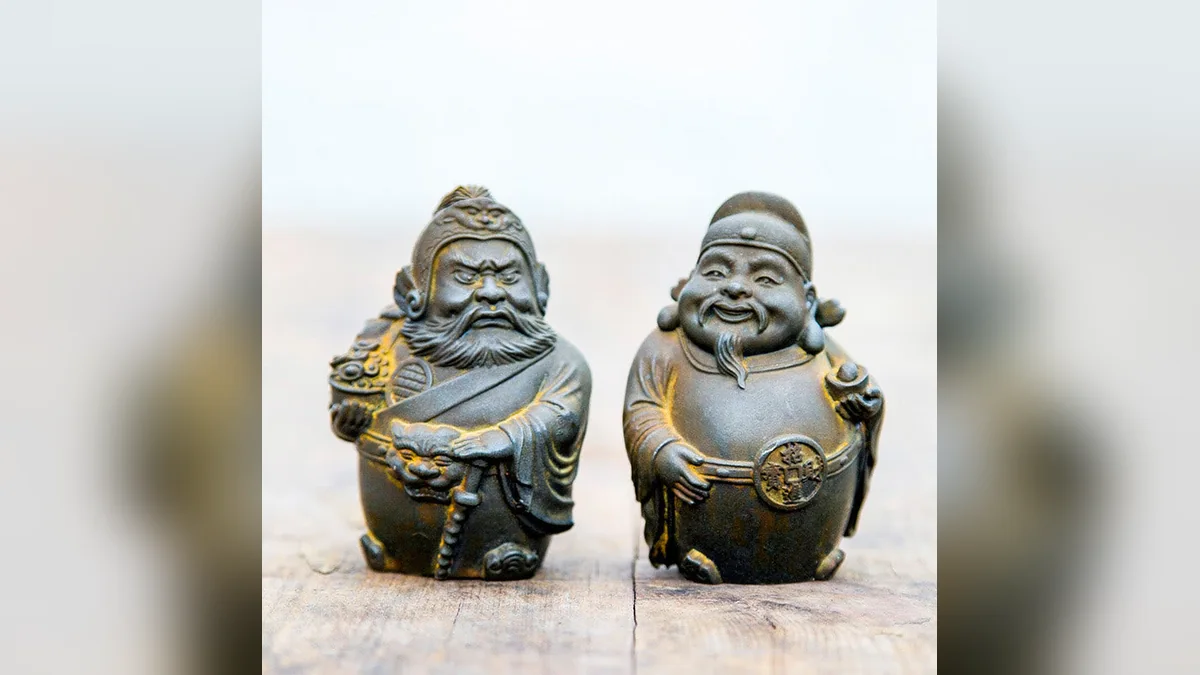
Literary and military figures
Our Handmade Literary and Military God of Wealth statues are made from 80% iron powder and 20% resin. The literary figure measures 7 × 4.6 × 4 cm; the military figure measures 7 × 4.8 × 4.3 cm. Options include a single figure or a two-piece set, with rust or polished versions. The listed weight is about 250 g. The literary and military labels describe their categories without naming them as particular members of the four-figure reference above.
A wooden Caishen statue
The God of Wealth Caishen statue uses black walnut and beech and measures about 9 × 7.5 × 6 cm. Its page name mentions the Fu character and copper coins. Those references connect the listing to familiar traditional imagery, while Caishen supplies the broader name for the wealth deity.
The gold-swallowing beast
Our Handmade Gold Swallowing Beast statue is made from 80% iron powder and 20% resin. The small version measures 4.5 × 3.7 × 3.5 cm and weighs about 90 g. The medium measures 5.5 × 4.5 × 4.5 cm and weighs about 180 g; the large measures 10.5 × 7.5 × 7.3 cm and weighs about 800 g. It represents the separate folklore motif described above.
Coins, ingots, and cabbage in brass
The Year of the Snake Copper Coins Ingots Cabbage brass statue brings together a snake, copper coins, ingots, and a cabbage, as its name describes. The material is brass, the dimensions are 19 × 9 × 18 cm, and the weight is about 1.7 kg. Here, several traditional wealth motifs appear together without a human deity.
Placement follows local and family customs. Figures are often displayed facing the front door or on a shop counter, although conventions differ between civil and martial figures. Keeping a display clean and raised above the floor is a common expression of respect. Choose a stable surface with enough room for the stated dimensions, and follow an established household tradition where there is one.
Caishen imagery holds several identities within one familiar name. The official, merchant, tiger rider, and loyal warrior each give the subject a different emphasis, while their accompanying symbols keep those traditions recognizable.
Shop the story
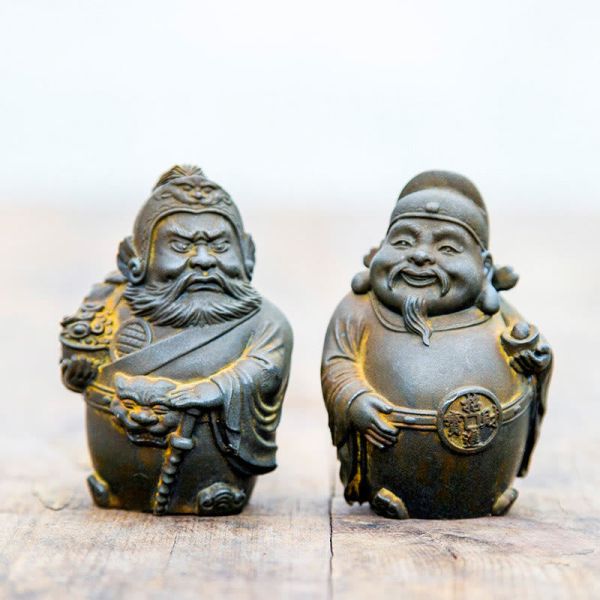 Buddha Stones Handmade Literary Military God of Wealth Iron Powder Rust Cast Resin Statue Home DecorationAs low as $39.59 Regular Price $52.79
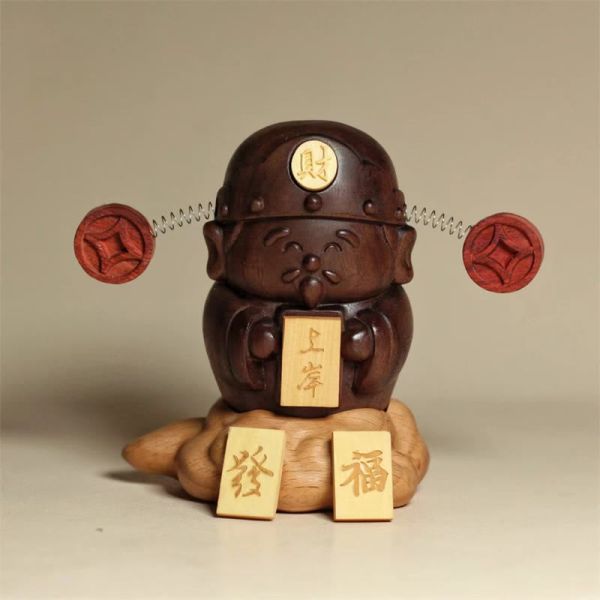 Buddha Stones God Of Wealth Caishen Black Walnut Beech Statue Fu Character Copper Coins Home DecorationSpecial Price $62.59 Regular Price $84.58
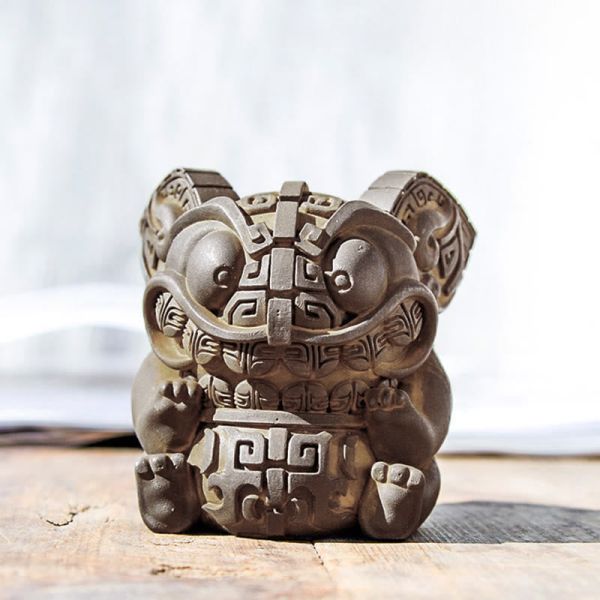 Buddha Stones Handmade Gold Swallowing Beast Iron Powder Rust Cast Resin Statue Home DecorationAs low as $29.59 Regular Price $39.45
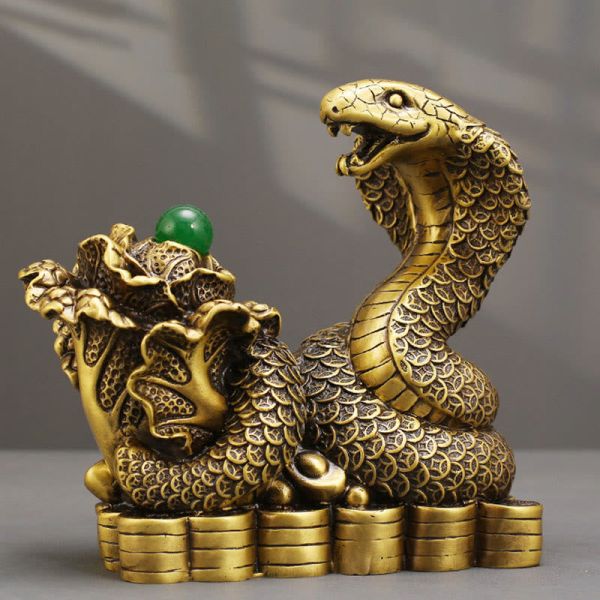 Buddha Stones Year Of The Snake Copper Coins Ingots Cabbage Brass Statue Home DecorationSpecial Price $252.59 Regular Price $336.79