
Aquamarine Meaning: Sea Lore, Stone Facts, and Fit
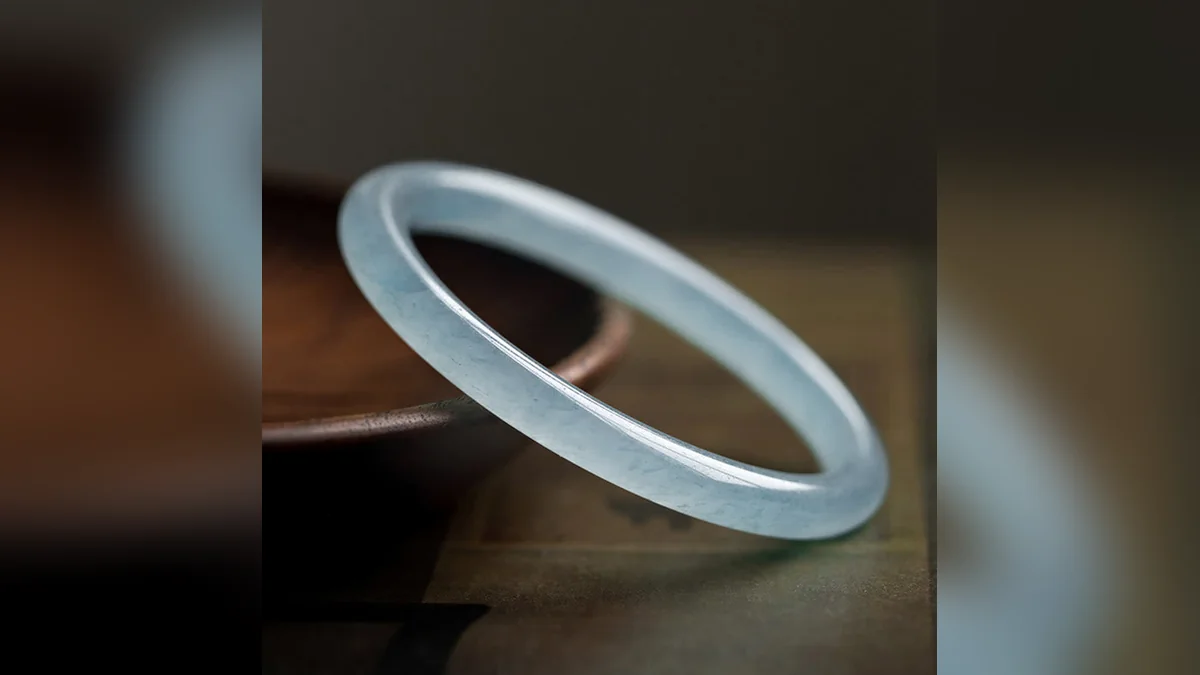
Aquamarine takes its name from the Latin aqua marina, “water of the sea.” It is the pale blue to blue-green variety of the mineral beryl. Traditional aquamarine meaning centers on the sea, calm, clarity, and courage; according to European folklore, sailors carried it as a charm for safe voyages. Those associations belong to storytelling and belief, and they promise nothing.
1. The name
The sea reference offers a useful starting point for understanding aquamarine's name and symbolism. Its blue and blue-green colors recall water, so the connection is easy to recognize without assigning the stone any special ability. The Latin phrase links the gem to an image that remains familiar across languages.
The name can also create expectations about color. Aquamarine does not have to be a strong ocean blue. Much of what appears on the market is pale, and lighter, cloudier stones are common in beads. A milky-looking bead can therefore sit within the familiar range of aquamarine jewelry. When comparing pieces, consider how much you like the visible color and cloudiness, alongside the shape and fit.
2. The mineral
Aquamarine belongs to the beryl family, which also includes emerald. Traces of iron give aquamarine its color. That shared mineral family does not mean the two stones have the same appearance: the variety name identifies aquamarine's pale blue to blue-green range.
Its hardness is about 7.5 to 8 on the Mohs scale. That number measures how well the surface resists scratches, and a hard gem can still chip or crack. A bracelet can still be damaged by a sharp knock against a hard edge, so sensible handling matters even with a relatively hard gem.
Aquamarine is also the March birthstone in the modern Western list. That makes it a familiar choice for a March birthday gift, although you do not need a birthstone connection to wear it. The calendar association and the mineral facts answer different questions: one concerns a jewelry tradition, while the other describes what the stone is.
3. The meanings people give it: aquamarine meaning
Calm, clarity, and courage are traditional themes associated with aquamarine. They can be read as qualities someone values or wishes to commemorate. A person might choose the stone as a symbol of speaking plainly, for example, without suggesting that wearing it changes how someone thinks or feels.
The sailor story belongs in that same symbolic frame. According to European folklore, sailors carried aquamarine as a charm for safe voyages. It is a sea-related tradition, not a promise of safety. We describe it as folklore so that the story remains distinct from practical decisions about travel or personal safety.
You can keep the symbolism simple. The color may stand for the sea, the March connection may mark a birthday, or courage may be the word you associate with a gift. There is no need to collect several meanings into one explanation. A brief, personal inscription on a gift card can express your intention without making a claim about what the jewelry will do.
4. Wearing and caring for it
Aquamarine's pale color gives you room to work with different clothing colors. A gray sleeve keeps the pairing subdued; white makes the blue easier to notice. A patterned outfit can also work with a plain bangle, while a bracelet with several listed materials offers more detail of its own. These are styling choices, so let your preference guide the combination.
For routine care of aquamarine, use mild soap and warm water, then wipe it with a soft cloth. Avoid sharp knocks and sudden heat changes. With a mixed-material bracelet, consider the whole piece before washing it: a care method suitable for a loose aquamarine is not automatically suitable for amber, pearl, silver, or elastic string.
Our product notes advise removing these bracelets before washing or sleeping. Put jewelry aside before activities where it might strike a hard surface. Store pieces separately so that they do not rub against one another, and handle an elastic bracelet gently rather than pulling it wide.
Fit deserves as much attention as care. A rigid bangle must pass over your hand, whereas an elastic beaded bracelet is selected using the stated wrist range. Measuring only your wrist will leave an important question unanswered when choosing a bangle.
5. Four aquamarine pieces to compare
A continuous bangle
Our Natural Aquamarine Serenity Bangle lists aquamarine as its only material. Width options are 6 mm or 8 mm. The listed inner diameters are 54-55, 56-57, 58-59, 60-61, 62-63, and 64-65 mm. Width and inner diameter describe different measurements, so check both when choosing an option.
For bangle fit, press your thumb in toward the palm and hold the fingers close, so the hand is as narrow as it will go. Measure across its widest part and compare that measurement with the inner diameter and the page's sizing guide. The page suggests lubricant, detergent, or soap to help slide the bangle over the hand. Keep any such aid mild and suitable for your skin, and never force a tight bangle.
Smaller beads with a gourd motif
The Aquamarine Red Agate Peace Gourd Charm Bracelet lists aquamarine, red agate, and amber. Its beads are 8 mm, its string is elastic, and the stated wrist circumference range is 14-19 cm. The gourd is a traditional Chinese motif; here it adds a cultural reference alongside aquamarine's sea-related associations. Choose it for that combination of materials and motif if those details appeal to you.
Larger beads with Chinese knotting
Our Natural Aquamarine Amber Chinese Knotting Charm Bracelet uses 10 mm beads and elastic string, with a stated wrist circumference range of 15-19 cm. Its listed materials are aquamarine, amber, red agate, green jasper, and pearl. Chinese knotting is a traditional Chinese folk art. For this choice, compare both the larger bead size and the wrist range with the gourd bracelet rather than treating the two fits as interchangeable.
Aquamarine with sterling silver
The 925 Sterling Silver Natural Aquamarine Flower Love Key Charm Bracelet lists aquamarine and 925 sterling silver. It has 10 mm beads and elastic string, with a stated wrist circumference range of 14-16 cm and a listed perimeter of 18 cm. The perimeter is a separate specification; use the stated wrist range when assessing fit. Store the silver-containing bracelet in a dry place and keep it away from strong household chemicals.
For fit, compare a bangle's inner diameter with your hand measurement. For a beaded bracelet, compare your wrist measurement with its listed wrist range; elastic still needs a suitable fit.
Shop the story
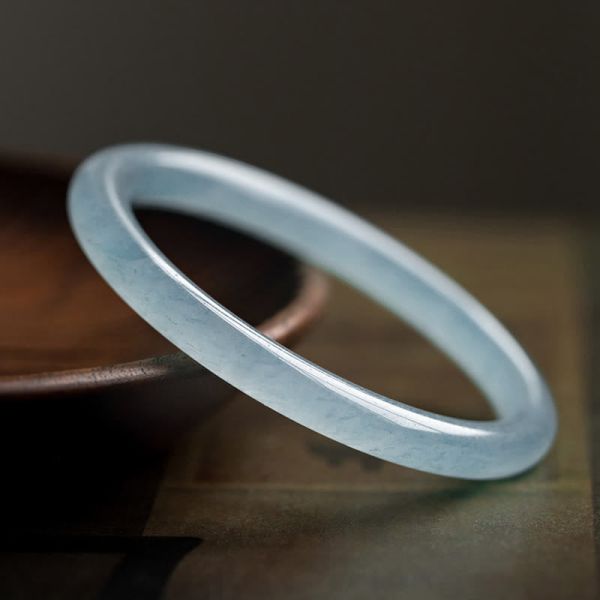 Buddha Stones Natural Aquamarine Serenity Bangle BraceletAs low as $75.59 Regular Price $106.46
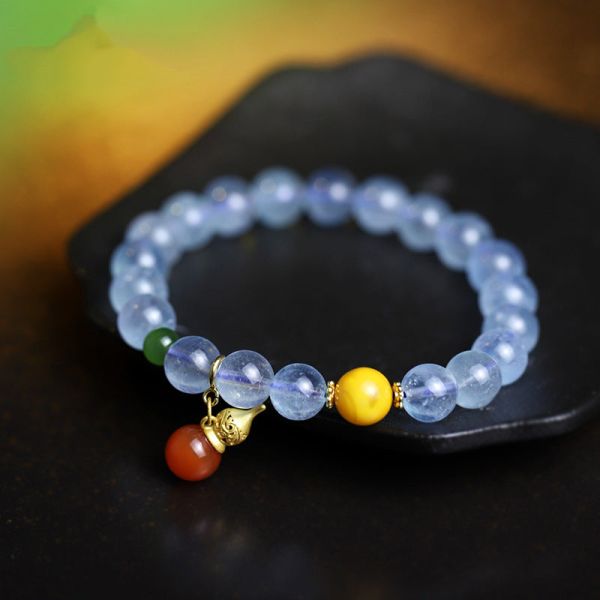 Buddha Stones Aquamarine Red Agate Peace Gourd Charm BraceletSpecial Price $79.59 Regular Price $112.10
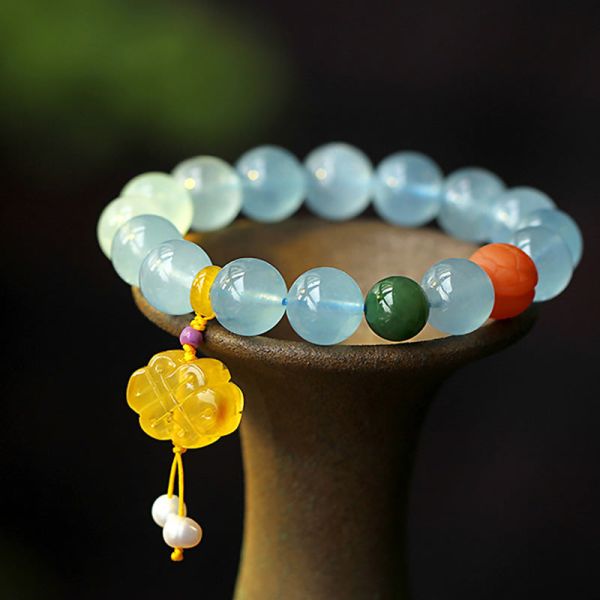 Buddha Stones Natural Aquamarine Amber Chinese Knotting Charm Peace BraceletSpecial Price $123.59 Regular Price $174.07
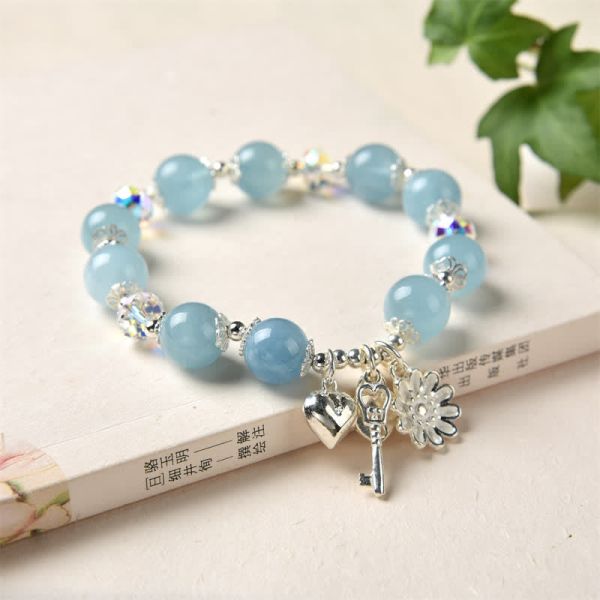 Buddha Stones 925 Sterling Silver Natural Aquamarine Serenity Flower Love Key Charm BraceletSpecial Price $229.59 Regular Price $306.12