
Agate Symbolism: A Visual Guide to Pattern and Meaning
Pale ribbons curve through a gray agate slice like contour lines on a map. In tradition, agate symbolism centers on steadiness, balance, and protection, although meanings differ across cultures and settings. Protection, luck, and wealth are matters of belief; a stone or bracelet cannot guarantee them. This field guide starts with what you can actually see: bands, patches, contrast, and the shapes placed beside the stone.
At Buddha Stones, we separate a material’s appearance from the wishes attached to it. That distinction helps you read a design without treating its name as a promise.
How to recognize the motif
Agate is a material rather than one fixed emblem. Its recurring visual feature is layered pattern, often curved or irregular. A bracelet can combine that pattern with a separate motif, such as a flower or an animal figure. Use these cues to distinguish the two.
- Following bands: Look for lines that run beside one another, bending around a center or following an uneven edge. They may resemble rings, ribbons, or a small landscape. Some bands are easy to see; others are faint.
- Areas of translucency: Some agate lets light pass through thin edges or pale sections. Other areas look more opaque. A photograph may show this unevenly, so a bright patch alone is not proof of a particular variety.
- Changes across the surface: Color can shift within one stone. Read the pattern across the visible area instead of expecting the same mark on every side of a round bead.
- Shape versus pattern: A sphere, disc, or drop describes the object’s outline. Bands and patches describe its surface. Keeping those features separate makes product descriptions easier to compare.
- Added symbols: Cord, metal elements, flowers, and figures belong to the wider design. An animal motif carries its own traditional associations; it does not make those associations a property of agate itself.
These are observation cues, not an identification test. Strong color or visible striping cannot establish a stone’s treatment, origin, or exact identity from a picture. For a particular bracelet, use its stated materials rather than matching it to a photograph of another stone.
Agate symbolism in tradition
Agate has been used in ornaments and amulets across different cultures. Its associations with protection belong to those cultural practices, rather than to a single universal system. There is no guarantee of safety, luck, or wealth from wearing it. We present these meanings as traditions that may inform a design or a gift.
Layering also offers a visual way to discuss continuity. A band can continue around a curve without keeping an identical width; several colors can share the same outline. Reading those features as balance or persistence is a symbolic interpretation. It is not evidence that a stone changes the wearer.
Color adds another layer of interpretation, but it does not provide a universal code. White may suggest purity or simplicity in a particular setting, while contrasting colors may be read as complementary parts. The surrounding design matters. A white stone beside a figure is a different composition from a plain strand of white beads.
Agate should not automatically be described as a Buddhist emblem. A material can appear in Buddhist jewelry without having one prescribed Buddhist meaning. Likewise, placing it beside a Chinese auspicious figure combines separate references. Read the stone, the figure, and the overall arrangement individually before connecting them.
For a gift, a brief explanation can keep that distinction clear: the layered pattern represents continuity to you, or the contrasting colors represent balance. Such wording shares an interpretation without assigning an outcome to the recipient.
Where agate patterns enter a design
Scale changes what you notice. A broad surface may show a sequence of bands, while a small bead reveals only part of one. These common settings offer different ways to read the material.
| where you see it | how it usually appears |
|---|---|
| Beaded bracelets | Small rounded surfaces show fragments of bands or patches; repetition becomes part of the design. |
| Pendants | A single focal stone gives its visible pattern more space, sometimes within a metal setting. |
| Polished slices | A wider face can reveal nested bands and an irregular outer boundary. |
| Decorative objects | The object’s shape frames the pattern, which may continue across an edge or curved surface. |
These are general settings, not a checklist of features guaranteed in a product. A stone does not need dramatic stripes to belong in a design described as agate. Subtle pattern and broad areas of color can be part of its appearance too.
Four bracelet designs, read by their details
Our bracelet selection includes different ways to combine agate with cord, other stones, and metal. Start with the construction and materials, then consider any symbolic language separately. The following details come from the specifications for these designs.
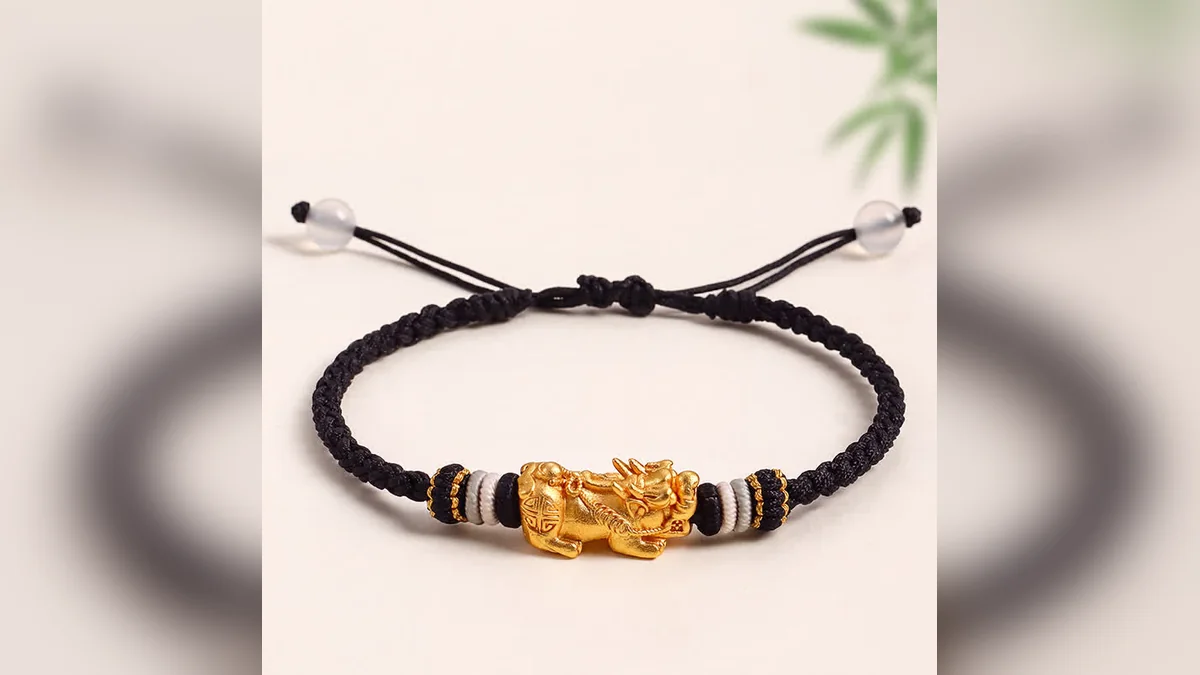
White agate beside a Pi Xiu reference
The White Agate Copper Pi Xiu Hand-Woven Bracelet combines string, white agate, and copper. It has an adjustable cord, with wrist circumference given as 5.9–7.5 in (15–19 cm), and Black or Brown options. Its white agate may vary slightly in color, details, and overall appearance.
The Pi Xiu reference adds a Chinese auspicious association alongside the stone. Wishes for wealth and luck associated with that figure are traditional beliefs, and neither is guaranteed by the bracelet.
A floral drop with several stone options
The Elegant White Chalcedony Black Agate Floral Drop Bracelet uses Premium Elastic String and has 8mm beads. Its wrist circumference specification is 5.9–6.3 in (15–16 cm). The materials named are white chalcedony, black agate, jade, red agate, and yellow agate; available options are Black Onyx, Red Agate, and Yellow Agate.
Those option names distinguish choices rather than establishing that every option contains the same combination. The floral drop is a design reference to consider separately from the stone names. Slight variations in gemstone color, details, and appearance are possible.
Indian agate with braided construction
The Natural Indian Agate Braided Balance Bead Bracelet pairs Indian agate with copper alloy and uses an adjustable cord. Its specified wrist circumference is 6.3-6.7 in (16-17 cm). The braided construction named in the design provides another visual element beside the beads.
Gemstone color, details, and overall appearance may vary slightly. Treat the word “balance” as a symbolic theme, rather than a result the bracelet delivers.
Black and white contrast on string
The Black and White Fire Agate String Balance Bracelet has an adjustable cord and a wrist circumference specification of 5.9–8.2 in (15–21 cm). Its materials are string and black and white fire agate. The natural materials may show slight differences in color, details, and overall appearance.
Here, the black and white wording identifies the contrast named in the design. You can read that contrast as a representation of balance without treating it as a claim about what wearing the bracelet will do.
Let the visible details lead
Begin with the pattern, then consider the shape, setting, and any accompanying emblem. Tradition supplies possible meanings; the product specifications supply the practical details. Keeping both in view lets you choose a design for its appearance and explain its symbolism in plain words, leaving the stone’s bands and variations room to speak visually.
Shop the story
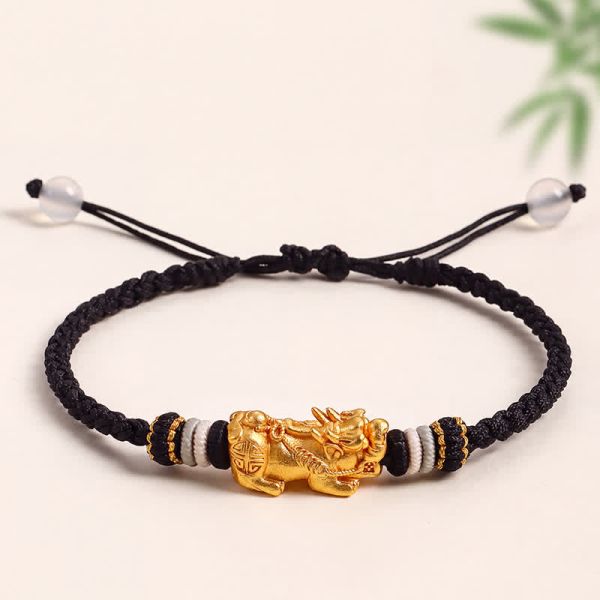 Buddha Stones White Agate Copper Pi Xiu Auspicioisness Hand-Woven BraceletAs low as $25.59 Regular Price $34.58
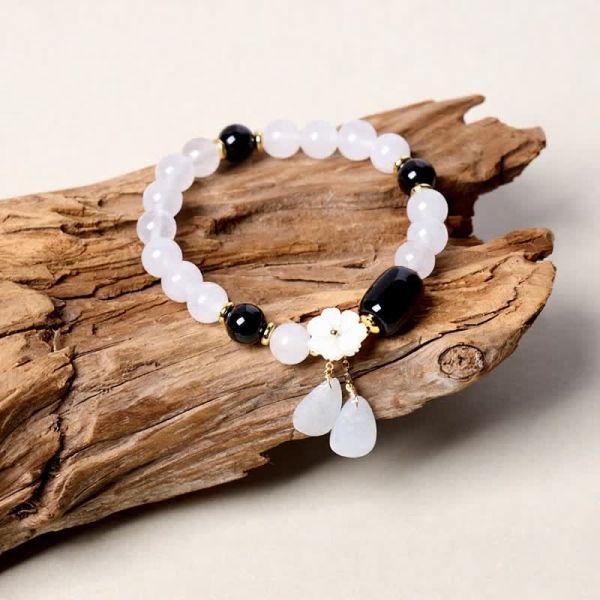 Buddha Stones Elegant White Chalcedony Black Agate Floral Drop BraceletAs low as $25.59 Regular Price $34.58
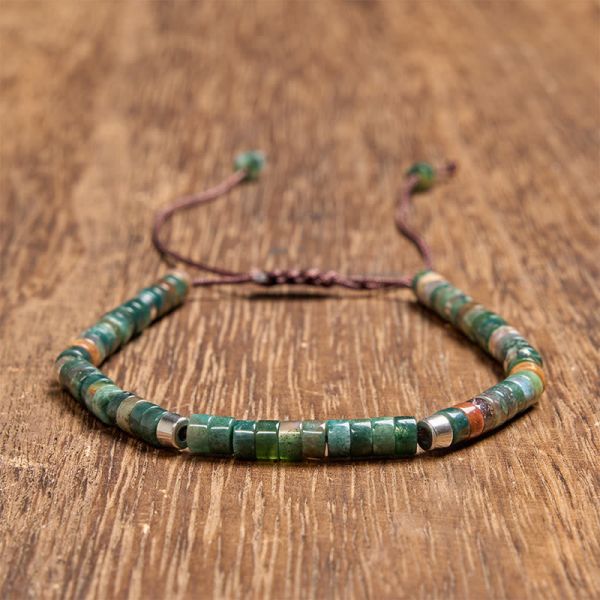 Buddha Stones Natural Indian Agate Braided Balance Bead BraceletSpecial Price $25.59 Regular Price $34.58
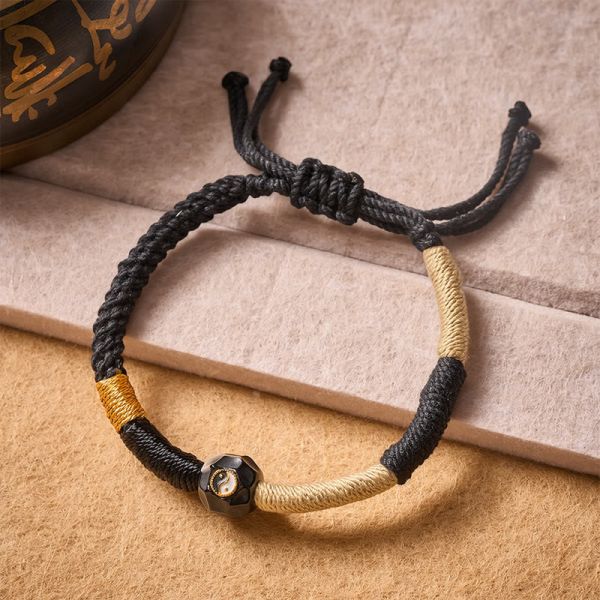 Buddha Stones Black and White Fire Agate String Balance BraceletSpecial Price $27.59 Regular Price $36.79